Which equation is generally used to calculate the speed of a wave?
The wave speed equation is v = λf, where v is wave speed, λ is wavelength, and f is frequency.
What is the difference between transverse and longitudinal waves?
Transverse waves have particle displacement perpendicular to the direction of wave propagation, while longitudinal waves have particle displacement parallel to the direction of propagation.
In what direction is matter displaced in a transverse wave?
In a transverse wave, matter is displaced perpendicular to the direction of wave travel.
What kinds of patterns can be observed for transverse waves?
Transverse waves exhibit patterns of crests and troughs, with oscillations perpendicular to the direction of propagation.
Which statement applies to transverse waves?
In transverse waves, the vibration of the medium is perpendicular to the direction the wave travels.
How do you calculate the frequency of a wave given its speed and wavelength?
Frequency is calculated using f = v / λ, where v is wave speed and λ is wavelength.
What is the main difference between transverse and longitudinal waves?
The main difference is the direction of particle displacement: transverse waves displace particles perpendicular to wave travel, while longitudinal waves displace particles parallel to wave travel.
How do you calculate the wavelength of a wave given its frequency and speed?
Wavelength is calculated using λ = v / f, where v is wave speed and f is frequency.
What determines the speed of a wave on a string?
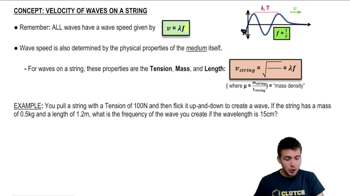
The speed of a wave on a string is determined by the physical properties of the string: its tension and mass per unit length (μ).
How do you calculate the speed of a wave given its frequency and wavelength?
Wave speed is calculated using v = λf, where λ is wavelength and f is frequency.
What is the speed of a wave with a frequency of 2 Hz and a wavelength of 10 m?
The speed is v = λf = 10 m × 2 Hz = 20 m/s.
What is the difference between a transverse and a longitudinal wave?
Transverse waves have oscillations perpendicular to the direction of propagation; longitudinal waves have oscillations parallel to the direction of propagation.
Which type of wave has oscillations perpendicular to the disturbance?
Transverse waves have oscillations perpendicular to the disturbance.
In what type of wave is the vibration perpendicular to the direction of travel?
In transverse waves, the vibration is perpendicular to the direction of travel.
What is the formula for calculating wave speed?
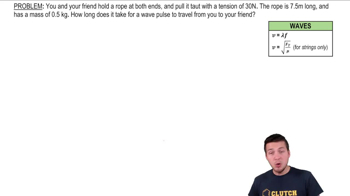
The general formula is v = λf. For waves on a string, v = sqrt(tension/μ), where μ is mass per unit length.
What is an example of a transverse wave?
A wave traveling along a stretched string is an example of a transverse wave.
How do you calculate the period of a wave given its wavelength and speed?
Period is calculated as T = λ / v, where λ is wavelength and v is speed.
What happens to the period of a wave as the frequency increases?
As frequency increases, the period decreases since T = 1/f.
How do you calculate the period of a wave given its wavelength and frequency?
Period is calculated as T = 1/f, where f is frequency.
What does the speed of a wave depend on for a string?
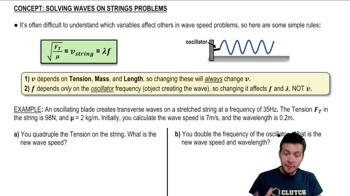
For a string, wave speed depends on the tension and the mass per unit length (μ) of the string.
What happens when the period of a wave increases?
When the period increases, the frequency decreases since they are inversely related (T = 1/f).
How do you calculate the speed of a wave?
Wave speed is calculated using v = λf, or for a string, v = sqrt(tension/μ).
What determines the speed of S waves (transverse seismic waves)?
The speed of S waves depends on the physical properties of the medium through which they travel.
What direction does each part of a string move when a transverse wave travels along it?
Each part of the string moves perpendicular to the direction of wave travel.
What happens if the speed of a wave doubles while the wavelength remains the same?
If speed doubles and wavelength remains the same, frequency also doubles since v = λf.
Which type of earthquake wave travels fastest?
Longitudinal (P) waves travel faster than transverse (S) waves.
What are the differences between transverse and longitudinal waves?
Transverse waves have perpendicular oscillations to propagation; longitudinal waves have parallel oscillations.
What are two characteristics of transverse waves not found in longitudinal waves?
Transverse waves have crests and troughs and oscillate perpendicular to propagation; longitudinal waves do not.
Does increasing a wave’s speed affect its frequency or wavelength?
Increasing wave speed affects the relationship between frequency and wavelength, since v = λf.
What causes a sound wave to travel?
A sound wave travels due to vibrations that propagate through a medium.
Which type of wave moves fastest and reaches a seismograph first?
Longitudinal (P) waves move fastest and reach a seismograph first.
As the frequency of a wave increases, what happens to its period?
As frequency increases, period decreases (T = 1/f).
Which type of wave displaces its medium in the direction of propagation?
Longitudinal waves displace the medium in the direction of propagation.
How do you calculate the wavelength of a wave given its speed and frequency?
Wavelength is calculated as λ = v / f.
How are transverse waves best described?
Transverse waves are waves in which the medium oscillates perpendicular to the direction of wave travel.
What is the speed of a wave with a frequency of 2 Hz and a wavelength of 87 m?
The speed is v = λf = 87 m × 2 Hz = 174 m/s.
What is the speed of a wave with a wavelength of 3 m and a frequency of 0.1 Hz?
The speed is v = λf = 3 m × 0.1 Hz = 0.3 m/s.
How do you determine the number of wavelengths in a wave pattern?
Count the number of complete cycles (crests and troughs) in the wave pattern.
What is the equation for the velocity of a wave?
The general equation is v = λf. For a string, v = sqrt(tension/μ).
Which wave will produce the highest pitch?
A wave with the highest frequency will produce the highest pitch.