Vertical Motion and Free Fall definitions Flashcards
Vertical Motion and Free Fall definitions
You can tap to flip the card.
Control buttons has been changed to "navigation" mode.
1/15
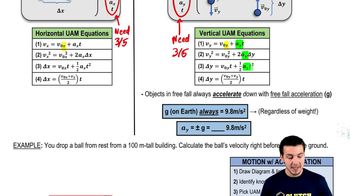
Vertical MotionMovement of objects in the vertical plane, analyzed using similar equations as horizontal motion but with y-components.Free FallCondition where the only force acting on an object is gravity, resulting in constant vertical acceleration.GravityThe force that pulls objects towards the Earth, denoted as Fg, and causes free fall.AccelerationThe rate of change of velocity, in free fall it is constant and equal to 9.8 m/s².DisplacementThe change in position of an object, in vertical motion denoted as Delta y.Initial VelocityThe starting speed of an object before it undergoes acceleration, denoted as V0.Final VelocityThe speed of an object at the end of its motion, denoted as Vy in vertical motion.DiagramA visual representation used to outline the problem setup and variables in motion problems.VariablesQuantities such as initial velocity, final velocity, displacement, acceleration, and time used in equations.EquationA mathematical statement used to solve for unknown variables in motion problems.UAM EquationsUniformly Accelerated Motion equations used to solve problems involving constant acceleration.Positive DirectionThe chosen direction in a problem setup that determines the sign of acceleration and displacement.Negative SignIndicates direction opposite to the chosen positive direction, often used for downward acceleration.Square RootA mathematical operation used to find the original value from its square, considering both positive and negative roots.BuildingA structure used in example problems to illustrate vertical motion and free fall concepts.