Vertical Motion and Free Fall quiz #1 Flashcards

Vertical Motion and Free Fall quiz #1
Control buttons has been changed to "navigation" mode.
1/29
  • What is the only force that acts on a falling body when it is in free fall?
    The only force acting on a falling body in free fall is gravity.
  • In which scenario is an object considered to be in free fall?
    An object is in free fall when the only force acting on it is gravity, such as when it is dropped or thrown upward and is no longer being held or supported.
  • What happens to an object when it is thrown upward and only gravity acts on it?
    When an object is thrown upward and only gravity acts on it, it slows down as it rises, stops momentarily at its highest point, and then accelerates downward as it falls.
  • How does the acceleration of two balls compare as they drop toward the ground in free fall?
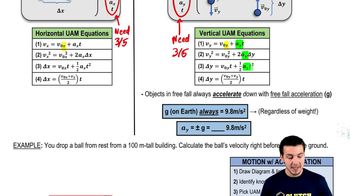
    Both balls experience the same acceleration due to gravity, which is 9.8 m/s² downward, regardless of their mass.
  • For a ball that is dropped from rest, what is its initial velocity?
    The initial velocity of a ball dropped from rest is zero.
  • Is the vertical component of velocity ever zero during vertical motion? If so, when?
    Yes, the vertical component of velocity is zero at the highest point of the object's trajectory when thrown upward.
  • How do you calculate the velocity of an object when it hits the ground after being dropped from a certain height?
    Use the equation: v² = v₀² + 2aΔy, where v₀ is initial velocity (zero if dropped), a is acceleration due to gravity (-9.8 m/s² if up is positive), and Δy is displacement.
  • What happens to the temperature of an air mass as it rises?
    As an air mass rises, its temperature typically decreases due to expansion and lower pressure at higher altitudes.
  • What is the velocity of an object 1 second after it reaches its highest point during free fall?
    The velocity 1 second after reaching the highest point is v = -g × t = -9.8 m/s (downward), assuming up is positive.
  • How do you determine the velocity of a rock when it reaches the ground after being dropped from a certain height?
    Use the equation v² = v₀² + 2aΔy, with v₀ = 0, a = -9.8 m/s², and Δy as the negative of the drop height if up is positive.
  • What happens to the velocity of a ball thrown directly upward as it moves?
    The ball's velocity decreases as it rises, becomes zero at the highest point, and then increases in the downward direction as it falls.
  • In the absence of air resistance, how do objects fall near Earth's surface?
    In the absence of air resistance, all objects fall with the same constant acceleration due to gravity, 9.8 m/s² downward.
  • What is the apparent weight of a 60 kg rider during free fall?
    During free fall, the apparent weight of the rider is zero because gravity is the only force acting and there is no normal force.
  • At the top of its trajectory, what is the direction of velocity for a ball thrown straight up from the ground?
    At the top of its trajectory, the velocity of the ball is zero; immediately after, it points downward.
  • What is the acceleration of an object moving upward during free fall?
    The acceleration is always downward at 9.8 m/s², regardless of the object's direction of motion.
  • How do you calculate the distance an object falls in free fall after a certain time?
    Use the equation Δy = v₀t + (1/2)at², with v₀ = 0 and a = -9.8 m/s² if up is positive.
  • How many forces act on an object in free fall?
    Only one force acts on an object in free fall: gravity.
  • How do the accelerations of two objects in free fall compare?
    Both objects have the same acceleration due to gravity, 9.8 m/s² downward, regardless of their mass.
  • What is the speed of an object at half its maximum height during vertical motion?
    At half the maximum height, use energy conservation or kinematic equations to find speed: v = sqrt(v₀² - 2g(hmax/2)), where v₀ is initial speed and hmax is maximum height.
  • What is the free-fall acceleration at the surface of Jupiter?
    The free-fall acceleration at Jupiter's surface is greater than Earth's, but the exact value is not provided in the materials.
  • If a rock falls 4.9 meters in 1 second, what does this indicate about its motion?
    This indicates the rock is in free fall, as the distance fallen in 1 second matches the value calculated using Δy = (1/2)gt² with g = 9.8 m/s².
  • How do you calculate the speed of a package when it hits the ground after being dropped from a certain height?
    Use v² = v₀² + 2aΔy, with v₀ = 0, a = -9.8 m/s², and Δy as the negative of the drop height if up is positive.
  • How do you determine the height climbed by an object above its original starting position during vertical motion?
    The height climbed is the maximum displacement reached above the starting position, which can be found using kinematic equations or by setting final velocity at the top to zero.
  • When two objects are dropped from the same height at the same time, which hits the ground first?
    Both objects hit the ground at the same time if air resistance is negligible.
  • Why are objects that fall near Earth's surface rarely in true free fall?
    Objects rarely experience true free fall near Earth's surface because air resistance acts in addition to gravity.
  • When a bullet is fired from a rifle, when does it begin to fall?
    A bullet begins to fall as soon as it leaves the barrel and gravity becomes the only force acting on it vertically.
  • How do a feather and a coin fall in a vacuum?
    In a vacuum, a feather and a coin fall with equal acceleration due to gravity, 9.8 m/s².
  • If a rock falls 4.9 meters in 1 second, how far will it fall in 3 seconds?
    Use Δy = (1/2)gt²; for t = 3 s, Δy = 0.5 × 9.8 × (3)² = 44.1 meters.
  • What happens when a pellet gun is fired straight downward from a height?
    When a pellet gun is fired straight downward, the pellet accelerates downward due to gravity, and its motion can be analyzed using vertical motion equations.