What does it mean when a wave's amplitude increases?
When a wave's amplitude increases, the maximum displacement from its equilibrium position becomes larger, indicating the wave carries more energy.
What does a wave carry?
A wave carries energy from one place to another.
What is common between transverse waves and longitudinal waves?
Both transverse and longitudinal waves transfer energy through a medium via oscillations.
Does the medium in which a wave travels move with the wave?
No, the medium itself does not move with the wave; only the disturbance or energy is transferred.
How does the amplitude of a wave change when it carries more energy?
The amplitude increases when a wave carries more energy.
Which waves can travel slowly within the surface?
Surface waves, such as those on water, can travel slowly along the surface.
Which wave property measures how many waves pass a point in one second?
Frequency measures how many waves pass a point in one second.
What kinds of patterns can be observed for longitudinal waves?
Longitudinal waves exhibit patterns of compressions and rarefactions along the direction of travel.
What is the frequency of a wave that travels at 20 m/s with a wavelength of 200 meters?
Frequency f = v / λ = 20 m/s / 200 m = 0.1 Hz.
How does increasing energy affect the amplitude of a wave?
Increasing energy increases the amplitude of a wave.
What is wave frequency?
Wave frequency is the number of complete wave cycles passing a point per second.
Which wave has the lowest amplitude?
The wave with the smallest maximum displacement from equilibrium has the lowest amplitude.
What is the relationship between the amplitude of a wave and the amount of energy it produces?
The energy carried by a wave is proportional to the square of its amplitude.
Which type of waves has a disturbance that travels in the same direction as the wave?
Longitudinal waves have disturbances that travel in the same direction as the wave.
How do you determine which wave has the largest or smallest amplitude?
The wave with the greatest maximum displacement from equilibrium has the largest amplitude; the one with the smallest displacement has the smallest amplitude.
What is the term for the distance between a point on one wave and the same point on the next wave?
This distance is called the wavelength.
What is the difference between light and sound waves as they travel?
Light waves are electromagnetic and can travel through a vacuum, while sound waves are mechanical and require a medium.
What is one difference between a longitudinal and a transverse wave?
In a longitudinal wave, the disturbance is parallel to the direction of travel; in a transverse wave, it is perpendicular.
Which type of wave does not need a medium to travel through?
Electromagnetic waves do not require a medium to travel.
What is a disturbance that transfers energy from one place to another without transferring matter?
A wave is a disturbance that transfers energy without transferring matter.
What is a repeating pattern that can transfer energy?
A periodic wave is a repeating pattern that transfers energy.
Which waves require a medium to travel?
Mechanical waves require a medium to travel.
What will happen to a wave’s frequency if its speed increases and its wavelength remains the same?
The frequency will increase, since frequency f = v / λ.
What are mechanical waves caused by?
Mechanical waves are caused by a disturbance or vibration in a medium.
To what is amplitude related?
Amplitude is related to the maximum displacement from equilibrium and the energy carried by the wave.
How is amplitude indicated in a wave function?
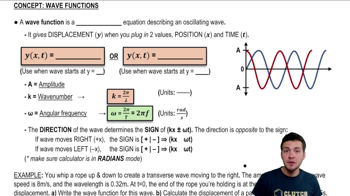
Amplitude is the coefficient outside the sine or cosine in the wave function, representing the maximum displacement.
In which type of wave does the disturbance move in the same direction as the wave?
In longitudinal waves, the disturbance moves in the same direction as the wave.
Which particles exhibit properties of waves in some experiments?
Particles such as electrons can exhibit wave-like properties in certain experiments.
What property makes a light wave different from all mechanical waves?
Light waves are electromagnetic and do not require a medium, unlike mechanical waves.
What is the distance between crests called?
The distance between crests is called the wavelength.
On what does the speed of a wave depend?
The speed of a wave depends on the properties of the medium and the type of wave.
What happens to the wave when you set the amplitude to 0 mm?
If the amplitude is set to zero, there is no displacement and the wave ceases to exist.
If two waves are traveling at the same speed, which has the highest frequency?
The wave with the shortest wavelength has the highest frequency, since f = v / λ.
What is one difference between an electromagnetic wave and a mechanical wave?
Electromagnetic waves do not require a medium; mechanical waves do.
Sound and light are both forms of energy that travel in what?
Sound and light are forms of energy that travel in waves.
What properties do all mechanical waves share?
All mechanical waves require a medium and transfer energy through oscillations.
A wave traveling at 140 m/s with a wavelength of 4.0 m has what frequency?
Frequency f = v / λ = 140 m/s / 4.0 m = 35 Hz.
How can you change the frequency of a wave?
You can change the frequency by altering the wave speed or the wavelength.
What is the equation for wave speed?
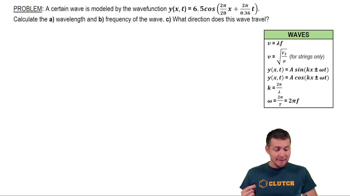
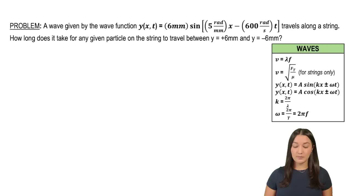
Wave speed v = frequency × wavelength, or v = fλ. For sinusoidal waves, v = ω / k.
What is the difference between a wave and a particle?
A wave is a disturbance that transfers energy, while a particle is a localized object with mass.