Back

Wave Interference quiz #1

Control buttons has been changed to "navigation" mode.
1/26
  • What occurs when the trough of one wave overlaps the trough of another wave?

    When the trough of one wave overlaps the trough of another wave, their displacements add together, resulting in a larger trough. This is an example of constructive interference.
  • What occurs when the trough of one wave overlaps the crest of another wave?

    When the trough of one wave overlaps the crest of another wave, their displacements partially or completely cancel each other, resulting in a smaller net displacement. This is an example of destructive interference.
  • What happens when two waves pass through each other in the same medium?

    When two waves pass through each other, they interfere by adding their displacements at each point. After passing, they continue traveling as if they had not interacted.
  • How can you determine if the interference between two sources at a point is constructive or destructive?

    Interference is constructive if the resulting displacement at the point is greater in magnitude than either individual wave, and destructive if the resulting displacement is less in magnitude than either wave.
  • What happens to the spacing between interference fringes if the wavelength of light is decreased?

    If the wavelength of light is decreased, the spacing between interference fringes decreases.
  • What phenomenon occurs when two sound waves of slightly different frequencies interfere with each other?

    When two sound waves of slightly different frequencies interfere, they produce beats, which are periodic variations in amplitude.
  • How does the distance between consecutive bright fringes in an interference pattern depend on the slit separation?

    The distance between consecutive bright fringes is inversely proportional to the slit separation; increasing slit separation decreases fringe spacing.
  • Can two waves travel through the same medium at the same time?

    Yes, two or more waves can travel through the same medium at the same time and will interfere with each other.
  • How can the amplitude of a wave be increased through wave interference?

    The amplitude of a wave can be increased through constructive interference, where the displacements of the combining waves add together.
  • What is the difference between constructive and destructive interference?

    Constructive interference occurs when the resulting displacement is greater in magnitude than either individual wave, while destructive interference occurs when the resulting displacement is less in magnitude than either wave.
  • What does it mean for two light waves to be in phase?

    Two light waves are in phase if their peaks and troughs align, meaning their phase difference is zero.
  • How do constructive and destructive interference differ in terms of wave displacement?

    In constructive interference, the net displacement is greater in magnitude than either wave alone; in destructive interference, the net displacement is less in magnitude than either wave alone.
  • An echo bouncing off a wall and returning to the source is an example of what wave phenomenon?

    An echo is an example of wave reflection.
  • What happens to waves that are reflected off a physical barrier?

    Waves reflected off a physical barrier reverse direction and may be inverted depending on the nature of the boundary.
  • How do sound waves travel after reflecting off a wall?

    After reflecting off a wall, sound waves travel back toward their source, maintaining the same frequency.
  • What happens when a wave travels between media of different densities?

    When a wave travels between media of different densities, part of the wave is transmitted into the new medium and part is reflected. The reflected wave may be inverted if the boundary is fixed.
  • During which situations does superposition of waves occur?

    Superposition occurs whenever two or more waves occupy the same position in space at the same time.
  • What happens if two waves meet and build on each other?

    If two waves meet and build on each other, constructive interference occurs, resulting in a larger net displacement.
  • When two waves interfere constructively, which property of the resulting wave increases?

    When two waves interfere constructively, the amplitude of the resulting wave increases.
  • Two waves traveling along the same line will do what when they meet?

    Two waves traveling along the same line will interfere with each other when they meet.
  • Interference is a property of what type of phenomenon?

    Interference is a property of waves.
  • What is it called when two or more waves are at the same place at the same time?

    When two or more waves are at the same place at the same time, it is called superposition or interference.
  • When the waves created by two speed boats in a lake interact to form larger waves, what is this an example of?

    This is an example of constructive interference.
  • What happens when two waves on a string are moving towards each other?

    When two waves on a string move towards each other, they interfere by adding their displacements at each point, and then continue traveling as before after passing through each other.
  • What is the result when two waves in phase arrive at the same spot at the same time?

    When two waves in phase arrive at the same spot at the same time, their displacements add together, resulting in constructive interference and a wave with greater amplitude.
  • Where does wave reflection occur?

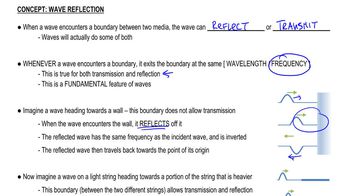
    Wave reflection occurs when a wave encounters a boundary between two media. At this boundary, part or all of the wave can reflect back into the original medium. Examples include a wave on a string reflecting off a fixed wall or a change in mass per unit length in the string. The reflected wave will have the same frequency as the incident wave, and its orientation (upright or inverted) depends on whether the boundary is fixed or free to move.