Skip to main content
Physics with Calculus
My Course
Learn
Exam Prep
AI Tutor
Study Guides
Textbook Solutions
Flashcards
Explore
Try the app
My Course
Learn
Exam Prep
AI Tutor
Study Guides
Textbook Solutions
Flashcards
Explore
Try the app
Back
Wavefunctions of EM Waves definitions
You can tap to flip the card.
Electromagnetic Waves
You can tap to flip the card.
👆
Electromagnetic Waves
Transverse waves consisting of oscillating electric and magnetic fields perpendicular to each other.
Track progress
Control buttons has been changed to "navigation" mode.
1/15
Related flashcards
Related practice
Recommended videos
Wavefunctions of EM Waves quiz
Wavefunctions of EM Waves
15 Terms
Wavefunctions of EM Waves
32. Electromagnetic Waves
5 problems
Topic
Patrick
Radiation Pressure
32. Electromagnetic Waves
2 problems
Topic
David-Paige
32. Electromagnetic Waves
7 topics
8 problems
Chapter
Patrick
Guided course
09:48
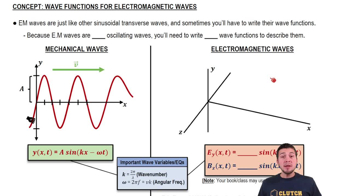
Wavefunctions of EM Waves
3770
views
36
rank
5
comments
Guided course
03:10
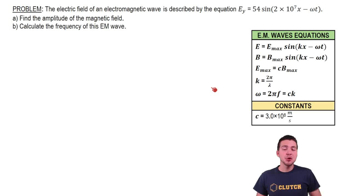
Wavefunctions of EM Waves Example 1
2563
views
34
rank
2
comments
Terms in this set (15)
Hide definitions
Electromagnetic Waves
Transverse waves consisting of oscillating electric and magnetic fields perpendicular to each other.
Wave Function
Mathematical description of a wave, using sinusoidal functions to represent oscillations.
Electric Field (E field)
Component of an electromagnetic wave that oscillates perpendicular to the magnetic field.
Magnetic Field (B field)
Component of an electromagnetic wave that oscillates perpendicular to the electric field.
Amplitude
Maximum value of the wave's oscillation, represented as E max for electric and B max for magnetic fields.
Wave Number (k)
Spatial frequency of a wave, calculated as 2*pi divided by the wavelength.
Angular Frequency (omega)
Rate of oscillation of a wave, calculated as the product of wave number and speed of light.
Transverse Waves
Waves where oscillations occur perpendicular to the direction of wave propagation.
In Phase
Condition where electric and magnetic fields reach their maximum, minimum, and zero values simultaneously.
Wavelength (lambda)
Distance over which the wave's shape repeats, used to calculate wave number.
Speed of Light (c)
Constant speed at which electromagnetic waves propagate in a vacuum, approximately 3 x 10^8 m/s.
Infrared Laser
Device emitting electromagnetic radiation with a wavelength longer than visible light, used in the example problem.
Sinusoidal Functions
Mathematical functions like sine and cosine used to describe wave oscillations.
Phase
Position of a point in time on a waveform cycle, important for determining wave function form.
Teslas
Unit of magnetic field strength, used to express B max in electromagnetic waves.
 BackBack

 09:48
09:48