Skip to main content
Physics with Calculus
My Course
Learn
Exam Prep
AI Tutor
Study Guides
Textbook Solutions
Flashcards
Explore
Try the app
My Course
Learn
Exam Prep
AI Tutor
Study Guides
Textbook Solutions
Flashcards
Explore
Try the app
Back
PV Diagrams & Work quiz
You can tap to flip the card.
What does a PV diagram plot on its axes?
You can tap to flip the card.
👆
What does a PV diagram plot on its axes?
A PV diagram plots pressure (P) on the y-axis and volume (V) on the x-axis.
Track progress
Control buttons has been changed to "navigation" mode.
1/15
Related flashcards
Related practice
Recommended videos
PV Diagrams & Work definitions
PV Diagrams & Work
15 Terms
PV Diagrams & Work
22. The First Law of Thermodynamics
3 problems
Topic
Patrick
Cyclic Thermodynamic Processes
22. The First Law of Thermodynamics
5 problems
Topic
Patrick
22. The First Law of Thermodynamics
5 topics
13 problems
Chapter
Patrick
Guided course
04:07
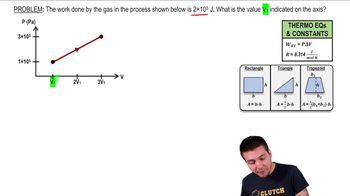
Finding Value of V on Axis
2767
views
47
rank
Guided course
08:07
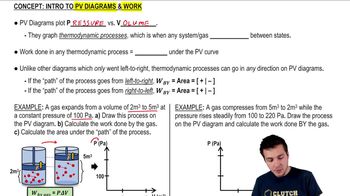
Work and PV Diagrams
4532
views
43
rank
Terms in this set (15)
Hide definitions
What does a PV diagram plot on its axes?
A PV diagram plots pressure (P) on the y-axis and volume (V) on the x-axis.
What does the area under the curve in a PV diagram represent?
The area under the curve represents the work done during a thermodynamic process.
How do you calculate work done by a gas at constant pressure using a PV diagram?
Work is calculated using the formula W = P × ΔV, where P is constant pressure and ΔV is the change in volume.
What is the work done when a gas expands from 2 to 5 m³ at a constant pressure of 100 units?
The work done is 300 joules, calculated as W = 100 × (5 - 2) = 300 J.
How do you find the area under the curve for a constant pressure process on a PV diagram?
For constant pressure, the area is a rectangle with base ΔV and height P, so area = P × ΔV.
Why is the work done equal to the area under the curve in a PV diagram?
Because the area under the curve mathematically represents the integral of P dV, which is the definition of work in thermodynamics.
What must you do if pressure is not constant during a process on a PV diagram?
You must calculate the area under the curve by dividing it into simpler shapes, such as rectangles and triangles.
Why can't you use W = PΔV when pressure changes during a process?
Because W = PΔV only applies when pressure is constant; with variable pressure, you need to use the area under the curve.
How do you calculate the work done when a gas compresses from 5 to 2 m³ and pressure rises from 100 to 220 units?
Divide the area under the curve into a triangle and a rectangle, calculate each area, and sum them, considering the direction for sign.
What is the total work done in the compression example where the gas goes from 5 to 2 m³ and pressure from 100 to 220 units?
The total work done is -480 joules, indicating work done on the gas.
How do you determine the sign of work from the direction of the process on a PV diagram?
If the process goes from left to right (increasing volume), work is positive; if from right to left (decreasing volume), work is negative.
What does a negative value for work indicate in a PV diagram process?
A negative work value means work is done on the gas, such as during compression.
Why is it important to indicate the direction of the process on a PV diagram?
Because the direction determines the sign of the work and ensures correct calculation.
What is the formula for the area of a triangle used in PV diagram work calculations?
The area of a triangle is (1/2) × base × height.
What is the relationship between the base and height of shapes under the curve and the variables in the work formula?
The base corresponds to the change in volume (ΔV), and the height corresponds to pressure (P).
 BackBack
 04:07
04:07