Skip to main content
Physics with Calculus
My Course
Learn
Exam Prep
AI Tutor
Study Guides
Textbook Solutions
Flashcards
Explore
Try the app
My Course
Learn
Exam Prep
AI Tutor
Study Guides
Textbook Solutions
Flashcards
Explore
Try the app
Back
Linear Thermal Expansion quiz
You can tap to flip the card.
What is linear thermal expansion?
You can tap to flip the card.
👆
What is linear thermal expansion?
Linear thermal expansion is the increase in length of a material when its temperature increases.
Track progress
Control buttons has been changed to "navigation" mode.
1/15
Related flashcards
Related practice
Recommended videos
Linear Thermal Expansion definitions
Linear Thermal Expansion
15 Terms
Linear Thermal Expansion
20. Heat and Temperature
2 problems
Topic
Patrick
Volume Thermal Expansion
20. Heat and Temperature
4 problems
Topic
Patrick
20. Heat and Temperature - Part 1 of 2
5 topics
12 problems
Chapter
Patrick
20. Heat and Temperature - Part 2 of 2
4 topics
11 problems
Chapter
Patrick
Guided course
07:31
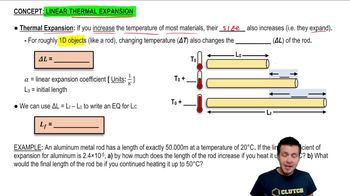
Linear Thermal Expansion
6773
views
123
rank
3
comments
Guided course
03:47
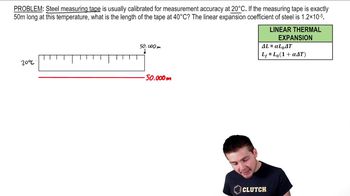
Expanding Steel Measuring Tape
4325
views
81
rank
Terms in this set (15)
Hide definitions
What is linear thermal expansion?
Linear thermal expansion is the increase in length of a material when its temperature increases.
What is the formula for calculating the change in length due to thermal expansion?
The formula is ΔL = α * L₀ * ΔT, where α is the linear expansion coefficient, L₀ is the initial length, and ΔT is the change in temperature.
What does the linear expansion coefficient (α) represent?
The linear expansion coefficient (α) measures how easily a material expands with temperature and is given in units of 1/K or 1/°C.
If the temperature change (ΔT) doubles, what happens to the change in length (ΔL)?
The change in length (ΔL) also doubles because ΔL is directly proportional to ΔT.
Why are there gaps in bridges and sidewalks?
Gaps are left to allow materials to expand on hot days without breaking due to thermal expansion.
How do you calculate the final length of a rod after heating?
The final length is calculated using Lf = L₀ * (1 + α * ΔT).
Does it matter if you use Celsius or Kelvin for ΔT in thermal expansion calculations?
No, because the size of the temperature change (ΔT) is the same in both Celsius and Kelvin.
What is the initial length (L₀) in the context of thermal expansion?
L₀ is the original length of the object before any temperature change occurs.
What is the change in length (ΔL) of a 50 m aluminum rod heated from 20°C to 35°C, given α = 2.4 × 10⁻⁵ 1/°C?
The change in length (ΔL) is 0.018 meters (1.8 cm).
How do you find ΔT if a rod is heated from 20°C to 35°C?
ΔT is found by subtracting the initial temperature from the final temperature: 35°C - 20°C = 15°C.
What is the final length of a 50 m aluminum rod heated from 20°C to 50°C with α = 2.4 × 10⁻⁵ 1/°C?
The final length is 50.036 meters.
Why are the actual changes in length due to thermal expansion usually small?
Because the linear expansion coefficients are small, so even large objects only expand by a few centimeters for typical temperature changes.
What does ΔL stand for in the thermal expansion formula?
ΔL stands for the change in length of the object due to a temperature change.
How is the formula for final length (Lf) derived from the change in length formula?
It is derived by adding the change in length (ΔL) to the initial length (L₀), resulting in Lf = L₀ + ΔL = L₀ * (1 + α * ΔT).
Why is understanding thermal expansion important in engineering and construction?
It is important to prevent structural damage by allowing for material expansion in designs such as bridges and sidewalks.
 BackBack
 07:31
07:31