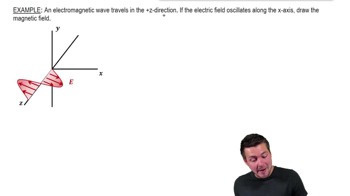
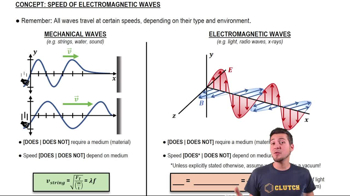
Light originates from the accelerated motion of electrons, producing electromagnetic waves made of vibrating electric and magnetic fields.
What is the electromagnetic spectrum?
The electromagnetic spectrum classifies waves by frequency, ranging from low-frequency radio waves to high-frequency gamma rays, with visible light in between.
Which portion of the electromagnetic spectrum is the narrowest named portion?
Visible light is the narrowest named portion of the electromagnetic spectrum.
How do transparent materials like glass transmit light?
Photons are absorbed and reemitted by atoms; vibrating electrons absorb energy and emit photons, causing a time delay and slower average light speed in the material.
Is the photon exiting a transparent material the same as the one entering?
No, the photon that exits is not the same as the one that initially entered due to absorption and reemission processes.
How does the frequency of light change when passing through transparent materials?
The frequency of light remains the same when passing from air into any transparent medium, even though speed changes.
What is the speed of light in glass compared to vacuum?
Light travels slower in glass, approximately 0.67 times the speed of light in vacuum.
What defines an opaque material in terms of light interaction?
Opaque materials absorb light without reemitting it, converting light energy into internal kinetic energy and heat.
How do metals reflect light differently from other opaque materials?
Metals have free electrons that vibrate and emit their own light, causing reflection.
What causes shadows and what are umbra and penumbra?
Shadows form where light rays are blocked; umbra is the total shadow, penumbra is a partial shadow where some light is blocked but some fills in.
What is the role of the cornea in the human eye?
The cornea is a transparent cover that bends about 70% of incoming light to help focus it onto the retina.
What is the function of the retina's rods and cones?
Rods handle vision in low light and are more peripheral; cones handle color vision and detail, concentrated in the fovea.
What are the additive primary colors of light?
Red, green, and blue are the additive primary colors that combine to produce any color in the spectrum.
What colors are the subtractive primary colors in pigments?
Cyan, magenta, and yellow are the subtractive primary colors used in pigments and printing.
Why is the sky blue?
The sky is blue due to selective scattering of shorter wavelength blue light by small atmospheric particles.
Why are sunsets red?
Sunsets appear red because low-frequency red light is least scattered and travels best through the atmosphere at sunset.
What causes clouds to appear white?
Clouds appear white because clusters of water droplets of various sizes scatter all visible wavelengths of light.
Why does water appear greenish blue?
Water absorbs red light more strongly, leaving the complementary cyan color, and scattering from suspended particles enhances the blue-green color.
What is lateral inhibition in vision?
Lateral inhibition prevents the brightest areas in our visual field from outshining the rest, helping us perceive contrast rather than absolute brightness.
What is the blind spot in the eye?
The blind spot is the area on the retina where optic nerves connect and no photoreceptor cells exist, causing a lack of vision in that spot.
 Back
 05:22