 Back
Reflection and Refraction - Physics with Calculus
 06:25

Terms in this set (25)
Reflection is when light is returned into the medium from which it came after illuminating a material.
Fermat’s principle of least time states that light takes the quickest path from one place to another.
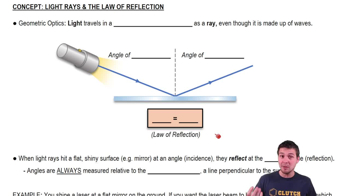
The angle of reflection equals the angle of incidence, both measured from the normal to the reflecting surface.
The normal is an imaginary line perpendicular to the reflecting surface, lying in the same plane as incident and reflected rays.
A plane mirror forms a virtual image that is the same size as the object, located as far behind the mirror as the object is in front.
Convex mirrors form smaller, closer virtual images; concave mirrors form larger, farther virtual images for close objects.
Diffuse reflection occurs when light reflects off a rough surface, scattering in many directions, allowing us to see objects from various angles.
Refraction is caused by a change in the speed of light as it passes obliquely from one medium to another, bending the light rays.
The refractive index is the ratio of the speed of light in vacuum to the speed of light in the material, denoted as \(n\).
Light that bends toward the normal has slowed down entering a medium with a higher refractive index.
Light that bends away from the normal has sped up entering a medium with a lower refractive index.
Objects submerged in water appear closer to the surface due to refraction.
Atmospheric refraction bends light rays, causing illusions such as mirages and displacement of objects like the Sun.
Dispersion is the separation of white light into colors arranged by frequency, such as when passing through a prism.
Green light bends more than red because it has a higher frequency and is refracted more by the prism.
Rainbows form by dispersion of sunlight by millions of water drops, creating a cone of colors visible to the observer.
The secondary rainbow is dimmer, has reversed colors, and is caused by two internal reflections inside raindrops.
Total internal reflection occurs when light inside a medium hits the boundary at or above the critical angle and reflects entirely within the medium.
The critical angle is the minimum angle of incidence inside a medium at which light is totally internally reflected at the boundary with a less dense medium.
Optical fibers use total internal reflection to transmit light efficiently over long distances with minimal loss.
Converging (convex) lenses are thicker in the center and focus light; diverging (concave) lenses are thinner in the center and spread light.
The focal point is where incident parallel light rays converge after passing through a lens.
Spherical aberration is distortion caused when light rays passing through the edges of a lens focus at different points than rays through the center.
Chromatic aberration results from different colors of light refracting at different speeds, causing color fringes in images.
Astigmatism is caused by an uneven curvature of the eyeball's front surface, leading to distorted vision.