 Back
1-D Kinematics I: Representing Motion and Units
Study Guide - Smart Notes
 Tailored notes based on your materials, expanded with key definitions, examples, and context.
Representing Motion
Introduction to Motion
Physics is the study of matter, energy, and their interactions. Mechanics, a branch of physics, focuses on the motion of matter, including both the description of how objects move and the causes of their motion. Motion is defined as the change of an object’s position or orientation with time. The path along which an object moves is called its trajectory.
Straight-line motion: Motion along a straight path.
Projectile motion: Motion of an object thrown at an angle, following a curved path under gravity.
Circular motion: Motion along a circular path.
Fluid motion: Motion of fluids or objects moving through fluids.
Oscillatory motion: Repetitive back-and-forth motion.
Wave motion: Disturbances that travel through a medium, transferring energy.

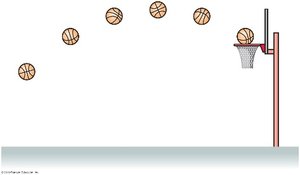


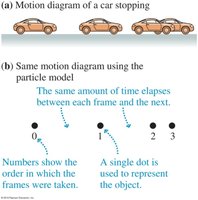

We begin by studying the simplest case: straight-line (one-dimensional) motion.
Motion Diagrams
Visualizing Motion
A motion diagram is a sequence of images showing the positions of a moving object at equally spaced time intervals. Each image in the sequence is called a frame. Motion diagrams help us visualize how an object moves over time.
Equally spaced images indicate constant speed.
Increasing distance between images indicates the object is speeding up.
Decreasing distance between images indicates the object is slowing down.
Complex patterns can show changes in both speed and direction.
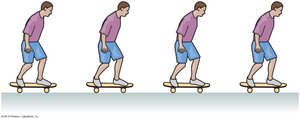
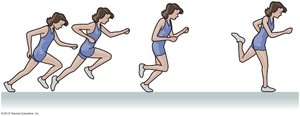



Example: Comparing two cars' motion diagrams, the car with greater spacing between images (for equal time intervals) is moving faster.
The Particle Model
Simplifying Motion Analysis
To simplify the analysis of motion, we often use the particle model, treating an extended object as if all its mass were concentrated at a single point. This is valid when the object is rigid and not rotating, so all points move in the same way.
In diagrams, a complex object (like a car) can be represented by a single point (particle).
This model is especially useful for analyzing translational motion.
Position and Time
Describing Location and Duration
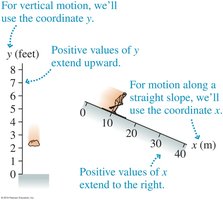
The position of an object is its location at a given time, represented as the coordinate in a chosen coordinate system. A coordinate system consists of an origin and one or more axes (e.g., -axis for horizontal motion, -axis for vertical motion).
Position can be positive, negative, or zero, depending on the chosen origin.
For one-dimensional motion, we use the -axis; for vertical motion, the -axis; for inclined motion, an axis along the incline.
The displacement is the change in position:
Displacement can be positive, negative, or zero.
Distance is the total length of the path traveled and is always positive.
The time interval is the elapsed time:
Time intervals are always positive.
Example: If an object moves from to , the displacement is .
Velocity
Describing How Fast and in What Direction
Speed and velocity are related but distinct concepts in physics:
Average speed is the total distance traveled divided by the time interval:
Average velocity is the displacement divided by the time interval:
For uniform motion (constant speed), speed and velocity are constant:
Speed is always positive; velocity can be positive or negative, indicating direction.
Example: If an object moves in , average velocity is .
Units
SI Units and Conversions
The three basic physical quantities in mechanics are mass (kilograms, kg), length (meters, m), and time (seconds, s). All other quantities are combinations of these units. It is important to use SI units in calculations and convert other units as needed.
Examples: 1 m ≈ 3.28 feet; 1 kg ≈ 2.2 pounds.
Significant figures and scientific notation are used for precision.
Introduction to Vectors
Scalars vs. Vectors
Scalar quantities are described by a single number with a unit (e.g., mass, time, temperature, distance, speed). Notation: non-bold italic letters (e.g., , , ).
Vector quantities require both magnitude and direction (e.g., position, displacement, velocity, acceleration, force). Notation: italic letters with an arrow above (e.g., , , ).
Vectors are represented by arrows in diagrams; the arrow's direction shows the vector's direction, and its length is proportional to magnitude.
In one dimension, or signs indicate direction relative to the chosen axis.
Vectors can be added or subtracted mathematically.
Position vector: Points from the origin to the object's location.
Displacement vector: (can be positive, negative, or zero in 1D).
Equation Summary
Concept | Equation |
|---|---|
Displacement | |
Distance traveled | No simple equation in general; for 1D, add absolute values of all displacements |
Time interval | |
Average speed | |
Average velocity | |
Speed in uniform motion | |
Velocity in uniform motion |
