 Back
Back1-D Kinematics III: Constant Acceleration and Free-Fall
Study Guide - Smart Notes
 Tailored notes based on your materials, expanded with key definitions, examples, and context.
Motion in One Dimension
Uniform Motion (Constant Velocity)
Uniform motion refers to motion at a constant velocity, meaning the acceleration is zero. In this case, the final velocity and position can be determined using simple equations:
Final velocity:
Final position:
These equations are only valid when acceleration .
Motion with Constant Acceleration
When an object's velocity changes at a constant rate, it is said to be under constant acceleration. The kinematic equations for this scenario are fundamental for solving a wide range of physics problems.
Velocity equation:
Position equation:
Velocity-position equation (no time):
These equations are valid for any motion in a straight line with constant acceleration. For vertical motion, replace all 's with 's.
Graphical Interpretation of Displacement
The displacement for an object under constant acceleration can be interpreted as the area under the velocity versus time graph. This area is the sum of a rectangle (representing the initial velocity) and a triangle (representing the change in velocity due to acceleration):
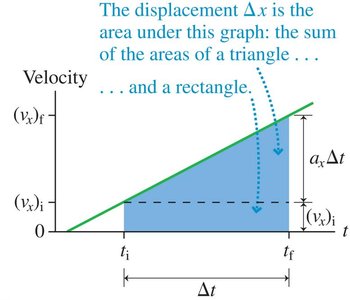
This graphical approach helps visualize why the position equation includes both a linear and a quadratic term in time.
Solving One-Dimensional Motion Problems
General Strategy
Draw a diagram of the situation, labeling known and unknown quantities and indicating the coordinate system.
List all known values and symbols for unknowns.
Identify relevant physical concepts and write down the corresponding equations.
Use the equations to connect unknowns to knowns. If necessary, use more than one equation.
Work symbolically and substitute numbers only at the end.
Check the reasonableness and units of your final answer.
For problems with multiple segments (e.g., changing acceleration), use the final values from one segment as the initial values for the next.
Example Problem
Example: A boat starts at m/s and accelerates at m/s for s. Find its velocity and displacement after this time.
Solution:
Final velocity: m/s
Displacement: m
Free Fall
Definition and Properties
Free fall describes the idealized motion of an object falling under the influence of gravity alone, with air resistance neglected. Galileo's experiments showed that all objects fall with the same constant acceleration near Earth's surface, regardless of mass.
Acceleration due to gravity: , vertically downward
Magnitude: m/s
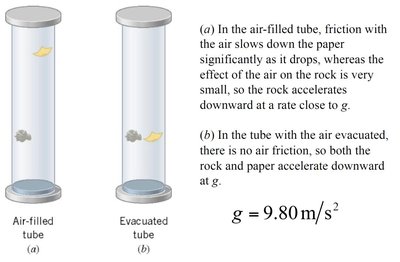
Explanation: In an air-filled tube, air resistance slows light objects (like paper) more than heavy ones (like rocks). In a vacuum, all objects accelerate downward at .
Sign Conventions
If upward is positive, m/s
If downward is positive, m/s
Always use the correct sign for based on your coordinate system.
Example Problems in Free Fall
Example 1: A stone is dropped from rest. How far does it fall between s and s?
Solution: Use for both times and subtract to find the distance fallen during the interval.
Example 2: A coin is tossed upward at m/s. How high does it go?
Solution: At the highest point, . Use to solve for .
Example 3: A ball is thrown upward from a m cliff at m/s. Find the time to reach the ground and its velocity at impact.
Equation Summary
Concept | Equation |
|---|---|
Constant acceleration kinematics (1D) |
|
Acceleration due to gravity | , m/s (downward) |
Appendix: Derivation of the Third Kinematic Equation
The third kinematic equation, , can be derived by eliminating between the velocity and position equations. This is useful when time is not given in a problem.
