 Back
BackAcceleration and Newton’s Second Law: Position, Displacement, Velocity, and Force
Study Guide - Smart Notes
 Tailored notes based on your materials, expanded with key definitions, examples, and context.
Acceleration & Newton’s Second Law
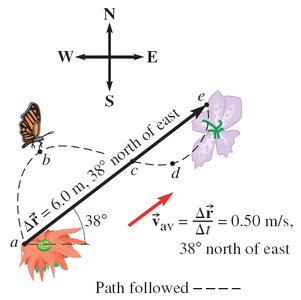
Position and Displacement
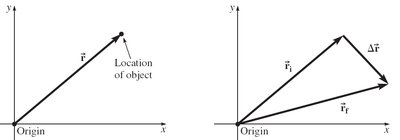
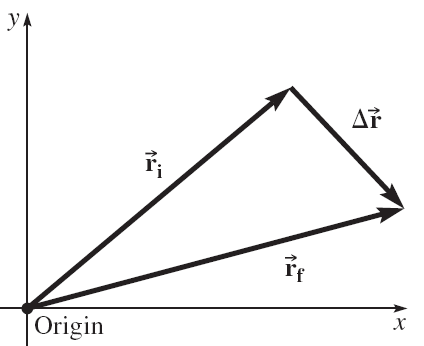
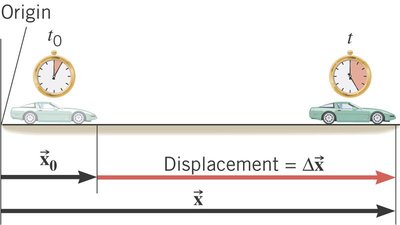
To describe the location of an object in space, we use its position vector, which specifies both the distance from the origin and the direction. Displacement is the change in position, defined as the difference between the final and initial position vectors. Both position and displacement are vector quantities, meaning they have both magnitude and direction.
Position Vector (\( \vec{r} \)): Indicates the location of an object relative to the origin.
Displacement (\( \Delta \vec{r} \)): \( \Delta \vec{r} = \vec{r}_f - \vec{r}_i \)
Vector subtraction: Used to find displacement.
Example: Displacement Calculation
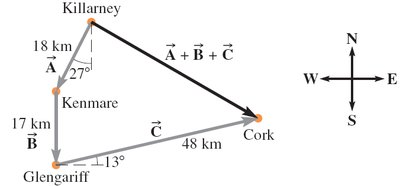
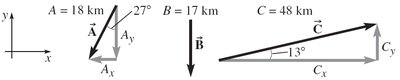
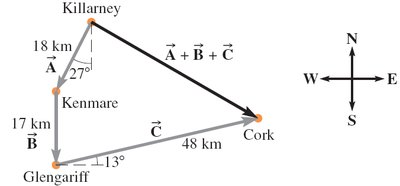
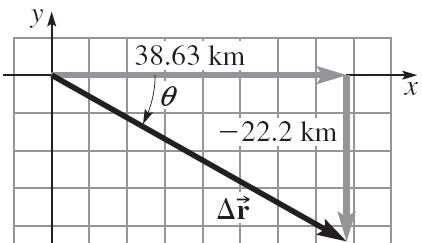
Consider a trip involving multiple segments with different directions. The total displacement is found by vector addition of each segment, and its magnitude and direction are determined using the Pythagorean theorem and trigonometry.
Vector addition: Add the x and y components of each segment.
Magnitude: \( \Delta r = \sqrt{(\Delta x)^2 + (\Delta y)^2} \)
Direction: \( \tan \theta = \frac{\Delta y}{\Delta x} \)





Speed and Velocity
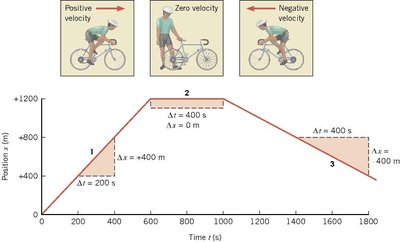
Speed is a scalar quantity representing the distance traveled divided by the elapsed time. Velocity is a vector quantity, defined as the displacement divided by the elapsed time. The direction of average velocity matches the direction of the displacement vector.
Average speed: \( \text{Average speed} = \frac{\text{Distance}}{\text{Elapsed time}} \)
Average velocity: \( \vec{v}_{\text{avg}} = \frac{\Delta \vec{x}}{\Delta t} \)
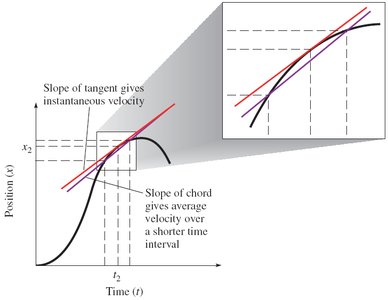
Instantaneous velocity: The velocity at a specific instant, found as the limit of average velocity as the time interval approaches zero.
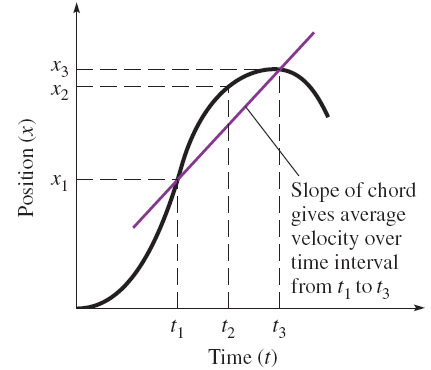
Graphical Relationships Between Position and Velocity
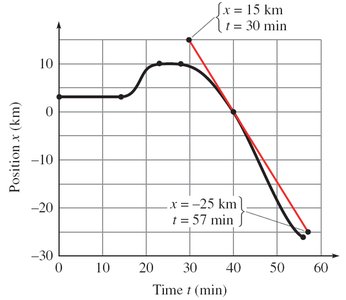
The slope of a position vs. time graph gives the average velocity over a time interval. The slope of the tangent at a point gives the instantaneous velocity.
Average velocity: Slope of the chord between two points.
Instantaneous velocity: Slope of the tangent at a single point.
Velocity Example: World Record Car
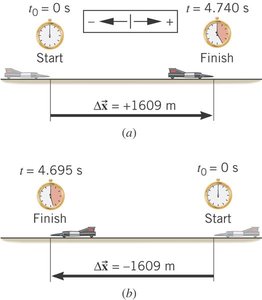
Calculating average velocity for two runs (forward and backward) demonstrates the vector nature of velocity and the importance of direction.
Forward run: \( \Delta \vec{x} = +1609 \text{ m}, \Delta t = 4.740 \text{ s} \)
Backward run: \( \Delta \vec{x} = -1609 \text{ m}, \Delta t = 4.695 \text{ s} \)
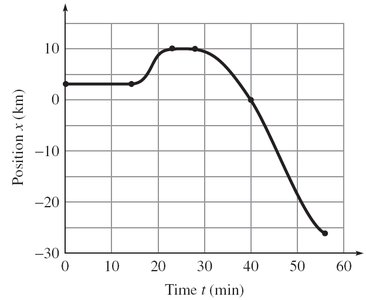
Velocity Example: Train Position Graph
Estimating velocity from a position vs. time graph involves finding the slope between two points.
Finding Displacement with Constant Velocity
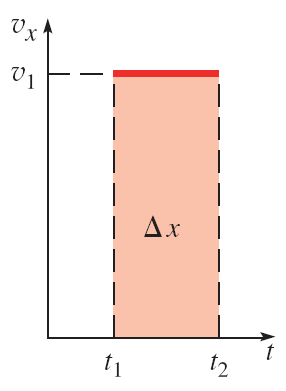
When velocity is constant, displacement is the area under the velocity vs. time curve.
Acceleration and Newton’s Second Law
When a nonzero net force acts on an object, its velocity changes. Acceleration is the rate of change of velocity, and Newton’s second law relates force, mass, and acceleration:
Newton’s Second Law: \( \sum \vec{F} = m \vec{a} \)
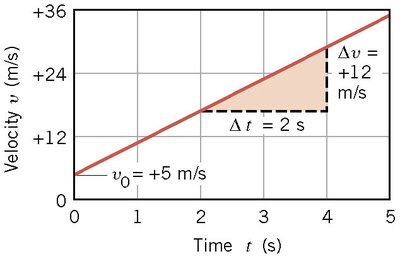
Average acceleration: \( \vec{a}_{\text{avg}} = \frac{\Delta \vec{v}}{\Delta t} \)
Instantaneous acceleration: The limit as \( \Delta t \to 0 \).
Acceleration Examples
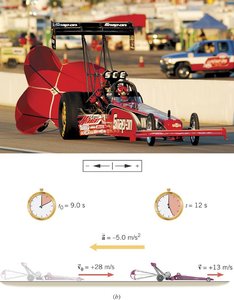
Acceleration can be positive (increasing velocity) or negative (decreasing velocity, also called deceleration). The direction of acceleration relative to velocity determines whether an object speeds up or slows down.
Graphical Analysis of Velocity and Acceleration
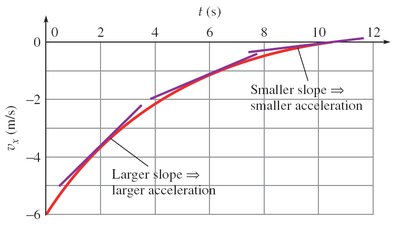
The slope of a velocity vs. time graph gives acceleration. The area under an acceleration vs. time graph gives the change in velocity.
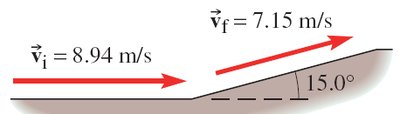
Acceleration Example: Inline Skater
Calculating the change in velocity and average acceleration for a skater moving up an incline involves vector subtraction and component analysis.
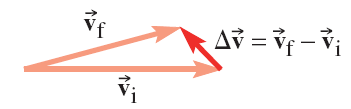
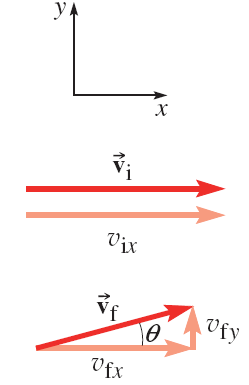

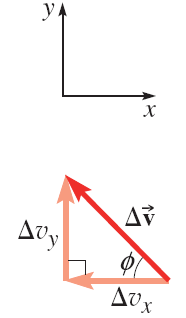
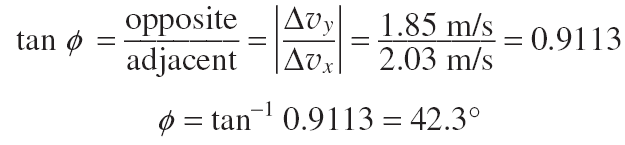
Graphical Relationships Between Velocity and Acceleration
On a velocity vs. time graph, the slope at any point gives the instantaneous acceleration. The area under an acceleration vs. time graph gives the change in velocity.
Newton’s Second Law and Mass
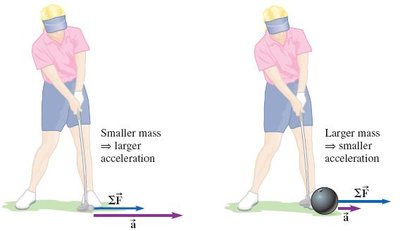
Newton’s second law states that acceleration is inversely proportional to mass. The SI unit of force is the newton (N), defined as the force required to accelerate 1 kg by 1 m/s2.
Force: \( 1 \text{ N} = 1 \text{ kg} \cdot \text{m/s}^2 \)
Mass: A measure of an object’s inertia, or resistance to changes in velocity.
Problem-Solving Strategy for Newton’s Laws
To solve problems involving Newton’s laws:
Identify the objects and systems involved.
List all external forces acting on each object.
Use Newton’s third law for interaction pairs.
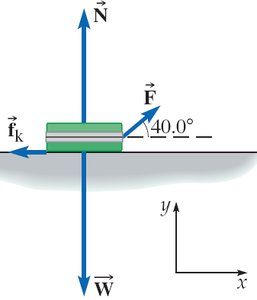
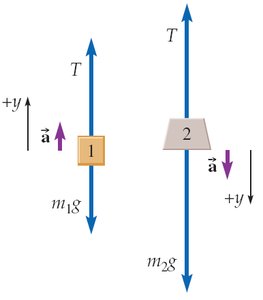
Draw a free-body diagram (FBD) for each object.
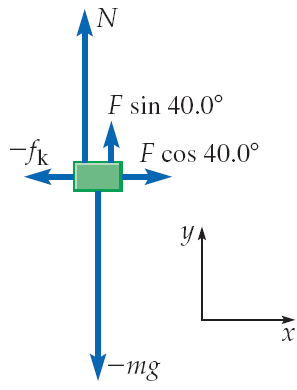
Choose a coordinate system aligned with the net force.
Add forces as vectors to find the net force.
Apply Newton’s second law to relate net force and acceleration.
Relate acceleration to velocity changes over the time interval.
Applying Newton’s Laws: Connected Objects
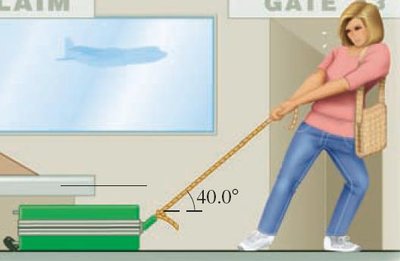
When objects are connected (e.g., train cars or blocks tied together), they share the same acceleration. The forces between them can be analyzed using Newton’s laws and free-body diagrams.
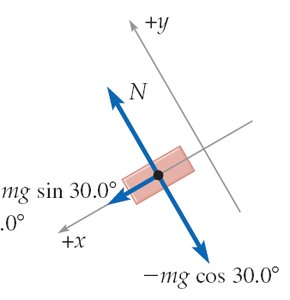
Inclined Planes Example
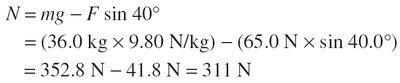
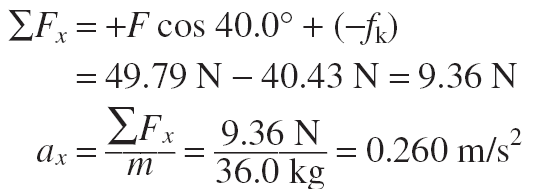
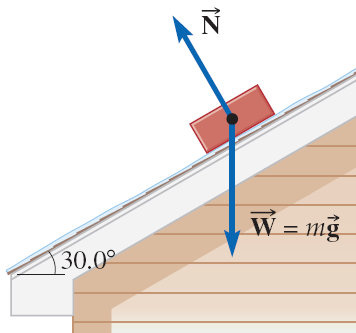
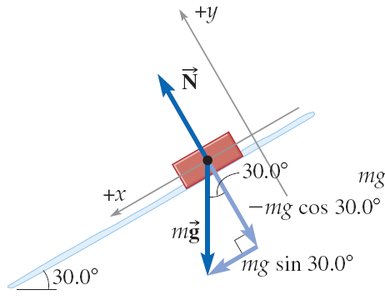
Analyzing motion on an inclined plane involves resolving forces into components parallel and perpendicular to the incline.
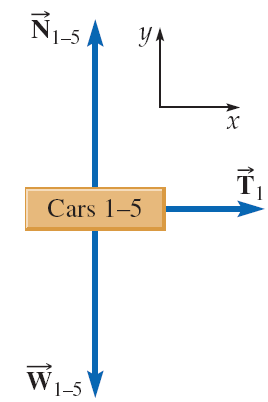
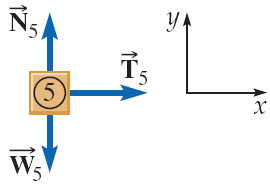
Train Cars Example
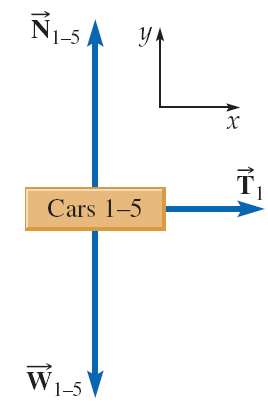
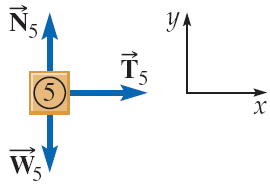
For a train engine pulling multiple cars, the force in the couplings and the acceleration of each car can be found using Newton’s laws and free-body diagrams.
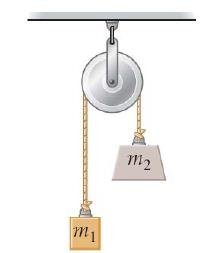
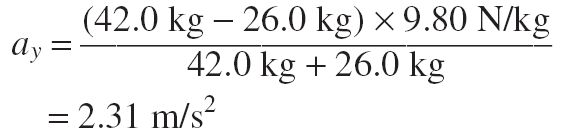
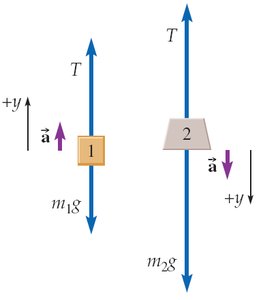
Pulley System Example
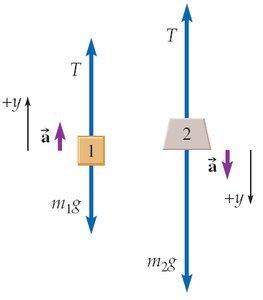
When two blocks are connected by a cord over a pulley, their accelerations and the tension in the cord can be found by applying Newton’s laws to each block.

Additional info: These notes cover topics from Chapter 3: Motion and Acceleration, and Chapter 2: Force and Equilibrium, including vector analysis, graphical interpretation, and applications of Newton’s second law. All images included are directly relevant to the explanations provided.
