 Back
BackAcceleration and Newton’s Second Law: Position, Displacement, Velocity, and Force
Study Guide - Smart Notes
 Tailored notes based on your materials, expanded with key definitions, examples, and context.
Acceleration & Newton’s Second Law
Introduction to Newton’s Second Law of Motion
Newton’s second law of motion describes how the net force acting on an object determines its acceleration, which is the rate of change of velocity. Before applying this law, it is essential to understand the vector quantities: position, displacement, velocity, and acceleration.
Position and Displacement
Position Vector
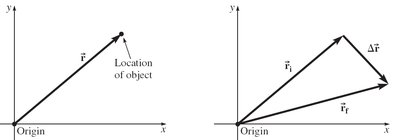
The position of an object is described by a vector that gives its distance and direction from a chosen origin. This vector is denoted as \( \vec{r} \).
Position vector: Points from the origin to the location of the object.
Vector notation: Direction and magnitude are both specified.
Displacement
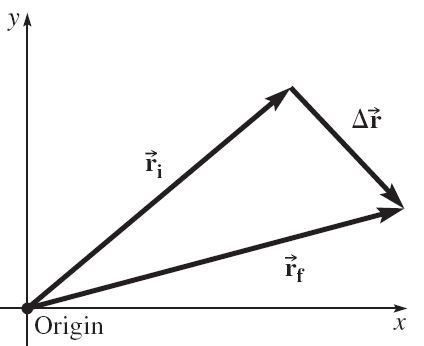
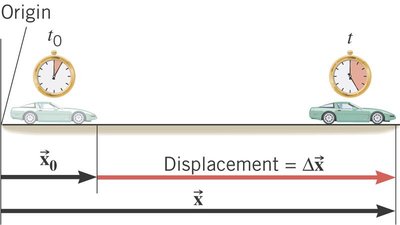
Displacement is the change in position, defined as the difference between the final and initial position vectors:
Displacement vector: \( \Delta \vec{r} = \vec{r}_f - \vec{r}_i \)
Displacement is a vector quantity, indicating both magnitude and direction.
Example: Vector Addition in Displacement
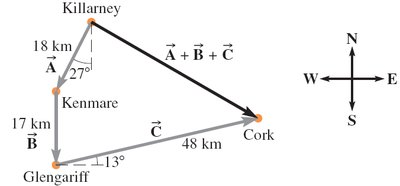
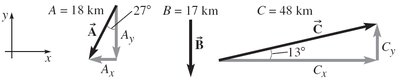
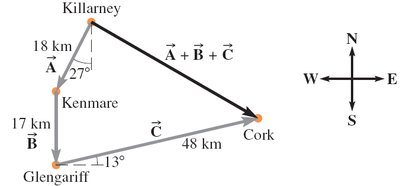
Consider a trip involving multiple segments with different directions. The total displacement is found by vector addition of each segment.
Each segment is broken into x and y components.
Sum all x-components and y-components to find the total displacement.
Calculating Displacement Components
To find the total displacement, add the x and y components:
\( \Delta x = A_x + B_x + C_x \)
\( \Delta y = A_y + B_y + C_y \)


Magnitude and Direction of Displacement
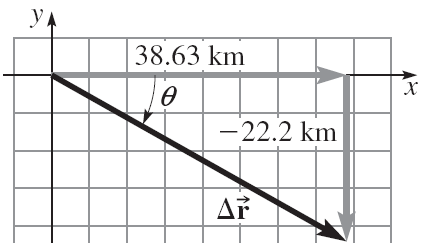
The magnitude of the displacement vector is found using the Pythagorean theorem:
\( \Delta r = \sqrt{(\Delta x)^2 + (\Delta y)^2} \)
The direction is given by \( \tan \theta = \frac{\Delta y}{\Delta x} \)

Speed and Velocity
Average Speed
Average speed is the total distance traveled divided by the elapsed time. It is a scalar quantity and does not depend on direction.
\( \text{Average speed} = \frac{\text{Distance}}{\text{Elapsed time}} \)
SI unit: meters per second (m/s)
Average Velocity
Average velocity is the displacement divided by the elapsed time. It is a vector quantity.
\( \vec{v}_{\text{avg}} = \frac{\Delta \vec{x}}{\Delta t} \)
Direction of average velocity is the same as the displacement vector.
Instantaneous Velocity
Instantaneous velocity describes how fast and in what direction an object moves at a specific instant:
\( \vec{v} = \lim_{\Delta t \to 0} \frac{\Delta \vec{x}}{\Delta t} \)
It is a vector quantity.
Graphical Relationships
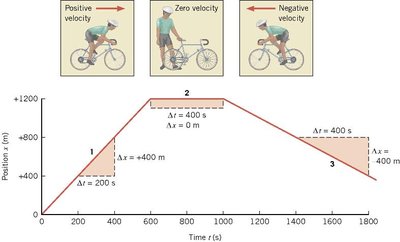
The slope of a position vs. time graph gives the average velocity over a time interval. The slope of the tangent at a point gives the instantaneous velocity.


Acceleration
Definition of Acceleration
Acceleration is the rate at which velocity changes. It is a vector quantity:
\( \vec{a}_{\text{avg}} = \frac{\Delta \vec{v}}{\Delta t} \)
SI unit: meters per second squared (m/s2)
Example: Acceleration and Increasing/Decreasing Velocity
When acceleration and velocity vectors are in the same direction, speed increases. When they are opposite, the object decelerates.
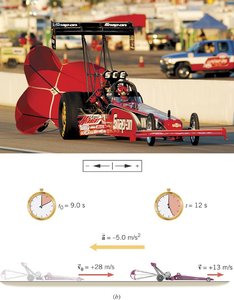
Graphical Analysis of Velocity and Acceleration
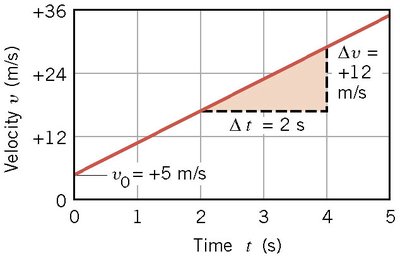
The slope of a velocity vs. time graph gives the acceleration. The area under an acceleration vs. time graph gives the change in velocity.
Newton’s Second Law of Motion
Statement and Formula
Newton’s second law states that the net force acting on an object is equal to the mass of the object multiplied by its acceleration:
\( \sum \vec{F} = m \vec{a} \)
Force is measured in newtons (N): \( 1\,\text{N} = 1\,\text{kg} \cdot \text{m}/\text{s}^2 \)
Mass and Inertia
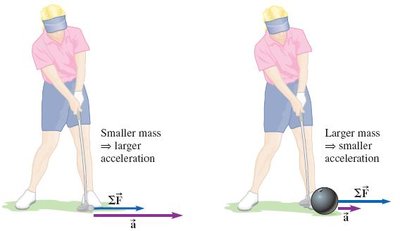
Mass is a measure of an object’s inertia, or resistance to changes in velocity. The greater the mass, the smaller the acceleration for a given force.
Problem-Solving Strategy for Newton’s Laws
Steps for Applying Newton’s Laws
Identify the objects or system to analyze.
List all external forces acting on each object.
Draw a free-body diagram (FBD) for each object.
Choose a coordinate system aligned with the net force.
Add forces as vectors to find the net force.
Use Newton’s second law to relate net force to acceleration.
Relate acceleration to the change in velocity over the time interval.
Applications of Newton’s Laws
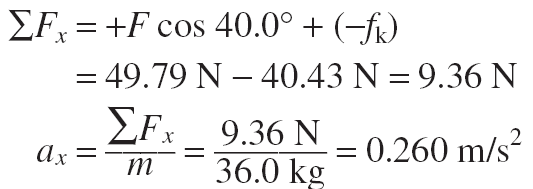
Example: Suitcase Pulled at an Angle
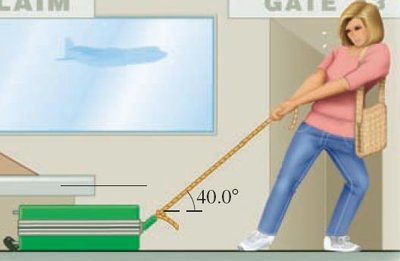
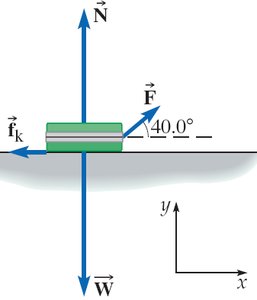
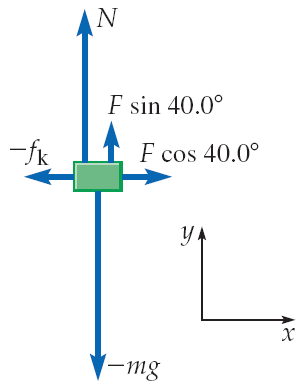
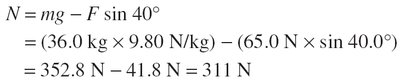
A suitcase is pulled with a force at an angle, requiring analysis of forces in both x and y directions, including friction and normal force.
Draw FBD and resolve forces into components.
Calculate normal force, frictional force, and acceleration.
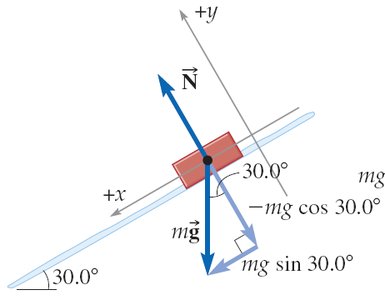
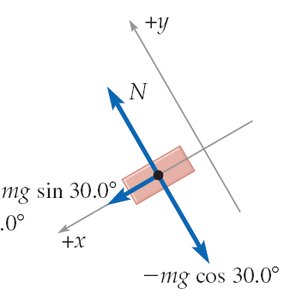
Example: Brick Sliding Down an Inclined Roof
When an object slides down an incline, resolve the weight into components parallel and perpendicular to the surface. The parallel component causes acceleration down the slope.
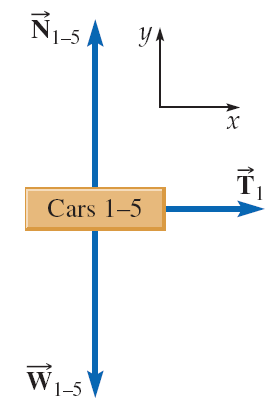
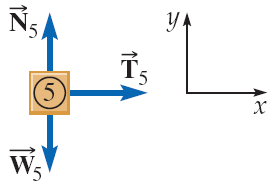
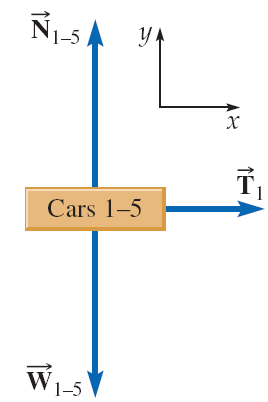
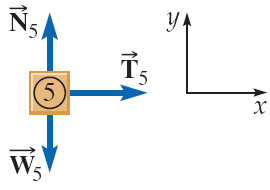
Example: Train Engine Pulling Freight Cars
When multiple objects are connected, they share the same acceleration. Analyze the forces on each car and the tension in the couplings.
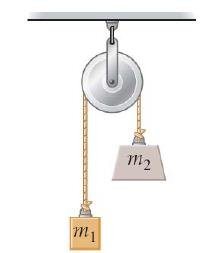
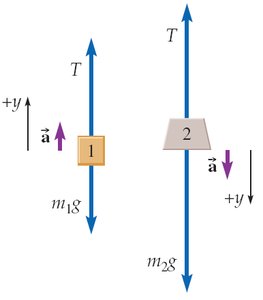
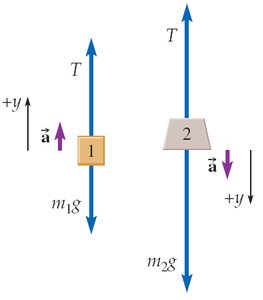
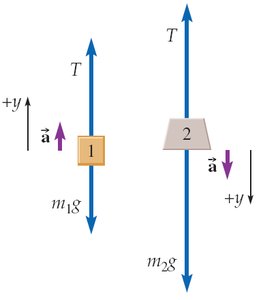
Example: Two Blocks Connected by a Cord Over a Pulley
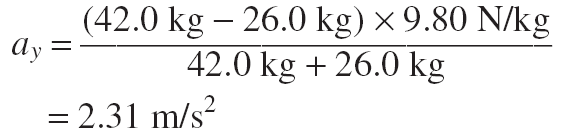
For two masses connected by a cord over a pulley, analyze the forces and calculate the acceleration and tension in the cord.
Use Newton’s second law for each mass.
Set up equations for tension and acceleration.
Summary Table: Key Concepts
Quantity | Definition | Formula | Type |
|---|---|---|---|
Position | Location relative to origin | \( \vec{r} \) | Vector |
Displacement | Change in position | \( \Delta \vec{r} = \vec{r}_f - \vec{r}_i \) | Vector |
Speed | Distance/time | \( \text{Speed} = \frac{\text{Distance}}{\text{Time}} \) | Scalar |
Velocity | Displacement/time | \( \vec{v} = \frac{\Delta \vec{x}}{\Delta t} \) | Vector |
Acceleration | Change in velocity/time | \( \vec{a} = \frac{\Delta \vec{v}}{\Delta t} \) | Vector |
Force | Mass × acceleration | \( \vec{F} = m \vec{a} \) | Vector |
