 Back
BackEXAM 3 PRACTICE
Study Guide - Smart Notes
 Tailored notes based on your materials, expanded with key definitions, examples, and context.
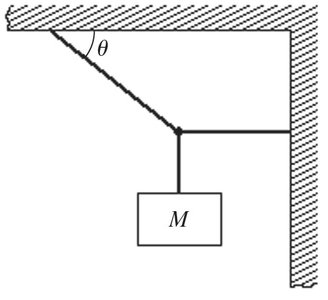
Q1. For the system shown, with a mass M suspended by two cables (one at an angle θ), draw the free-body diagram and determine the tension in each cable.
Background
Topic: Static Equilibrium and Forces
This question tests your understanding of equilibrium conditions, vector components of forces, and how to analyze forces acting on an object suspended by cables at angles. You will need to apply Newton's First Law (equilibrium) and resolve forces into components.
Key Terms and Formulas:
Static Equilibrium: The sum of all forces in both the x and y directions must be zero.
Newton's First Law: and
Weight:
Resolving Tension: For a cable at angle , ,
Step-by-Step Guidance
Draw a free-body diagram for the mass M. Identify all forces acting on the mass: the weight (downward), the tension in the angled cable (at angle ), and the tension in the horizontal cable (horizontal).
Resolve the tension in the angled cable into its horizontal () and vertical () components using trigonometry: (horizontal) and (vertical).
Write the equilibrium equations for the and directions:
Horizontal:
Vertical:
Rearrange the vertical equilibrium equation to solve for in terms of , , and .
Substitute the value of into the horizontal equation to express in terms of , , and .
Try solving on your own before revealing the answer!
Final Answer:
These results come from applying equilibrium conditions and resolving the forces into components.
