 Back
Analyzing Motion on an Inclined Plane: Maximum Speed of a Skier
Study Guide - Smart Notes
 Tailored notes based on your materials, expanded with key definitions, examples, and context.
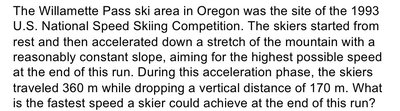
Q1. What is the fastest speed a skier could achieve at the end of a 360 m run, dropping a vertical distance of 170 m, starting from rest on a constant slope?
Background
Topic: Kinematics and Energy Conservation on an Inclined Plane
This question tests your understanding of motion on an inclined plane, specifically how to relate the vertical drop and the distance traveled along the slope to the skier's final speed. It involves concepts from kinematics and energy conservation, assuming negligible friction.
Key Terms and Formulas
Kinematic equations: Used to relate displacement, velocity, acceleration, and time.
Conservation of Energy: The loss in gravitational potential energy is converted into kinetic energy (if friction is neglected).
Gravitational Potential Energy:
Kinetic Energy:
Relationship between vertical drop and slope: Use trigonometry to relate the vertical and slope distances.
Step-by-Step Guidance
Identify the known values: the skier starts from rest (), the distance along the slope is , and the vertical drop is .
Assume no friction, so all gravitational potential energy lost is converted to kinetic energy at the bottom of the slope.
Write the conservation of energy equation: .
Notice that the mass cancels out, so you can solve for the final speed in terms of and .
Set up the equation for and prepare to substitute the known values for and .
Try solving on your own before revealing the answer!
Final Answer:
Using conservation of energy:
Solving for :
This is the maximum possible speed, assuming no friction or air resistance.
