 Back
BackAngular Momentum and Static Equilibrium: Study Notes
Study Guide - Smart Notes
 Tailored notes based on your materials, expanded with key definitions, examples, and context.
Angular Momentum and Static Equilibrium
Angular Momentum of a Single Particle
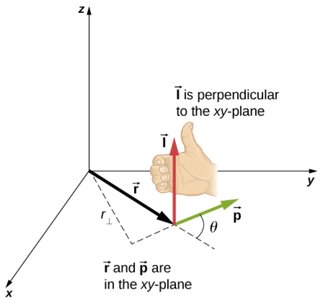
Angular momentum is a fundamental concept in rotational dynamics, describing the rotational analog of linear momentum for a particle or system. For a single particle, angular momentum \( \vec{L} \) is defined as the cross product of the position vector \( \vec{r} \) and the linear momentum \( \vec{p} \):
Definition: \( \vec{L} = \vec{r} \times \vec{p} \)
Direction: Determined by the right-hand rule; perpendicular to the plane formed by \( \vec{r} \) and \( \vec{p} \).
Units: kg·m2/s
Physical Meaning: Measures the tendency of a particle to rotate about a point or axis.
Example: A meteor entering Earth's atmosphere with given position and momentum vectors. The angular momentum about the origin can be calculated using the cross product.

Net Torque and the Rate of Change of Angular Momentum
The net external torque acting on a particle or system is equal to the time rate of change of its angular momentum. This is the rotational analog of Newton's second law:
Equation:
Interpretation: If the net external torque is zero, angular momentum is conserved.
Example: Calculating the torque on a meteor as it moves through the atmosphere.
Angular Momentum of a Rigid Body
For a rigid body rotating about a fixed axis, the angular momentum depends on the moment of inertia and angular velocity:
Equation:
Moment of Inertia (I): Quantifies the distribution of mass relative to the axis of rotation.
Direction: Along the axis of rotation, following the right-hand rule.
Example: A rotating disk or flywheel, where each mass segment contributes to the total angular momentum.

Conservation of Angular Momentum
Angular momentum is conserved in a system with no net external torque. This principle is crucial in analyzing rotational collisions and isolated systems:
Conservation Law:
For a system:
Application: Figure skaters spin faster by pulling in their arms, reducing their moment of inertia and increasing angular velocity to conserve angular momentum.
Equation for changing moment of inertia:


Example: Coupled Flywheels
When two flywheels are coupled, the law of conservation of angular momentum can be used to determine the final angular velocity:
Given: One flywheel at rest, the other rotating; moments of inertia differ.
Find: Final angular velocity after coupling.

Example: Collision and Angular Momentum
When a bullet embeds itself in a rotating disk, the conservation of angular momentum allows calculation of the disk's angular velocity immediately after the collision:
Given: Bullet mass and speed, disk mass and radius.
Find: Angular velocity after collision.

Static Equilibrium
Conditions for Static Equilibrium
Static equilibrium occurs when a rigid body is at rest and remains at rest under the action of all applied forces and torques. There are two main conditions:
First Equilibrium Condition (Translational): The vector sum of all external forces must be zero.
Equation:
Second Equilibrium Condition (Rotational): The vector sum of all external torques must be zero.
Equation:

Center of Gravity and Applications
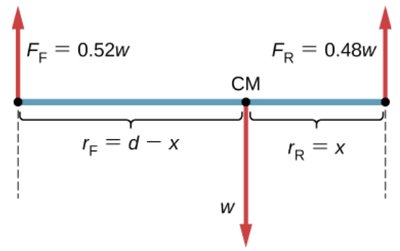
The center of gravity (CG) is the point where the total weight of a body is considered to act. In static equilibrium problems, the CG is used to analyze the distribution of forces and torques:
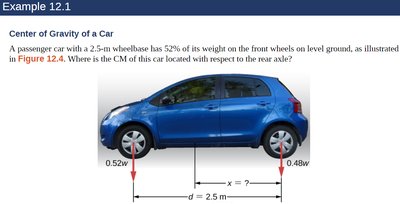
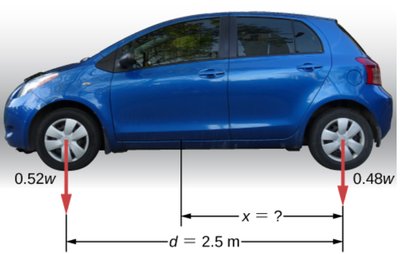
Application: Determining the location of the center of mass of a car based on the distribution of weight on its wheels.
Example: A car with a 2.5-m wheelbase has 52% of its weight on the front wheels and 48% on the rear wheels. The position of the CG can be found using the equilibrium conditions.
Condition | Equation | Physical Meaning |
|---|---|---|
Translational Equilibrium | No net force; no linear acceleration | |
Rotational Equilibrium | No net torque; no angular acceleration |
Additional info: In all examples, the principles of angular momentum and static equilibrium are applied to real-world systems, such as meteors, flywheels, and vehicles, to illustrate the importance of these concepts in physics and engineering.
