 Back
BackAngular Momentum and the Cross Product: Principles, Examples, and Applications
Study Guide - Smart Notes
 Tailored notes based on your materials, expanded with key definitions, examples, and context.
Angular Momentum
The Cross Product of Two Vectors
The cross product is a fundamental operation in vector algebra, essential for describing rotational quantities in physics. It produces a vector that is perpendicular to the plane formed by the two input vectors.
Definition: If u and v are vectors, their cross product is w = u \times v.
Direction: The resulting vector w is orthogonal to both u and v.
Right-Hand Rule: The direction of w is given by the right-hand rule: point your index finger along u, your middle finger along v, and your thumb points in the direction of w.
Anti-commutativity: u \times v = -v \times u.
Unit Vector Cross Products: Examples include \hat{x} \times \hat{y} = \hat{z}, \hat{y} \times \hat{z} = \hat{x}, \hat{z} \times \hat{x} = \hat{y}.
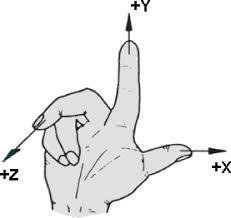
Cartesian Coordinates: For vectors u = (u_x, u_y, u_z) and v = (v_x, v_y, v_z):
The cross product is given by:
Cylindrical Coordinates: For vectors u = (u_r, u_\theta, u_z) and v = (v_r, v_\theta, v_z):
The cross product is:
Properties:
Linearity: for scalar .
Distributivity: .
The Moment (Torque)
The moment (or torque) of a force about a point describes the tendency of the force to cause rotation about that point.
Definition:
If lies on the action line of , then .
Both translation and rotation can result from a force, depending on its line of action.
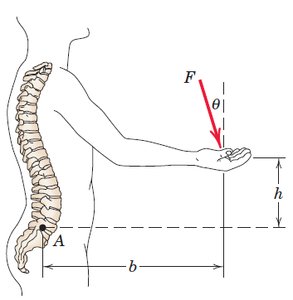
Example: Calculating the Moment
Given and , the moment about point A is:
Using the determinant formula:
Quantity of Motion (Linear Momentum)
Linear momentum is a measure of the motion of a particle and is defined as:
Kinetic energy:
Newton's Second Law
Newton's second law relates the time derivative of momentum to the net force:
Angular Momentum
Definition and Properties
Angular momentum is the rotational analog of linear momentum, describing the motion of a particle relative to a reference point.
Definition:
For a particle of mass and velocity :
is orthogonal to the plane formed by and .
Time Derivative and Principle
The time derivative of angular momentum is related to the moment of the net force:
Principle: The moment about point of all forces acting on equals the time rate of change of angular momentum of $P$ about $O$.
Vector equation:
Remarks
if (no rotation relative to ).
Central forces do not create a moment and thus do not affect angular momentum.
Application: Simple Pendulum
Equation of Motion Using Angular Momentum Principle
The simple pendulum consists of a mass at point , attached to a string of length and swinging under gravity. The angular momentum principle is used to derive its equation of motion.
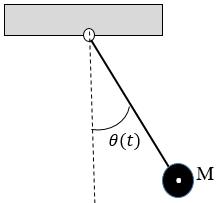
Kinematics
Position:
Velocity:
Momentum:
Angular momentum:
Time derivative:
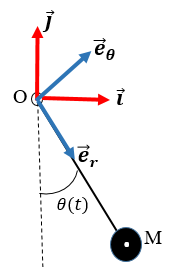
Forces and Moments
Tension: (central force, moment is zero)
Weight:
Moment of weight about :
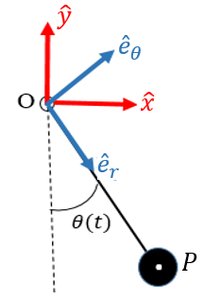
Principle of Angular Momentum and Equation of Motion
Applying the principle:
Since , the equation simplifies to:
Equation of motion:
Example: The equation above governs the oscillatory motion of the pendulum, and for small angles (), it reduces to simple harmonic motion.
