Back
BackAP Physics 1 Rotational Motion & Torque Review – Step-by-Step Study Guidance
Study Guide - Smart Notes
 Tailored notes based on your materials, expanded with key definitions, examples, and context.
Q1. An ice skater is spinning on frictionless ice with her arms spread outward from her body. Her initial rotational velocity is ω. The skater then moves her arms inward toward her body. How does the final rotational velocity and rotational inertia of the skater compare to the initial values?
Background
Topic: Conservation of Angular Momentum
This question tests your understanding of how rotational inertia and angular velocity change when the distribution of mass changes, and how angular momentum is conserved in the absence of external torques.
Key Terms and Formulas
Rotational inertia (moment of inertia),
Angular velocity,
Angular momentum,
Conservation of angular momentum: (if no external torque)
Step-by-Step Guidance
Recognize that the system is isolated (frictionless ice), so angular momentum is conserved.
When the skater pulls her arms in, her mass distribution changes, decreasing her rotational inertia .
Apply conservation of angular momentum: .
Since , must change to keep constant. Think about whether increases or decreases.
Try solving on your own before revealing the answer!
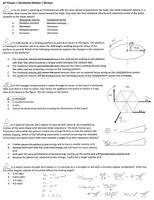
Q2. A child stands on a rotating platform at point A as shown in the figure. The platform is rotating at a constant rate of ω when the child begins walking along the radius of the platform to point B. Which of the following statements explains the changes in the rotational velocity of the platform?
Background
Topic: Conservation of Angular Momentum in Rotational Systems
This question examines how the movement of mass within a rotating system affects the system's angular velocity, and the role of external vs. internal forces.
Key Terms and Formulas
Rotational inertia () depends on mass distribution relative to the axis.
Angular velocity ()
Conservation of angular momentum:
External torque: Needed to change total angular momentum.
Step-by-Step Guidance
Identify whether any external torques act on the child-platform system.
As the child walks toward the center, their distance from the axis decreases, changing the system's rotational inertia.
Apply conservation of angular momentum to predict how changes as changes.
Consider whether the child’s movement along the radius produces a torque or not.
Try solving on your own before revealing the answer!
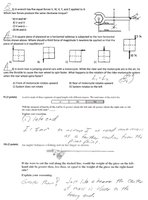
Q3. A thin hexagon-shaped board is nailed through its center to the top of a horizontal table such that it is free to rotate. Four forces are applied to the board as shown in a top view of the board in the figure. The net torque on the board is:
Background
Topic: Net Torque and Rotational Equilibrium
This question tests your ability to analyze forces and their lever arms to determine the net torque on a body.
Key Terms and Formulas
Torque:
Clockwise vs. counterclockwise torque
Net torque: Sum of all individual torques
Step-by-Step Guidance
Identify the direction (clockwise or counterclockwise) of each force’s torque about the center.
Calculate the magnitude of each torque using .
Add the torques, considering their directions, to find the net torque.
Determine if the net torque is zero, clockwise, or counterclockwise.
Try solving on your own before revealing the answer!
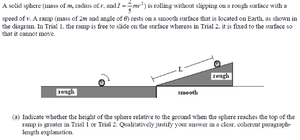
Q4. A block of mass m, and a sphere of mass m with radius R, are propelled up inclines of the same shape with identical initial velocities v. The block moves up a frictionless incline while the sphere’s incline has enough friction so that the sphere rolls without slipping. Which of the following statements is correct concerning the velocities of the block and sphere when both have traveled a height h up their respective inclines?
Background
Topic: Conservation of Energy with Translational and Rotational Motion
This question tests your understanding of how energy is distributed between translational and rotational forms for rolling objects, and how this affects their speed compared to sliding objects.
Key Terms and Formulas
Kinetic energy (translational):
Kinetic energy (rotational):
Potential energy:
Conservation of energy:
For rolling without slipping:
Step-by-Step Guidance
Write the energy conservation equation for both the block and the sphere as they move up the incline.
For the block (sliding, no rotation), all kinetic energy is translational.
For the sphere (rolling), kinetic energy is split between translational and rotational forms.
Set up the equations to compare the final velocities after both have risen to height .
Try solving on your own before revealing the answer!
Q5. A wheel rotates through 10.0 radians in 2.5 seconds as it is brought to rest with a constant angular acceleration. What was the initial angular velocity of the wheel before the braking began?
Background
Topic: Rotational Kinematics with Constant Angular Acceleration
This question tests your ability to use rotational kinematic equations to solve for initial angular velocity given angular displacement, time, and final angular velocity.
Key Terms and Formulas
Angular displacement: (in radians)
Initial angular velocity:
Final angular velocity: (here, 0 since it comes to rest)
Time:
Rotational kinematic equation:
Angular acceleration:
Step-by-Step Guidance
List the known values: rad, s, .
Write the kinematic equation for angular displacement: .
Write the equation for final angular velocity: .
Use these two equations to solve for (eliminate ).
Try solving on your own before revealing the answer!
Q6. A wrench has five equal forces V, W, X, Y, and Z applied to it. Which two forces produce the same clockwise torque?
Background
Topic: Torque and Lever Arm
This question tests your understanding of how torque depends on both the magnitude of the force and the perpendicular distance from the axis of rotation (lever arm).
Key Terms and Formulas
Torque:
Clockwise vs. counterclockwise torque
Lever arm: Perpendicular distance from axis to line of action of force
Step-by-Step Guidance
Identify the axis of rotation (the bolt at the end of the wrench).
For each force, determine the perpendicular distance to the axis and the angle at which the force is applied.
Calculate the torque for each force using .
Compare the torques to find which two are equal and act in the clockwise direction.
Try solving on your own before revealing the answer!