 Back
AP Physics C Mechanics: Dynamics, Forces, Friction, Equilibrium, and Springs
Study Guide - Smart Notes
 Tailored notes based on your materials, expanded with key definitions, examples, and context.
Newton's Laws of Motion
Newton's First Law: Law of Inertia
Newton's First Law states that an object will maintain its velocity (both speed and direction) unless acted upon by a nonzero net force. This principle is also known as the Law of Inertia. Inertia is the tendency of an object to resist any change in motion.
Inertia: The resistance of any physical object to a change in its state of motion or rest.
Inertial Reference Frame: A frame of reference that is not accelerating or rotating. Newton's laws are valid only in such frames.
Example: A drink in a car appears to move backward when the car accelerates forward, illustrating non-inertial reference frames.


Free Body Diagrams
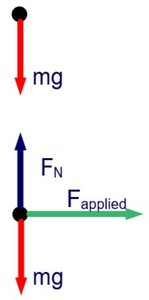
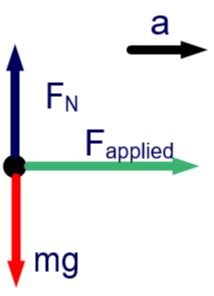
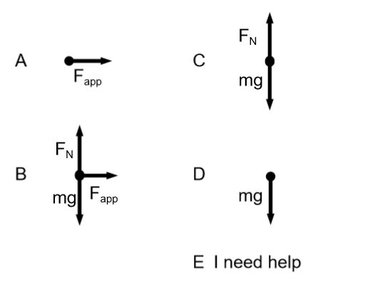
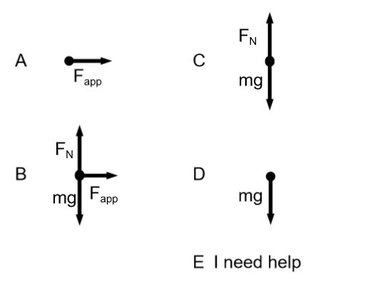
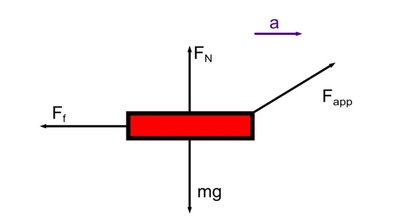
Free body diagrams are essential tools in physics for visualizing all the forces acting on an object. They help solve for unknown forces and predict motion.
Draw a dot for the object.
Draw arrows for each force, labeled and scaled according to magnitude.
Indicate the expected direction of acceleration.

Examples of Free Body Diagrams
Dropped object near Earth's surface: Only gravity acts downward.
Sled being pulled across icy pond: Gravity, normal force, and applied force.
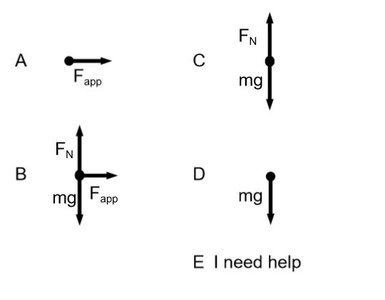
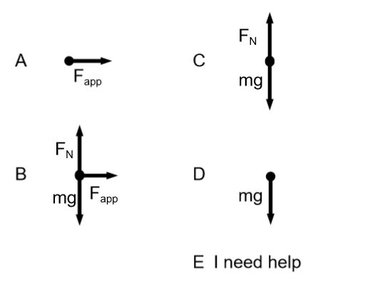
Cat sitting on a chair: Gravity and normal force.
Ball just after being kicked upwards: Gravity acts downward.
Newton's Second Law of Motion
Relationship Between Force, Mass, and Acceleration
Newton's Second Law quantifies how an object responds to a net force:
Formula:
Units: Force is measured in Newtons (N), where
Acceleration: Directly proportional to net force, inversely proportional to mass.


Example Calculations
Finding Net Force:
Finding Acceleration:
Finding Mass:
Newton's Third Law of Motion
Action-Reaction Pairs
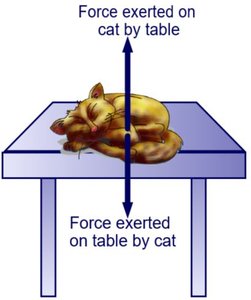
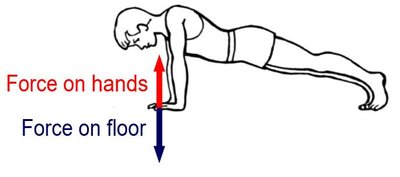
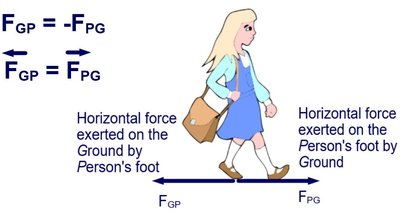
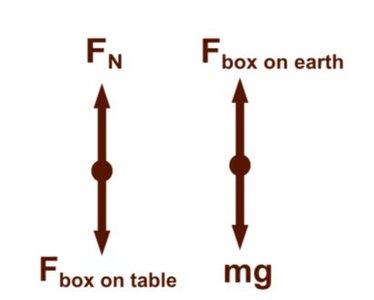
Whenever one object exerts a force on another, the second object exerts an equal and opposite force on the first. These forces act on different objects and do not cancel each other.
Action-Reaction Pair: Forces are equal in magnitude and opposite in direction.
Example: A cat sitting on a table: the table pushes up on the cat, and the cat pushes down on the table.


Normal Force and Weight
Normal Force
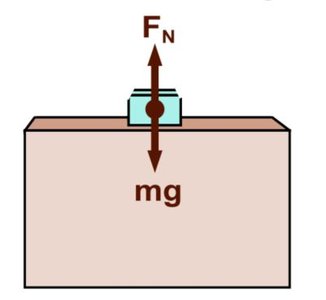
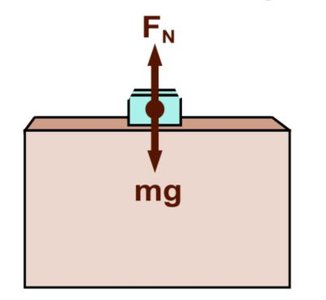
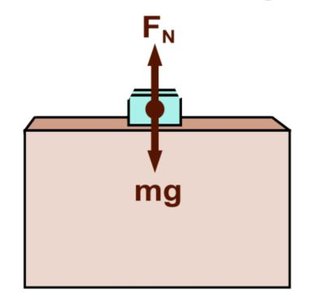
The normal force () is the perpendicular force exerted by a surface to support the weight of an object resting on it. It is a consequence of Newton's Third Law.
Formula: (on a flat surface, no acceleration)
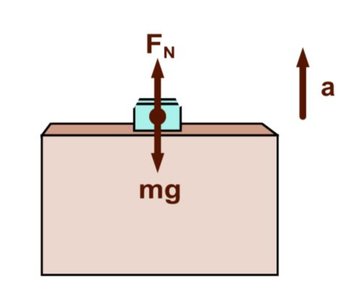
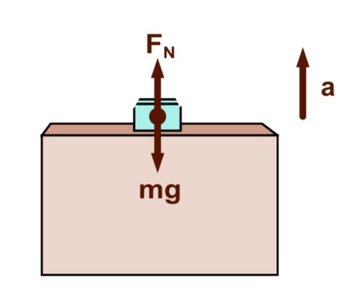
Apparent Weight: If the surface accelerates upward, increases.
Tension Force
Tension in Cords and Ropes
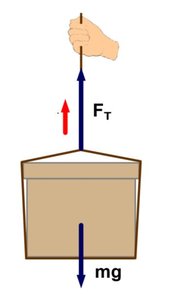
Tension is the force exerted by a rope or cord when it pulls on an object. If the object is stationary or moving at constant velocity, tension equals the weight.
Formula: (stationary or constant velocity)
With acceleration: (if accelerating upward)
Friction
Types of Friction
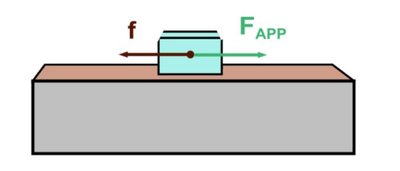
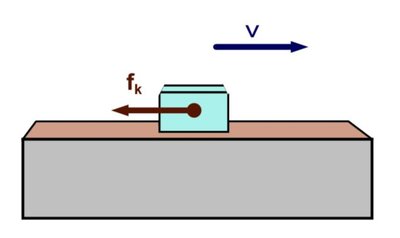
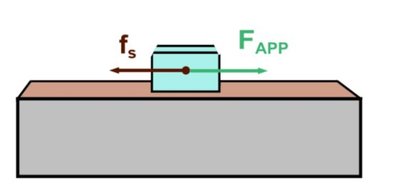
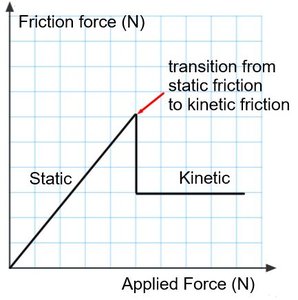
Friction opposes motion and comes in two forms:
Static Friction (): Prevents motion of stationary objects.
Kinetic Friction (): Opposes motion of moving objects.
Coefficients: (static), (kinetic);
Resolving Forces into Two Dimensions
Vector Components
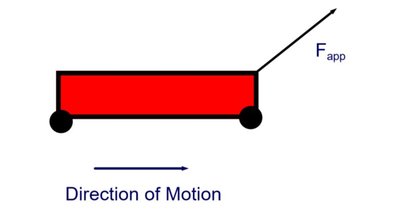
Forces acting at angles must be resolved into perpendicular components (usually x and y axes) using trigonometry:
Horizontal component:
Vertical component:


The Inclined Plane
Forces on an Inclined Plane
When an object is on an inclined plane, the axes are rotated to align with the surface. The gravitational force is resolved into components parallel and perpendicular to the incline:
Parallel to incline:
Perpendicular to incline:
Normal force:
Acceleration (frictionless):
With kinetic friction:
Static Equilibrium
Conditions for Equilibrium
Static equilibrium occurs when the net force and net torque on an object are zero. This ensures the object remains at rest.
Linear equilibrium:
Rotational equilibrium: (covered in rotational motion)
Forces and Springs (Hooke's Law)
Hooke's Law
Hooke's Law describes the force exerted by a spring:
Formula:
k: Spring constant (N/m)
x: Displacement from equilibrium
For springs in parallel: For springs in series:
Center of Mass
Definition and Calculation
The center of mass is the weighted average position of all the mass in a system. It determines how the system moves under external forces.
Position:
Velocity:
Momentum:
Example: The center of mass of a wire bent into a shape can be calculated using the above formulas.
*Additional info: The notes cover all major aspects of AP Physics C Mechanics Dynamics, including Newton's Laws, forces, friction, equilibrium, springs, and center of mass, with relevant images included only where they directly reinforce the explanation.*
