 Back
BackApplications of Newton's Laws: Equilibrium, Friction, and Elastic Forces
Study Guide - Smart Notes
 Tailored notes based on your materials, expanded with key definitions, examples, and context.
Chapter 5: Applications of Newton's Laws
Goals for Chapter 5
This chapter focuses on practical applications of Newton's Laws of Motion, emphasizing equilibrium, friction, and elastic forces. Students will learn to draw free-body diagrams, solve for unknowns using Newton's Second Law, analyze frictional forces, and apply Hooke's Law to springs.
Free-body diagrams: Visual representations of all forces acting on an object.
Newton's Second Law: Used to solve for unknown forces or accelerations.
Friction: Relationship between frictional force and normal force.
Hooke's Law: Describes the force exerted by a spring.
Equilibrium of Particles
Conditions for Equilibrium
An object is in equilibrium when the net force acting on it is zero. This can occur whether the object is at rest or moving with constant velocity.
Mathematical condition:
Component form: ,
Physical interpretation: No acceleration; object remains at rest or moves at constant speed.
Equilibrium in One Dimension
In one-dimensional equilibrium, forces are considered along a single axis. Example problems often involve objects suspended or supported vertically.
Key steps: Identify all forces, set up equations, solve for unknowns.
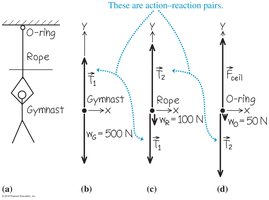
Two-Dimensional Equilibrium
For objects in two-dimensional equilibrium, forces must be resolved into x and y components. Both axes are analyzed separately.
Key steps: Draw free-body diagrams, resolve forces, apply equilibrium conditions to each axis.
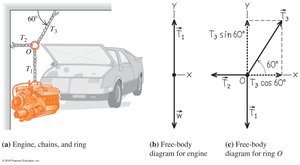
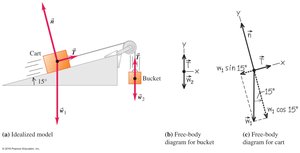
Complex Equilibrium: Multiple Systems
Problems may involve multiple connected objects, each with its own free-body diagram. The axes for each object may differ depending on orientation.
Example: Cart and bucket system moving at constant speed.
Important: Axes for different objects may not align.
Applications of Newton's Second Law: Non-Equilibrium
Dynamic Problems
When objects are accelerating, Newton's Second Law () is used to solve for unknowns. The direction of acceleration affects the orientation of forces.
Example: Accelerating cart causes liquid surface to slant.
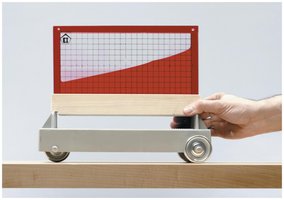
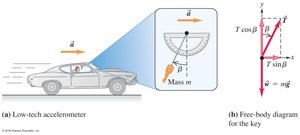
Low-Tech Accelerometer Example
Everyday applications, such as a car accelerating, can be analyzed using Newton's Second Law. A simple accelerometer demonstrates the effect of acceleration on suspended masses.
Key points: Forces resolved along axes, tension and gravity considered.
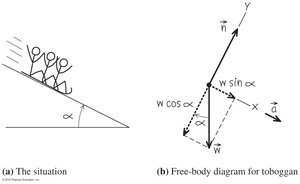
Sled and Toboggan Examples
Objects moving on inclined planes require resolving forces parallel and perpendicular to the surface. Friction and acceleration are considered.
Constant speed: Net force is zero; equilibrium.
Changing speed: Net force is nonzero; use Newton's Second Law.
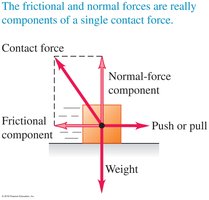
Contact Force and Friction
Nature of Friction
Friction arises from contact between surfaces. It opposes relative motion and depends on the normal force and the nature of the surfaces.
Kinetic friction: Acts when objects are sliding.
Static friction: Acts when there is no relative motion.
Formula: ,
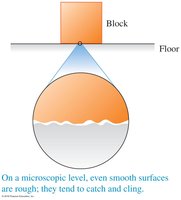
Microscopic View of Friction
Even smooth surfaces are rough at the microscopic level, leading to friction. The coefficient of friction () quantifies the interaction.
Key point: Surface imperfections cause catching and clinging.
No Dependence on Surface Area
The frictional force does not depend on the contact area, but rather on the normal force.
Normal force: The perpendicular force exerted by a surface.
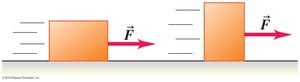
Friction Changes as Forces Change
Static friction increases with applied force up to a maximum value, after which kinetic friction takes over and remains relatively constant.
Static friction:
Kinetic friction:
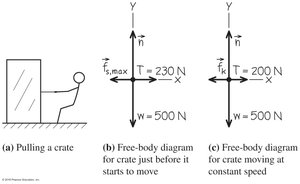
Effort to Move a Crate
When moving a crate, the force required to overcome static friction is greater than the force needed to maintain constant speed (kinetic friction).
Free-body diagrams: Show forces before and after motion begins.
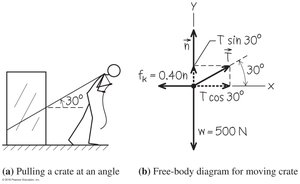
Forces Applied at an Angle
When a force is applied at an angle, it must be resolved into horizontal and vertical components. This affects the normal force and friction.
Key point: Vertical component reduces normal force, thus reducing friction.
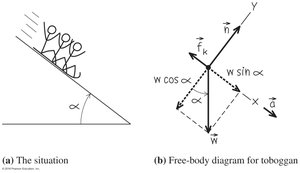
Toboggan on a Steep Hill with Friction
Analyzing motion on an incline with friction involves resolving forces and considering both normal and frictional components.
Constant speed: Forces balance; friction opposes motion.
Forces in Fluids
Drag Force and Terminal Velocity
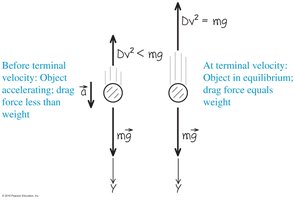
Objects moving through fluids experience drag, which increases with speed. At terminal velocity, drag force equals the object's weight, resulting in equilibrium.
Before terminal velocity:
At terminal velocity:
Elastic Forces and Hooke's Law
Hooke's Law
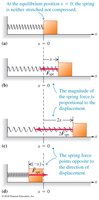
Springs and other elastic materials exert a force proportional to their displacement from equilibrium. Hooke's Law describes this relationship.
Formula:
k: Spring constant (N/m)
ΔL: Displacement from equilibrium (m)
Using Springs to Weigh Objects
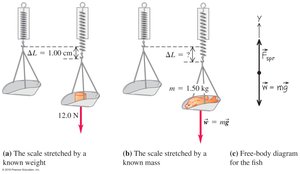
Spring scales are calibrated using known masses and forces. The force measured is proportional to the displacement of the spring.
Calibration: Scales may be marked in force (N) or mass (kg).
Variety of Force Laws in Nature
Fundamental Interactions
Physics recognizes four fundamental force laws: gravitational, electromagnetic, strong, and weak interactions. The search for a unified field theory aims to explain all forces under a single framework.
Gravitational: Attraction between masses.
Electromagnetic: Forces between charged particles.
Strong interaction: Holds atomic nuclei together.
Weak interaction: Responsible for radioactive decay.
Additional info: Unified field theory remains a major goal in modern physics, seeking to unify all fundamental forces.
