 Back
BackApplications of Newton’s Laws: Equilibrium, Tension, and Apparent Weight
Study Guide - Smart Notes
 Tailored notes based on your materials, expanded with key definitions, examples, and context.
Applications of Newton’s Laws of Motion
Equilibrium and Non-Equilibrium Problems
Newton’s Laws of Motion are fundamental for analyzing the forces acting on objects and predicting their motion. In equilibrium problems, the net force on an object is zero, resulting in no acceleration. In non-equilibrium problems, the net force is nonzero, causing acceleration according to Newton’s Second Law.
Equilibrium Condition: An object is in equilibrium if the vector sum of all forces acting on it is zero:
Non-Equilibrium: If , the object accelerates:
Free-Body Diagrams: Drawing all forces acting on an object helps in setting up equations for equilibrium or motion.
Example: Tension in Cables at an Angle
Consider a wrecking ball of mass suspended by two cables. One cable (B) makes an angle with the vertical. The goal is to find the tension in cable B.
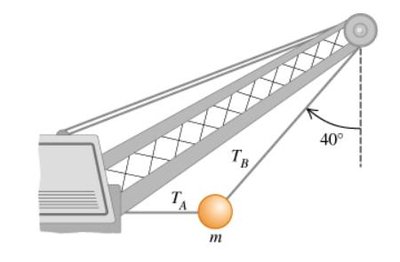
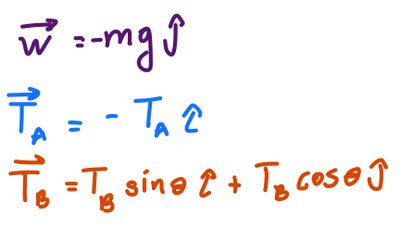
Step 1: Draw the Free-Body Diagram Forces acting on the ball:
Weight: (downward)
Tension in cable A: (horizontal)
Tension in cable B: (at to vertical)
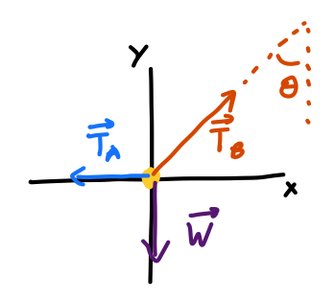
Step 2: Resolve Forces into Components
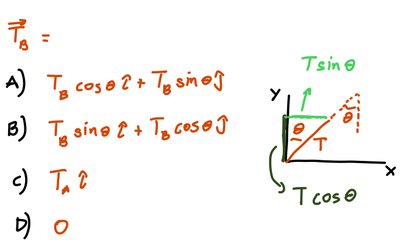
Step 3: Apply Equilibrium Conditions
Horizontal ():
Vertical ():
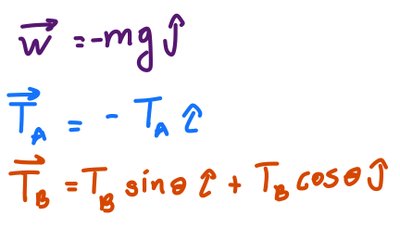
Step 4: Solve for Tension
From the -component:
Therefore,
Plug in values:
Step 5: Solve for Tension
From the -component:
Example Application: This type of analysis is common in engineering, construction, and physics labs where forces in cables, beams, or supports must be determined for safety and design.
Weight, Apparent Weight, and the Bathroom Scale
Definitions and Concepts
The weight of an object is the gravitational force exerted on it by the Earth (or another celestial body). The apparent weight is the normal force exerted by a surface (such as a scale) on the object, which can differ from the true weight if the object is accelerating.
Weight: (measured in newtons, N)
Apparent Weight: The normal force measured by a scale. If the object is accelerating vertically, .
Bathroom Scale: Measures the normal force, not the true gravitational weight.
Example: Apparent Weight in an Accelerating Elevator
A 550 N student stands on a scale in an elevator (total mass with elevator: 850 kg). When the elevator starts moving, the scale reads 450 N. Find the acceleration of the elevator (magnitude and direction).
Step 1: Free-Body Diagram Forces on the student:
Weight: (downward)
Normal force: (upward, what the scale reads)
Step 2: Apply Newton’s Second Law
Step 3: Calculate Mass
Step 4: Substitute Values The negative sign indicates acceleration is downward.
Interpretation: If the scale reads less than the true weight, the elevator is accelerating downward. If it reads more, the elevator is accelerating upward. If the scale reads zero, the student is in free fall.
Summary Table: Apparent Weight in an Elevator
Scale Reading | Elevator Acceleration | Direction |
|---|---|---|
Greater than | Upward | Up |
Equal to | Zero (at rest or constant speed) | None |
Less than | Downward | Down |
Zero | Free fall | Down |
Additional info:
These concepts are foundational for understanding forces in mechanical systems, engineering, and everyday phenomena such as amusement park rides and elevators.
Mastery of free-body diagrams and equilibrium equations is essential for solving a wide range of physics problems.
