 Back
BackApplying Bernoulli’s Principle and Fluid Dynamics to a U-Tube Manometer
Study Guide - Smart Notes
 Tailored notes based on your materials, expanded with key definitions, examples, and context.
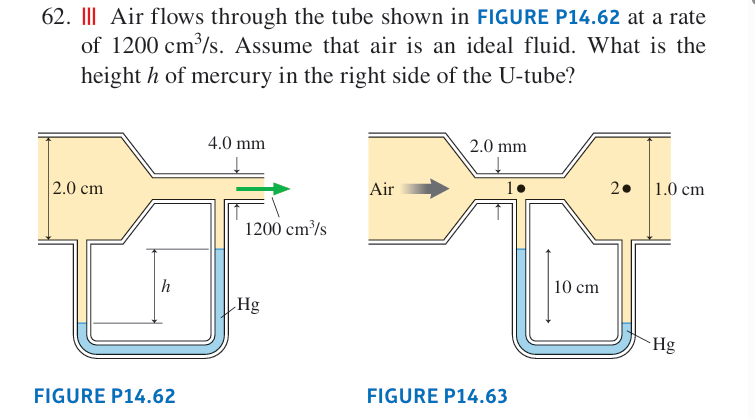
Q62. Air flows through the tube shown in FIGURE P14.62 at a rate of 1200 cm3/s. Assume that air is an ideal fluid. What is the height h of mercury in the right side of the U-tube?
Background
Topic: Fluid Dynamics & Bernoulli’s Principle
This question tests your understanding of how fluid flow affects pressure differences, and how those differences are measured using a U-tube manometer. You’ll need to relate the velocity of air in the tube to the pressure difference that causes the mercury to rise.
Key Terms and Formulas
Bernoulli’s Equation:
= pressures at two points in the tube
= velocities at two points
= density of air
Manometer Pressure Difference:
= density of mercury
= acceleration due to gravity
= height difference in mercury
Continuity Equation:
= cross-sectional areas at two points
= velocities at two points
Step-by-Step Guidance
First, identify the cross-sectional area at the narrow part of the tube (4.0 mm diameter). Convert this to centimeters: .
Calculate the velocity of air in the narrow section using the volumetric flow rate: , where and .
Apply Bernoulli’s equation between the wide and narrow sections of the tube to relate the pressure difference to the change in velocity.
Set the pressure difference equal to the manometer reading: .
Try solving on your own before revealing the answer!
Final Answer: h = 1.8 cm
This result shows the height difference in mercury due to the pressure drop caused by the increased velocity in the narrow section of the tube.
