 Back
BackApplying Conservation of Charge to Junctions in a Circuit
Study Guide - Smart Notes
 Tailored notes based on your materials, expanded with key definitions, examples, and context.
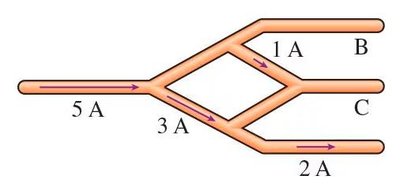
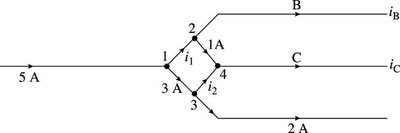
Q: What are the magnitudes and directions of the currents and in segments B and C?
Background
Topic: Conservation of Charge in Electric Circuits
This question tests your understanding of how electric current splits and combines at junctions in a circuit, using the principle that charge is conserved (Kirchhoff's Current Law).
Key Terms and Formulas
Current (): The flow of electric charge, measured in amperes (A).
Kirchhoff's Current Law (KCL): The sum of currents entering a junction equals the sum of currents leaving the junction.
Junction Equation:
Step-by-Step Guidance
Identify all the currents and their directions at each junction. Use the labeled diagram to help visualize the flow.
Apply Kirchhoff's Current Law at the first junction: splits into and another branch. Set up the equation for the unknown current :
At the next junction, splits into (segment B) and another branch. Set up the equation:
Continue to the lower branch: splits into and . Set up the equation:
At the final junction, and combine to form . Set up the equation:
Try solving on your own before revealing the answer!
Final Answer:
to the right, to the right.
By applying Kirchhoff's Current Law at each junction, you find the values and directions for the unknown currents.
