 Back
BackApplying Newton’s Laws: Equilibrium, Dynamics, and Friction
Study Guide - Smart Notes
 Tailored notes based on your materials, expanded with key definitions, examples, and context.
Forces and Newton’s Laws of Motion
Learning Outcomes
This chapter covers the application of Newton’s laws to solve problems involving equilibrium, dynamics, friction, circular motion, and the fundamental forces of nature. Students will learn to construct and analyze free-body diagrams, apply systematic problem-solving strategies, and understand the physical meaning of apparent weight and frictional forces.
Using Newton's First Law: Equilibrium of Forces
Definition of Equilibrium
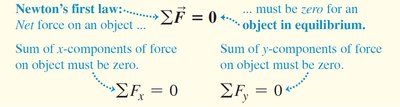
An object is in equilibrium when it is at rest or moving with constant velocity in an inertial frame of reference. According to Newton’s first law, the net force acting on an object in equilibrium is zero.
Equilibrium Condition: The vector sum of all forces on the object must be zero.
Component Form: The sum of the x-components and y-components of all forces must each be zero.
Mathematically, this is expressed as:
Problem-Solving Strategy for Equilibrium Situations
Identify the main concept: Use Newton’s first law.
Draw a sketch of the physical situation.
Draw a free-body diagram for each object in equilibrium.
Include only forces acting on the object (e.g., weight ).
Choose and indicate coordinate axes.
Find force components along each axis and set their sums to zero.
If multiple objects interact, use Newton’s third law to relate forces.
Solve the resulting equations for unknowns.
Using Newton’s Second Law: Dynamics of Particles
Newton’s Second Law and Accelerating Objects
When the net force on an object is not zero, the object accelerates in the direction of the net force. Newton’s second law relates the net force to the mass and acceleration of the object:
In component form:
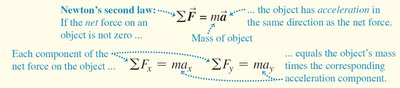
Key Point: The acceleration is in the same direction as the net force.
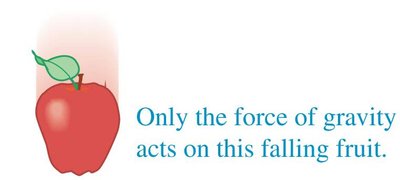
Example: A falling apple is acted on only by gravity, so its acceleration is downward.
Problem-Solving Strategy for Dynamics Situations
Identify the relevant concept: Use Newton’s second law.
Draw a sketch and a free-body diagram for each object.
Label all forces (e.g., weight, tension, normal force).
Choose coordinate axes and indicate them on the diagram.
Identify any additional equations (e.g., constraints from ropes or pulleys).
Write equations for each force component and solve for unknowns.
Free-Body Diagrams: Correct and Incorrect Practices
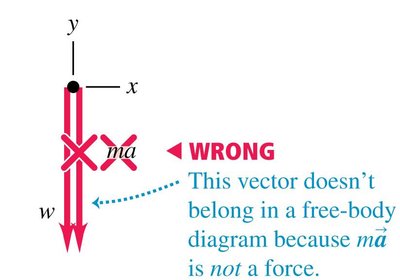
Correct: Only actual forces (e.g., weight, normal force, friction) should appear in a free-body diagram. The acceleration vector can be shown to the side for reference.
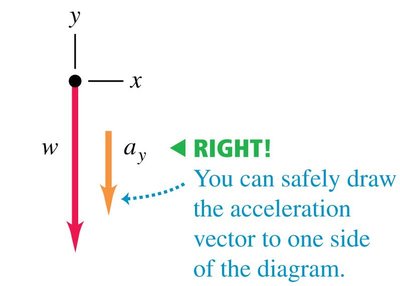
Incorrect: The vector (mass times acceleration) is not a force and should not be included in the free-body diagram.
Apparent Weight and Apparent Weightlessness
Definition and Examples
The apparent weight of an object is the normal force exerted by a surface (such as a scale) on the object. In an accelerating frame (e.g., an elevator), the apparent weight differs from the true weight:
If the elevator accelerates downward at , the apparent weight (weightlessness).
Astronauts in orbit experience apparent weightlessness because both they and their spacecraft are in free fall around Earth.

Frictional Forces
Nature and Importance of Friction
Friction is the force that opposes the relative motion or tendency of such motion of two surfaces in contact. It acts parallel to the surfaces. Friction is essential for locomotion, as seen in the movement of a caterpillar.

Friction enables walking, driving, and climbing.
Without friction, objects would slide uncontrollably.
Components of Contact Force
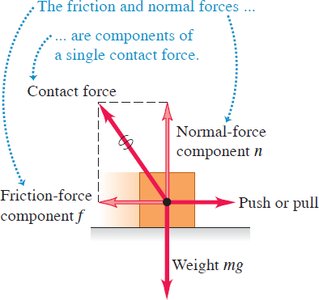
The contact force between two surfaces can be resolved into two perpendicular components:
Normal force (n): Perpendicular to the surface.
Friction force (f): Parallel to the surface.
Origin of Frictional Forces
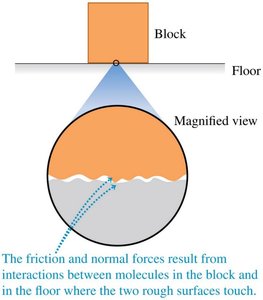
Friction arises from microscopic interactions between the molecules of the two surfaces in contact. The roughness of surfaces at the microscopic level leads to friction and normal forces.
Static friction: Prevents motion up to a maximum value.
Kinetic friction: Acts when surfaces slide past each other.
Example: The friction between a block and the floor is due to the microscopic roughness and molecular interactions at the contact points.
Summary Table: Key Equations and Concepts
Concept | Equation | Description |
|---|---|---|
Equilibrium (Newton’s 1st Law) | Object at rest or constant velocity | |
Dynamics (Newton’s 2nd Law) | Object accelerates in direction of net force | |
Apparent Weight | Normal force in accelerating frame | |
Friction Force | (static), (kinetic) | Opposes motion, depends on normal force |
