 Back
Applying Newton’s Laws: Equilibrium, Dynamics, Forces, and Interactions
Study Guide - Smart Notes
 Tailored notes based on your materials, expanded with key definitions, examples, and context.
Applying Newton’s Laws
Equilibrium
Equilibrium is a fundamental concept in Newtonian mechanics, describing situations where the net force acting on an object is zero. This can occur when an object is at rest (static equilibrium) or moving in a straight line at constant speed (dynamic equilibrium).
Static Equilibrium: Object at rest; net force is zero.
Dynamic Equilibrium: Object moves at constant velocity; net force is zero.
Component Form: For equilibrium in the x-y plane, both x- and y-components of the net force must be zero:
Example: An orangutan weighing 500 N hangs from a vertical rope. The tension in the rope equals the weight, as shown in the free-body diagram.
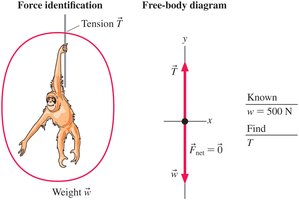
Key Forces: Tension (upward), Weight (downward)
Equation:
Conceptual Example: Forces in Static Equilibrium
When a rod is lifted by a string on a frictionless surface, the correct orientation of the string is vertical. Only then are all forces balanced and the net force is zero.
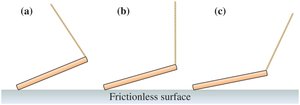
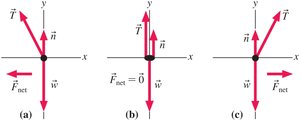
Forces: Tension (along string), Weight (down), Normal force (up, perpendicular to surface)
Correct Case: Only vertical string orientation (case b) achieves equilibrium.
Example: Tension in a Rope While Towing a Car
When towing a car at constant speed, the car is in dynamic equilibrium. The tension in the rope must balance the friction force and any vertical components due to the rope's angle.
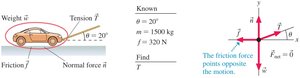
Key Forces: Tension, Weight, Normal force, Friction
Component Analysis: Resolve tension into horizontal and vertical components.
Equation: (horizontal), (vertical)
Example Problem: Tension in an Angled Rope
A ball weighing 50 N is pulled back by a rope at a 20° angle. The tension can be found by resolving forces and applying equilibrium conditions.
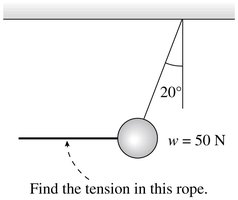
Equation:
Dynamics and Newton’s Second Law
Newton’s Second Law
Newton’s second law relates the net force acting on an object to its acceleration:
Component Form: ,
Problem-Solving Steps: Identify forces, draw free-body diagram, choose coordinate system, solve for acceleration or unknown forces.
Example: Putting a Golf Ball
A golf ball is putted with an initial speed and slowed by friction. Newton’s second law is used to find acceleration, then kinematics determines if the ball reaches the hole.
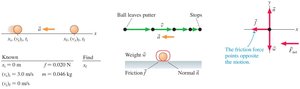
Equation:
Kinematics:
Normal Forces
Normal Force on a Pressed Book
The normal force is the perpendicular contact force exerted by a surface. It adjusts to balance the weight and any additional force applied.
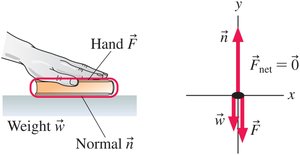
Equation: (where is the force from the hand)
Normal Forces on an Incline
On an inclined plane, the normal force is perpendicular to the surface, and the weight is decomposed into components parallel and perpendicular to the incline.
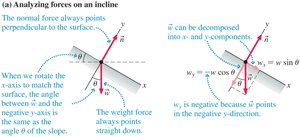
Weight Components: ,
Normal Force:
Mass and Weight
Mass vs. Weight
Mass is a measure of inertia; weight is the gravitational force on an object. Weight varies with location, mass does not.
Weight:
Apparent Weight
Apparent weight is the contact force felt, which can differ from actual weight when accelerating (e.g., in an elevator).
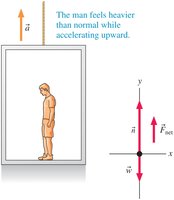
Equation: (for upward acceleration)
Weightlessness
Weightlessness occurs when there is no contact force (apparent weight is zero), such as in free fall.

Actual Weight: Still present, but not felt.
Friction
Static Friction
Static friction prevents relative motion between surfaces. It adjusts up to a maximum value:
Maximum Static Friction:
Direction: Opposes potential motion.
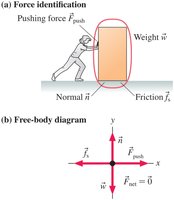
Kinetic Friction
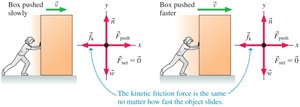
Kinetic friction acts when surfaces slide past each other, with a constant magnitude:
Kinetic Friction:
Speed Independence: does not depend on speed.
Drag Forces
Drag at High Reynolds Number
For objects moving quickly through a fluid, drag force is proportional to the square of speed:
Equation:
Variables: (drag coefficient), (fluid density), (cross-sectional area), (speed)
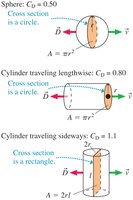
Terminal Speed Example
Terminal speed is reached when drag force equals gravitational force. For a skydiver and a mouse, terminal speed depends on mass, area, and drag coefficient.
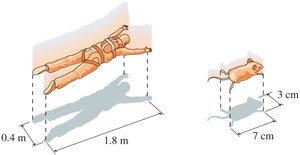
Equation:
Interacting Objects and Newton’s Third Law
Newton’s Third Law
Every force is part of an action/reaction pair, acting on different objects, equal in magnitude and opposite in direction.
Equation:
Example: Pushing Two Blocks
When two blocks are in contact and pushed together, the force one exerts on the other forms an action/reaction pair. Their accelerations are equal if they move together.
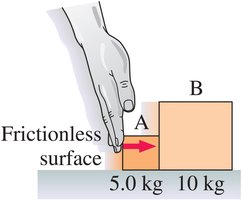
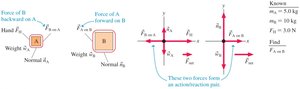
Key Point: Forces between blocks are equal and opposite.
Ropes and Pulleys
Ideal Pulley and Rope
For massless ropes and frictionless pulleys, tension is constant throughout the rope.
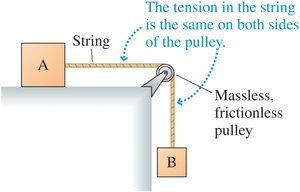
Key Point: Tension is the same on both sides of the pulley.
Example: Lifting a Stage Set
When two masses are connected by a rope over a pulley, their accelerations are related and the tension is the same for both.
Equation: (where is the set, is the man)
*Additional info: Academic context and equations have been expanded for clarity and completeness. Only images directly relevant to the explanation have been included.*
