 Back
BackApplying Newton’s Laws: Equilibrium, Dynamics, Friction, Circular Motion, and Fundamental Forces
Study Guide - Smart Notes
 Tailored notes based on your materials, expanded with key definitions, examples, and context.
Applying Newton’s Laws
Introduction
Newton’s three laws of motion form the foundation for understanding the behavior of objects under the influence of forces. This chapter focuses on applying these laws to solve problems involving equilibrium, dynamics, friction, circular motion, and the fundamental forces of nature. Analytical skills and systematic problem-solving strategies are essential for tackling real-life physics scenarios.
Using Newton's First Law: Equilibrium Situations
Definition and Principle
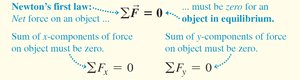
An object is in equilibrium when it is at rest or moving with constant velocity in an inertial frame of reference. Newton’s first law states that the net force on an object must be zero for equilibrium:
Sum of forces:
Sum of x-components:
Sum of y-components:
Problem-Solving Strategy for Equilibrium
Draw a sketch of the physical situation.
Draw a free-body diagram for each object in equilibrium.
Identify all forces acting on the object, including contact and non-contact forces.
Choose coordinate axes and include them in the diagram.
Find force components along each axis.
Set up equations: and .
Solve for unknowns using the equations.
Using Newton's Second Law: Dynamics of Particles
Definition and Principle
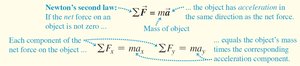
Newton’s second law applies to objects where the net force is not zero, resulting in acceleration. The law is expressed as:
Net force:
Component form: ,
Problem-Solving Strategy for Dynamics
Draw a sketch of the situation and free-body diagrams for each object.
Label all forces, including weight ().
Choose coordinate axes for each object.
Identify relationships among objects (e.g., ropes, pulleys).
Write equations for each force component using Newton’s second law.
Solve for target variables and evaluate the answer.
Free-Body Diagrams: Correct and Incorrect Practices
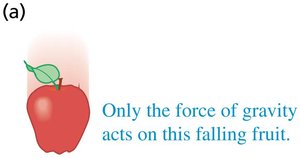
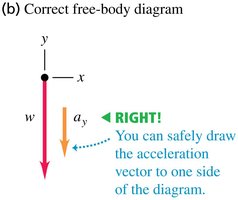
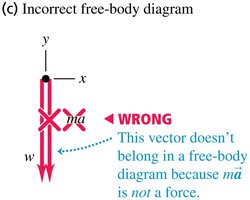
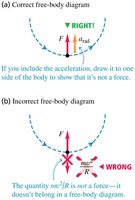
Only forces should be included in a free-body diagram.
Acceleration vectors may be shown to the side, but is not a force and should not be included as a force vector.
Apparent Weight and Apparent Weightlessness
Definition and Explanation
Apparent weight is the normal force measured by a scale, which can differ from true weight when an object is accelerating. In an elevator with vertical acceleration , the apparent weight is:
When (free fall), and the object appears weightless.
Astronauts in orbit experience apparent weightlessness due to continuous free fall around Earth.

Frictional Forces
Nature and Types of Friction
Friction is a force that opposes relative motion between surfaces in contact. It is essential for movement, as illustrated by a caterpillar climbing an apple.
Kinetic friction: Acts when objects slide over each other.
Static friction: Acts when there is no relative motion; can vary up to a maximum value.

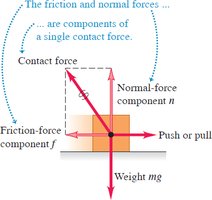
Friction Force Direction and Contact Forces
Friction force is always parallel to the surface.
Normal force is perpendicular to the surface.
Both are components of the contact force.
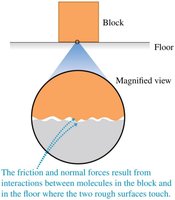
Molecular Origin of Friction
Friction arises from interactions between molecules at the surfaces.
Microscopic roughness and molecular bonds contribute to frictional resistance.
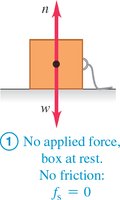
Static and Kinetic Friction: Sequence of Events
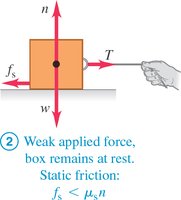
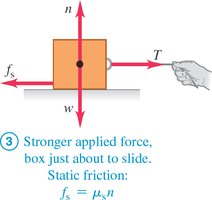
Before sliding, static friction acts ().
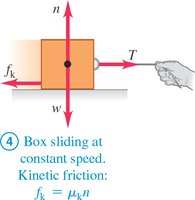
Once motion begins, kinetic friction () takes over.
Static friction increases with applied force up to its maximum ().
Kinetic friction is constant ().
Stick-Slip Phenomenon: Windshield Wipers
Stick-slip occurs when static friction alternates with kinetic friction.
Dry glass increases friction, causing wipers to stick and squeak.
Wet glass reduces friction, allowing smooth motion.

Fluid Resistance and Terminal Speed
Definition and Effects
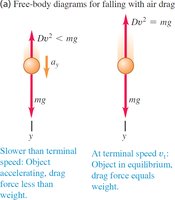
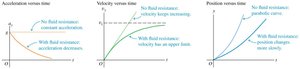
Fluid resistance (drag) opposes the motion of objects through fluids. As speed increases, drag force increases until it equals the weight, resulting in terminal speed.
At terminal speed, net force is zero and object moves at constant velocity.
Free-body diagrams illustrate forces at different speeds.
Graphs of Motion with Fluid Resistance
Acceleration decreases over time with fluid resistance.
Velocity approaches a limiting value (terminal speed).
Position increases more slowly compared to motion without resistance.
Dynamics of Circular Motion
Uniform Circular Motion
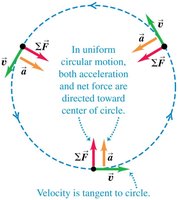
In uniform circular motion, both acceleration and net force are directed toward the center of the circle (centripetal direction). The net force is:
Velocity is tangent to the circle; acceleration points inward.
Free-Body Diagrams in Circular Motion
Correct diagrams show only forces; acceleration vectors may be shown separately.
Do not include 'centrifugal force' in inertial frames; it is not a real force.
Banked Curves
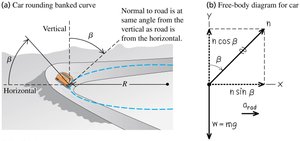
Banked curves allow cars to turn without relying on friction.
The angle of banking is determined by the balance of forces.
The Fundamental Forces of Nature
Overview
All forces in nature are manifestations of four fundamental interactions:
Gravitational interaction
Electromagnetic interaction
Strong interaction
Weak interaction
Physicists aim to unify these forces into a comprehensive theory of everything.
Summary Table: Types of Friction
Type | Condition | Formula |
|---|---|---|
Static Friction | No relative motion | |
Kinetic Friction | Sliding motion |
Summary Table: Fundamental Forces
Force | Relative Strength | Range | Examples |
|---|---|---|---|
Gravitational | Weakest | Infinite | Planetary motion |
Electromagnetic | Strong | Infinite | Electricity, magnetism |
Strong | Strongest | Short (atomic scale) | Nuclear binding |
Weak | Weak | Short (subatomic) | Radioactive decay |
