 Back
BackApplying Newton's Laws: Forces, Friction, and Circular Motion
Study Guide - Smart Notes
 Tailored notes based on your materials, expanded with key definitions, examples, and context.
Applying Newton's Laws
Equilibrium
Equilibrium occurs when all forces acting on an object balance out, resulting in no acceleration. This does not necessarily mean the object is stationary; it may be moving at constant velocity.
Definition: An object is in equilibrium if .
Key Point: Equilibrium implies , not necessarily .
Example: A box pulled by two equal forces at constant speed has zero acceleration.
Free-Body Diagrams (FBD) and Force Analysis
To solve force problems, always start by drawing a Free-Body Diagram (FBD) and identifying all forces acting on the object.
Common Forces: Weight (W), Applied Force (FA), Tension (T), Normal Force (N), Friction (f).
Procedure:
Draw FBD.
Write .
Solve for unknowns.
The Normal Force
The normal force is the force exerted by a surface perpendicular to the object. It is calculated using force balance equations, not a direct formula.
Definition: The normal force () is always perpendicular to the surface.
Calculation: Use to solve for .
Example: A book resting on a table: if no other vertical forces.
2D Forces in the Horizontal and Vertical Planes
When forces act in two dimensions, decompose each force into its x and y components. The net force is calculated by summing these components.
Decomposition: , .
Procedure:
Draw FBD.
Decompose forces.
Write and .
Solve for acceleration and other unknowns.
Inclined Planes
On inclined planes, tilt the coordinate axes to align with the slope. Decompose the weight into components parallel and perpendicular to the incline.
Component Formulas:
(parallel to incline)
(perpendicular to incline)
Acceleration: if no other forces.
Kinetic and Static Friction
Friction opposes motion between surfaces. Kinetic friction acts when objects are moving, static friction acts when objects are at rest.
Kinetic Friction:
Static Friction:
Threshold: is the maximum static friction before motion starts.
Comparison: ; it is harder to start moving than to keep moving.
Stacked and Connected Objects
When objects are stacked or connected, analyze each object separately, considering friction and tension forces. Connected objects share the same acceleration.
Procedure:
Draw FBDs for all objects.
Determine friction type (static or kinetic).
Write for each object.
Solve using substitution or addition.
Inclined Planes with Friction
For objects on inclined planes with friction, compare the net force along the axis of motion to the maximum static friction to determine if the object moves.
Critical Angles:
Centripetal Forces and Circular Motion
Circular motion requires a net force directed toward the center, called the centripetal force. The acceleration is given by .
Key Formulas:
Flat Curve:
Banked Curve:
Vertical Circular Motion: Forces change direction and magnitude depending on position in the loop.
Flat and Banked Curves
On flat curves, static friction provides the centripetal force. On banked curves, the normal force's horizontal component provides the centripetal force.
Flat Curve Formula:
Banked Curve Formula:
Vertical Centripetal Forces
In vertical circular motion, gravity affects the centripetal force, causing speed and normal force to vary at different points in the loop.
At the bottom:
At the top:
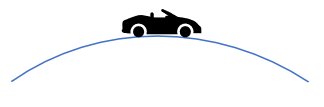
Example: A car passing over a bump experiences a normal force from the road that depends on its speed and the radius of the bump.
Summary Table: Friction Types
Type | Formula | When Used |
|---|---|---|
Kinetic Friction | Object is moving | |
Static Friction | Object is at rest |
Additional info: All equations are provided in LaTeX format for clarity. The study notes expand on brief points with academic context and examples, suitable for exam preparation.
