 Back
BackApplying Newton's Laws: Friction, Interacting Objects, Ropes, and Pulleys
Study Guide - Smart Notes
 Tailored notes based on your materials, expanded with key definitions, examples, and context.
Applying Newton's Laws
Friction and Motion on Inclines
Friction is a resistive force that opposes the relative motion of two surfaces in contact. When analyzing objects on inclined planes, both the gravitational force and frictional force must be considered to determine the object's acceleration.
Kinetic Friction: The force that opposes the motion of a sliding object. It is given by , where is the coefficient of kinetic friction and is the normal force.
Static Friction: The force that prevents an object from starting to move. It is given by , where is the coefficient of static friction.
Inclined Plane Example: For a 32-kg penguin sliding down a 30° incline with , the acceleration is found by resolving forces parallel and perpendicular to the incline and applying Newton's second law.
Equation for Acceleration:
Application: This method is used to analyze the motion of objects on ramps, slides, or hills.
Friction and Maximum Acceleration
When an object is placed on a moving surface, such as a crate on a truck, friction determines whether the object will move relative to the surface.
Maximum Static Friction:
Maximum Acceleration: The maximum acceleration before slipping occurs is
Example: For a 20.0-kg crate with ,
Friction Against Vertical Surfaces
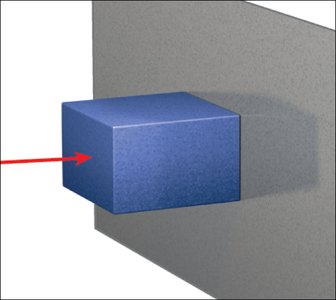
When a block is pressed against a vertical wall, friction can prevent it from sliding down. The normal force is provided by the push, and friction opposes gravity.
Static Friction Condition: The block remains at rest if , where is the weight.
Calculation: , with being the force pushing the block against the wall.
Example: For a 33 N block pushed with 55 N, N. Since , the block will slip.
Acceleration Down the Wall: Once sliding, , where .
Interacting Objects
Newton's Third Law and Action-Reaction Pairs
Newton's third law states that every force occurs as one member of an action/reaction pair. These forces are equal in magnitude, opposite in direction, and act on different objects.
Action-Reaction Pair: If object A exerts a force on object B, then object B exerts an equal and opposite force on object A.
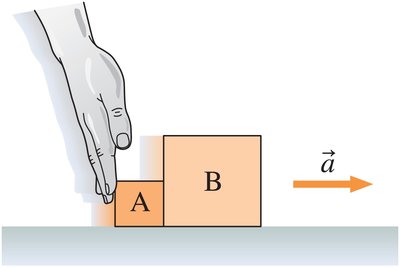
Application: When analyzing systems of interacting objects, such as two blocks in contact, their accelerations are linked.
Equation:
Free-Body Diagrams for Interacting Objects
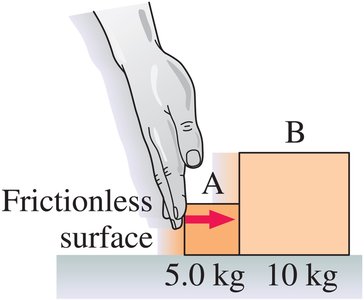
To analyze the motion of interacting objects, draw free-body diagrams for each object, identify all forces, and apply Newton's laws.
Same Acceleration: If blocks are in contact and move together, their accelerations are equal.
Example: For a 5.0 kg block A and a 10 kg block B pushed together, the force exerted by A on B is found by considering the total system and the forces between the blocks.
Ropes and Pulleys
Tension in Ropes
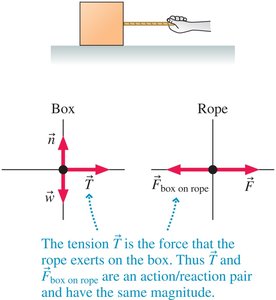
When a rope or string is used to pull an object, the force transmitted is called tension. For massless ropes, the tension is the same throughout the rope.
Tension Force: The force exerted by a rope on an object is equal in magnitude to the force pulling on the rope.
Action-Reaction Pair: The force the box exerts on the rope is equal and opposite to the force the rope exerts on the box.
Equation:
Tension in Massless Strings and Pulleys
For ideal (massless, frictionless) pulleys and ropes, the tension is transmitted undiminished from one end to the other, and is unaffected by passing over a pulley.
Massless Rope: Tension is the same at both ends.
Massless, Frictionless Pulley: Tension is unchanged by the pulley.
Equation:
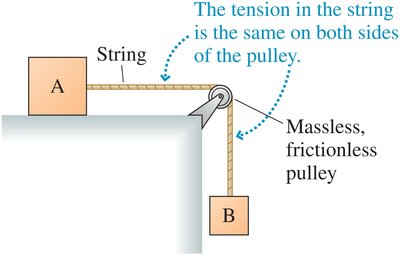
Comparing Tension Forces
When multiple objects are connected by ropes and pulled, the tension in each segment depends on the masses and the acceleration of the system.
Example: If two blocks are pulled to the right and one has a larger mass, the tension in the rope segment closer to the heavier block is greater.
Equation: (for each block, considering the forces acting on it)
Pulleys and Downward Acceleration
When a mass hangs from a rope over a pulley, the tension must be less than the weight for the mass to accelerate downward.
Condition: for downward acceleration.
Equation:
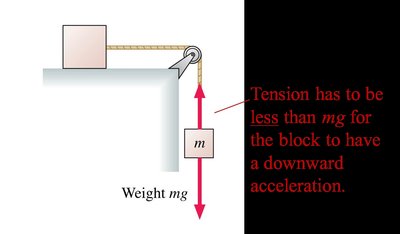
Complex Pulley Systems
In systems where two masses are connected by a rope over a pulley, such as a stage set and a stagehand, the acceleration of each mass can be found by applying Newton's laws to both masses and considering the tension in the rope.
Example: A 200 kg set and a 100 kg stagehand connected by a rope over a pulley. When the set falls, the stagehand is hoisted upward.
Equations:
For the set:
For the stagehand:
Solving for :
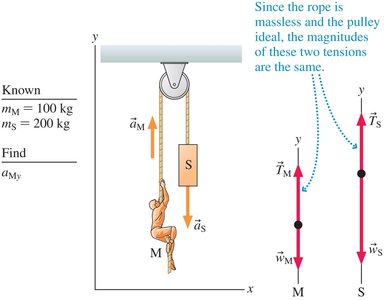
Summary Table: Properties of Friction and Tension
Property | Friction | Tension |
|---|---|---|
Force Formula |
| |
Direction | Opposes motion | Along rope, away from object |
Action-Reaction | Force pairs between surfaces | Force pairs between rope and object |
Effect of Pulley | Not applicable | Unchanged for ideal pulley |
Additional info: Academic context was added to clarify the application of Newton's laws to friction, interacting objects, and tension in ropes and pulleys, including relevant equations and examples for each scenario.
