 Back
BackApplying Newton’s Laws: Statics, Dynamics, Friction, and Circular Motion
Study Guide - Smart Notes
 Tailored notes based on your materials, expanded with key definitions, examples, and context.
Applying Newton’s Laws
Overview
This chapter focuses on the application of Newton’s laws of motion to a variety of physical situations, including equilibrium (statics), accelerating bodies (dynamics), frictional forces, fluid resistance, and circular motion. Mastery of these concepts is essential for solving real-world physics problems involving forces and motion.
Statics: Newton’s First Law and Equilibrium
Conditions for Equilibrium
Equilibrium occurs when a body is at rest or moves with constant velocity in an inertial frame of reference.
All forces acting on the body must sum to zero: .
Common forces include: normal force, friction, tension, contact forces, and weight (gravity).
Steps for Solving Equilibrium Problems
Visualize the situation and choose a coordinate system.
Draw a free-body diagram (FBD) showing all forces acting on the object.
Break forces into components along the chosen axes.
Apply Newton’s laws to each component: , .
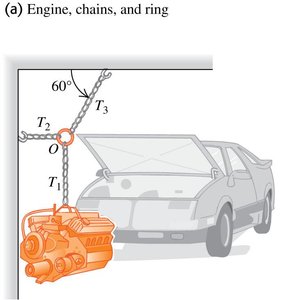
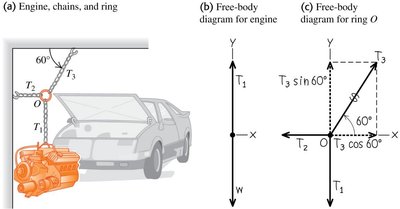
Worked Example: Engine Suspended by Chains
Given: Engine weight suspended by three chains at angles.
Solution involves resolving tensions and applying equilibrium conditions.
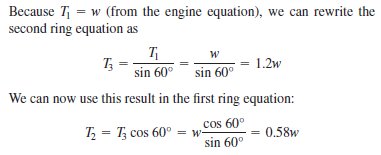
Worked Example: Car on a Ramp
Forces: weight , normal force , tension .
Weight is resolved into components parallel and perpendicular to the ramp.
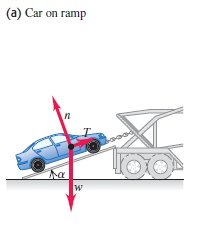
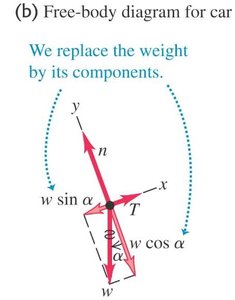
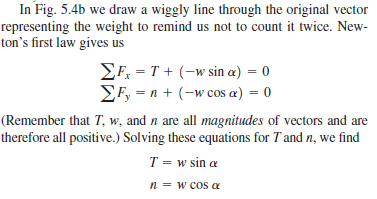
Equilibrium equations:
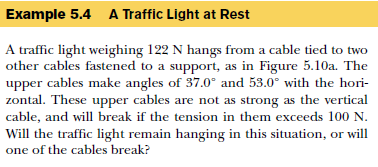
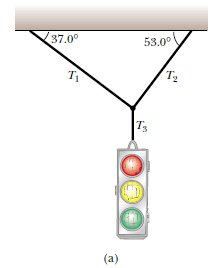
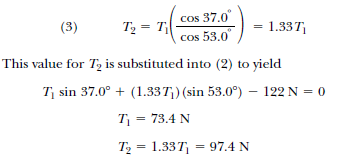
Worked Example: Traffic Light at Rest
Traffic light suspended by cables at angles; find tensions and check if cables will break.
Dynamics: Newton’s Second Law
Newton’s Second Law for Accelerating Bodies
When the net force on a body is not zero, it accelerates: .
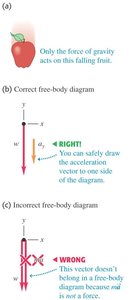
Free-body diagrams should include only real forces, not (which is the result of the net force).
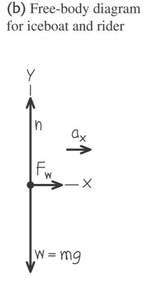
Worked Example: Iceboat on Frictionless Surface
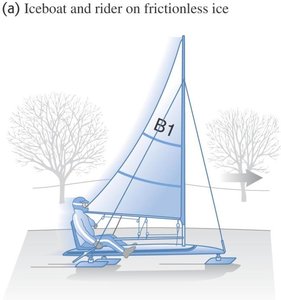
Given: Iceboat of mass 200 kg, wind force, and acceleration over time.
Find the force exerted by the wind.
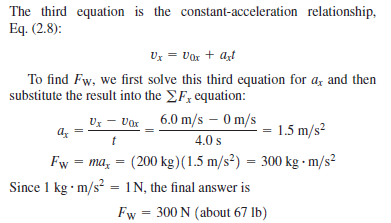
Use to find acceleration, then .
Result:
Worked Example: Iceboat with Friction
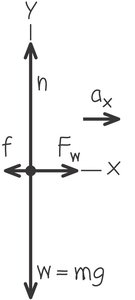
Now include a friction force opposing motion.
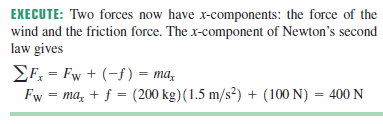
Apply Newton’s second law:
Result:
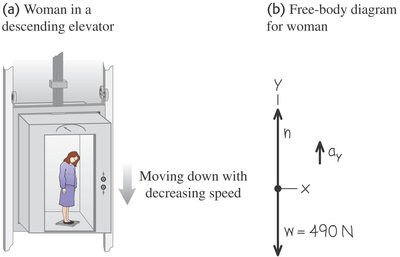
Worked Example: Apparent Weight in an Elevator
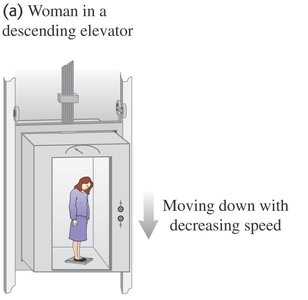
When an elevator accelerates, the normal force (apparent weight) changes.
Apply
For upward acceleration:
For downward acceleration:
Frictional Forces
Types of Friction
Static friction (): Acts when there is no relative motion; .
Kinetic friction (): Acts when a body slides; .
Friction always acts parallel to the surface and opposes relative motion.
Fluid Resistance and Terminal Speed
Fluid Resistance
A fluid is a gas or liquid that can flow.
Fluid resistance (drag) acts opposite to the velocity of a body moving through a fluid.
Drag force can depend on speed () or speed squared ():
(linear drag)
(quadratic drag)
Terminal speed is reached when drag force equals weight:
For :
For :
Circular Motion
Dynamics of Circular Motion
For uniform circular motion, the net force and acceleration are directed toward the center of the circle (centripetal).
Magnitude of net force:
If the inward force ceases (e.g., string breaks), the object moves tangentially to the circle.
There is no real “centrifugal force” in an inertial frame; it is a fictitious force.
Summary Table: Types of Forces in Newtonian Mechanics
Force Type | Symbol | Direction | Formula |
|---|---|---|---|
Weight | Downward (toward Earth) | ||
Normal Force | Perpendicular to surface | Varies | |
Tension | Along string/rope | Varies | |
Friction (kinetic) | Parallel to surface, opposes motion | ||
Friction (static) | Parallel to surface, opposes motion | ||
Drag (fluid resistance) | Opposite to velocity | or | |
Centripetal Force | Toward center of circle |
Key Equations
Newton’s First Law (Equilibrium):
Newton’s Second Law:
Kinetic Friction:
Static Friction:
Drag Force (linear):
Drag Force (quadratic):
Centripetal Force:
Applications and Examples
Free-body diagrams are essential for analyzing forces in all problems.
Friction and drag must be considered in real-world applications such as vehicles, sports, and engineering.
Apparent weight changes in accelerating systems (e.g., elevators).
Circular motion analysis is crucial for understanding orbits, amusement park rides, and rotating machinery.
