 Back
BackAtomic and Nuclear Physics: Structure, Radioactivity, and Nuclear Energy
Study Guide - Smart Notes
 Tailored notes based on your materials, expanded with key definitions, examples, and context.
Atomic Structure and Models
Historical Development of Atomic Models
The understanding of atomic structure has evolved through several scientific models, each improving upon the last as new experimental evidence became available.
Dalton's Atomic Theory: Proposed that each element is composed of identical, indestructible atoms, which combine to form compounds.
Thomson's Model: Suggested that atoms are spheres of positive charge with embedded electrons ("plum pudding model").
Rutherford's Model: Demonstrated that atoms have a small, dense, positively charged nucleus with electrons orbiting around it.
Bohr's Model: Introduced quantized electron orbits (stationary states) and explained atomic emission and absorption spectra.

Bohr Model of the Atom
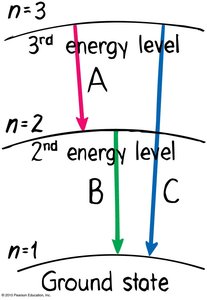
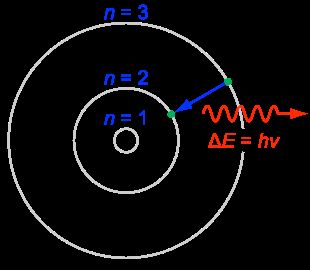
Niels Bohr refined the atomic model by proposing that electrons occupy discrete energy levels and can transition between these levels by absorbing or emitting energy in quantized amounts.
Stationary States: Electrons remain in fixed energy levels unless they absorb or emit energy.
Quantum Jumps: Electrons move between energy levels by absorbing or emitting a photon with energy , where is Planck's constant ( J·s).
Angular Momentum Quantization: The angular momentum of an electron is quantized: , where is a positive integer and .
Atomic Spectra
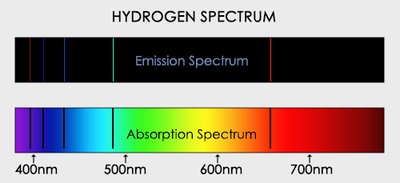
Atoms emit or absorb light at specific wavelengths, producing unique emission and absorption spectra. These spectra serve as atomic fingerprints, allowing identification of elements in distant stars and laboratory samples.
Emission Spectrum: Produced when electrons drop from higher to lower energy levels, emitting photons of specific energies.
Absorption Spectrum: Produced when electrons absorb photons and move to higher energy levels, resulting in dark lines at specific wavelengths.
Quantum Mechanics and Atomic Structure
Key Principles of Quantum Mechanics
Quantum mechanics describes the behavior of matter and energy at atomic and subatomic scales, where classical physics fails to explain observed phenomena.
Wave-Particle Duality: Both electromagnetic radiation and particles (like electrons) exhibit wave and particle properties.
Energy Quantization: Electrons in atoms can only occupy certain discrete energy states.
Uncertainty Principle: There is a fundamental limit to the precision with which position () and momentum () can be known simultaneously: .
Correspondence Principle: Quantum results must agree with classical physics in the limit of large quantum numbers or energies.
X-rays and Medical Imaging
Production and Properties of X-rays
X-rays are high-energy electromagnetic waves produced when energetic electrons strike a solid target, causing inner-shell electrons to be ejected and higher-energy electrons to fill the vacancy, emitting X-ray photons.
Wavelength: X-rays have wavelengths from 0.01 nm to 10 nm, much shorter than ultraviolet light.
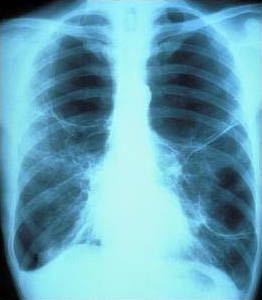
Penetration: X-rays can pass through soft tissues but are absorbed by denser materials like bone, making them useful for medical imaging.
CT Scans (Computerized Tomography)
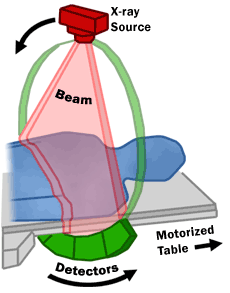
CT scans use X-rays and computer processing to create cross-sectional images of the body, providing more detailed information than standard X-rays.
Principle: Multiple X-ray images are taken from different angles and reconstructed into a 3D image.
Application: Useful for diagnosing diseases and injuries by visualizing internal structures in detail.
Nuclear Structure and Forces
The Nucleus and Nucleons
The nucleus is a tiny, dense region at the center of the atom, containing protons and neutrons (collectively called nucleons). The number of protons determines the atomic number, while the sum of protons and neutrons gives the mass number.
Isotopes: Atoms of the same element with different numbers of neutrons.
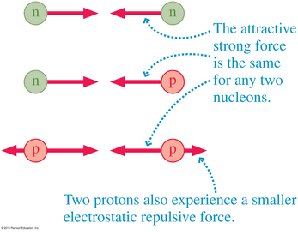
Strong Nuclear Force: The force that holds nucleons together, overcoming the electrostatic repulsion between protons. It is the strongest of the four fundamental forces but acts only at very short ranges.
Stability of Nuclei
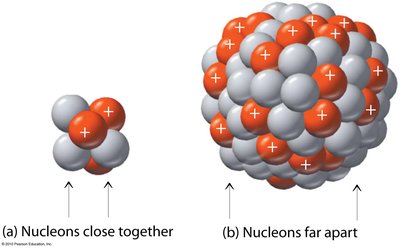
The stability of a nucleus depends on the balance between the strong nuclear force and the electrostatic repulsion among protons. Large nuclei (like uranium) are less stable due to increased repulsion.
Small Nuclei: More stable due to strong nuclear force dominating.
Large Nuclei: Less stable; more likely to undergo radioactive decay.

Radioactivity and Nuclear Decay
Types of Radioactive Decay
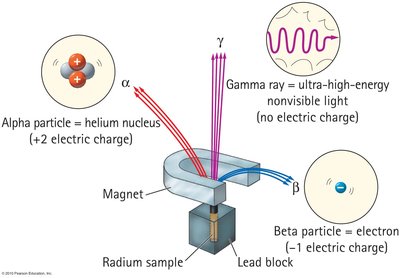
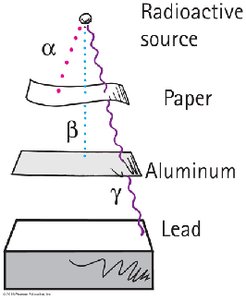
Unstable nuclei spontaneously emit radiation to become more stable. The three main types of radiation are alpha, beta, and gamma rays.
Alpha Decay: Emission of a helium nucleus (2 protons, 2 neutrons); reduces atomic number by 2 and mass number by 4.
Beta Decay: Emission of an electron (beta particle); increases atomic number by 1, mass number unchanged.
Gamma Decay: Emission of high-energy electromagnetic radiation; atomic and mass numbers unchanged.
Half-Life and Radioactive Decay Law
The half-life of a radioactive isotope is the time required for half of the original nuclei to decay. This process is probabilistic and independent of external conditions.
Decay Law: The number of undecayed nuclei at time is given by , where is the decay constant.
Half-Life Formula:
Applications of Radioactivity
Carbon Dating: Used to determine the age of archaeological artifacts by measuring the ratio of C to C.
Medical Uses: Radioactive tracers, cancer treatment (radiation therapy), sterilization of equipment, and diagnostic imaging (PET scans).
Nuclear Reactions: Fission and Fusion
Nuclear Fission
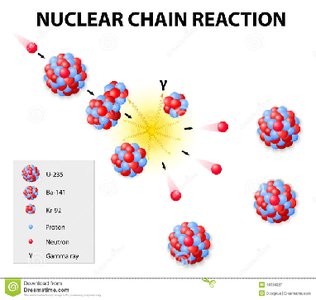
Nuclear fission is the splitting of a heavy nucleus (such as uranium-235) into smaller nuclei, accompanied by the release of energy and additional neutrons, which can initiate a chain reaction.
Fission Reaction Example:
Energy Release: The mass of the products is less than the original mass; the difference (mass defect) is converted to energy according to .
Chain Reaction: The neutrons produced can induce further fission events, leading to a self-sustaining reaction.
Nuclear Fusion
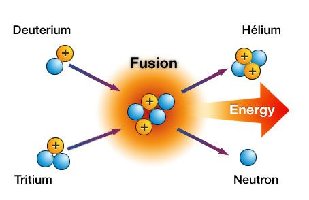
Nuclear fusion is the process by which two light atomic nuclei combine to form a heavier nucleus, releasing energy. Fusion powers the Sun and stars and has the potential for clean energy production on Earth.
Fusion Reaction Example:
Energy Release: The mass of the resulting nucleus is less than the sum of the original masses; the difference is released as energy.
Challenges: Fusion requires extremely high temperatures and pressures to overcome electrostatic repulsion between nuclei.
Detection and Measurement of Radiation
Radiation Detectors
Various instruments are used to detect and measure ionizing radiation, including:
Geiger Counter
Cloud Chamber
Bubble Chamber
Scintillation Counter
Radiation Dosage and Biological Effects
Radiation dose is measured in units such as rad, gray (Gy), sievert (Sv), and rem. The biological effect depends on the type and energy of radiation and the tissue exposed.
Alpha Particles: Highly damaging if ingested or inhaled, but not penetrating.
Beta Particles: Moderate penetration and biological effect.
Gamma Rays/X-rays: Highly penetrating, can cause significant biological damage.
Summary Table: Types of Nuclear Radiation
Type | Nature | Charge | Penetration | Effect on Nucleus |
|---|---|---|---|---|
Alpha (α) | Helium nucleus (2p, 2n) | +2 | Low (stopped by paper) | Atomic number -2, mass number -4 |
Beta (β) | Electron | -1 | Moderate (stopped by aluminum) | Atomic number +1, mass number unchanged |
Gamma (γ) | Electromagnetic wave | 0 | High (stopped by thick lead) | No change |
Applications and Implications of Nuclear Physics
Medical Diagnostics: X-rays, CT scans, PET scans, and radioactive tracers.
Energy Production: Nuclear reactors (fission), potential for fusion power.
Archaeology: Carbon dating for age determination of artifacts.
Radiation Therapy: Treatment of cancer using controlled doses of radiation.
Safety and Environmental Concerns: Handling and disposal of radioactive waste, risk of nuclear accidents, and proliferation of nuclear weapons.
