 Back
Atoms and the Periodic Table: Structure, Models, and Quantum Concepts
Study Guide - Smart Notes
 Tailored notes based on your materials, expanded with key definitions, examples, and context.
Atoms: Structure and Properties
Atoms Are Ancient and Mostly Empty
Atoms are the fundamental building blocks of matter, dating back to the origin of the universe. Most atoms are composed of a dense nucleus surrounded by a vast region of empty space. Elements heavier than hydrogen and much of the helium were produced in the interiors of stars.
Atoms are ancient: Most atoms have existed since the universe began.
Atoms are mostly empty space: The nucleus is extremely small compared to the overall size of the atom.
Elements heavier than hydrogen: Created in stars through nuclear fusion.
The Elements
Definition and Classification
An element is a material made of only one kind of atom. The term "element" is used for macroscopic quantities, while "atom" refers to the submicroscopic unit. There are 115 known elements, with 90 found in nature and the rest synthesized in laboratories.
Element: Material consisting of only one type of atom (e.g., pure gold).
Atom: The smallest unit of an element that retains its properties.
All matter: Composed of atoms.
Protons, Neutrons, and Electrons
Subatomic Particles
Atoms are composed of three main subatomic particles: protons, neutrons, and electrons. Protons and neutrons reside in the nucleus, while electrons orbit the nucleus.
Protons: Positively charged, about 1800 times more massive than electrons.
Neutrons: Electrically neutral, similar in mass to protons.
Electrons: Negatively charged, much less massive, identical in all atoms, and responsible for chemical behavior.
Atomic number (Z): Number of protons in the nucleus; defines the element.
Nucleons: Collective term for protons and neutrons.
Isotopes and Atomic Mass
Isotopes
Isotopes are atoms of the same element with the same number of protons but different numbers of neutrons. They are identified by their mass number (total protons + neutrons).
Isotopes: Same element, different neutron count.
Mass number (A): Total number of protons and neutrons.
Atomic mass: Total mass of an atom, measured in atomic mass units (amu).
Formula: Number of neutrons = mass number − atomic number.
The Periodic Table
Organization and Structure
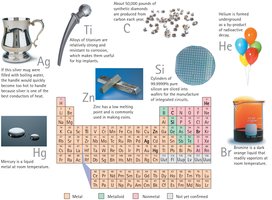
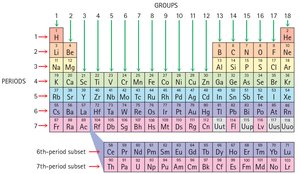
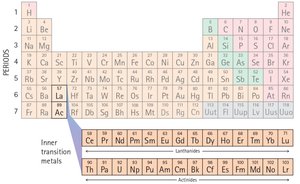
The Periodic Table is a systematic arrangement of all known elements. It is organized into vertical columns called groups and horizontal rows called periods. The table is a tool for understanding element properties and relationships, not for memorization.
Groups: Vertical columns; elements in the same group have similar chemical properties.
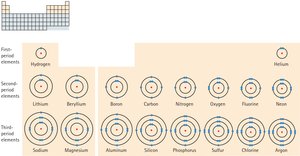
Periods: Horizontal rows; elements in the same period have the same number of electron shells.
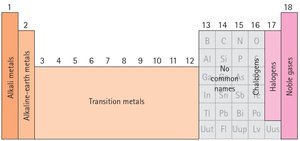
Element classification: Metals, nonmetals, metalloids, and noble gases.
Trends in Atomic Size
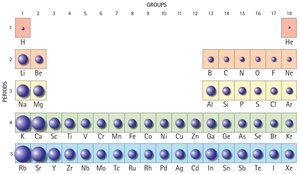
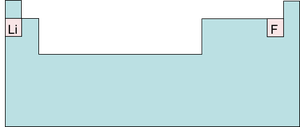
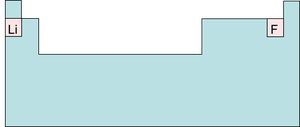
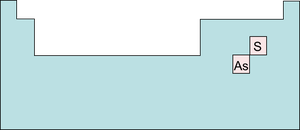
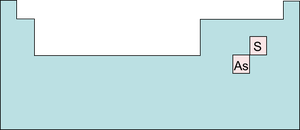
Atomic size varies across the periodic table. Generally, atoms become smaller across a period (left to right) and larger down a group (top to bottom).
Example: Lithium (Li) atom is larger than a fluorine (F) atom; arsenic (As) atom is larger than a sulfur (S) atom.
Physical and Conceptual Models
Understanding Atomic Structure
Models help visualize and understand atomic structure. A physical model replicates an object at a convenient scale, while a conceptual model describes a system's behavior. Atoms are best described by conceptual models due to their submicroscopic nature.
Physical model: Tangible representation (e.g., ball-and-stick model).
Conceptual model: Abstract representation (e.g., Bohr model, quantum model).
Identifying Atoms Using the Spectroscope
Atomic Spectra and Element Identification
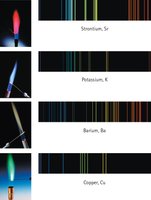
A spectroscope separates light into its component frequencies, allowing scientists to identify elements by their unique atomic spectra. Each element emits a characteristic pattern of spectral lines when energized.
Atomic spectrum: The "fingerprint" of an element; a pattern of discrete frequencies of light.
Spectral lines: Each line corresponds to a specific frequency of light emitted by an atom.
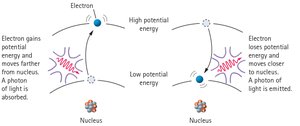
Energy transitions: Electrons absorb or emit photons as they move between energy levels.
The Quantum Hypothesis
Quantization of Energy
The quantum hypothesis, proposed by Max Planck and expanded by Albert Einstein, states that energy is emitted or absorbed in discrete bundles called quanta. Light consists of particles called photons, each carrying energy proportional to its frequency.
Energy of a photon: where is energy, is Planck's constant, and is frequency.
Wave-particle duality: Light exhibits both wave-like and particle-like properties.
Energy levels: Electrons occupy discrete energy levels; transitions between levels result in photon emission or absorption.
Bohr Model and Atomic Spectra
Niels Bohr used the quantum hypothesis to explain atomic spectra. Electrons can only occupy certain energy levels, and photons are emitted or absorbed when electrons transition between these levels. The principal quantum number (an integer) labels these levels.
Ground state: Lowest energy level (n = 1).
Excited state: Higher energy levels (n > 1).
Photon energy: Equal to the difference in energy between two levels.
Electron Waves
Wave Nature of Electrons
Electrons exhibit wave-like behavior, which explains why only certain energy levels are allowed in atoms. Permitted energy levels correspond to standing electron waves that fit perfectly around the nucleus.
Standing waves: Only an integer number of wavelengths can fit in the electron's orbit.
Energy quantization: Natural consequence of wave behavior.

The Shell Model
Electron Shells and the Periodic Table
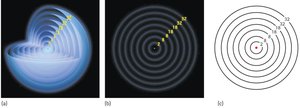
The shell model organizes electrons into shells around the nucleus. Each shell corresponds to a principal quantum number and can hold a specific number of electrons. The arrangement of electrons in shells explains the structure of the periodic table and the chemical properties of elements.
Shells: Layers of electrons at increasing distances from the nucleus.
Electron configuration: Determines chemical behavior and periodic trends.
Additional info: This summary expands on the original lecture slides by providing definitions, formulas, and academic context suitable for college-level Physics with Calculus students. The included images directly reinforce the explanations of atomic structure, periodic trends, quantum concepts, and electron configurations.
