 Back
BackBlackbody Radiation, Quantization, and the Uncertainty Principle
Study Guide - Smart Notes
 Tailored notes based on your materials, expanded with key definitions, examples, and context.
Blackbody Radiation and Quantization
Introduction to Blackbody Radiation
Blackbody radiation refers to the electromagnetic radiation emitted by an idealized object that absorbs all incident radiation, regardless of wavelength or angle. Such an object is called a blackbody. The study of blackbody radiation was crucial in the development of quantum mechanics, as classical physics could not explain its observed properties.
Blackbody: An ideal surface that absorbs and emits radiation at all wavelengths.
Continuous Spectrum: Unlike gases, which emit discrete line spectra, solids emit a continuous distribution of wavelengths due to interactions among atoms.
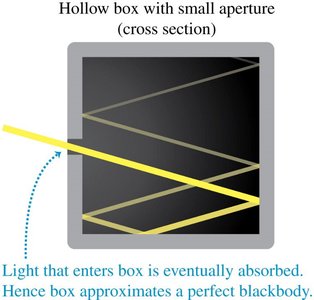
Practical Approximation: A hollow box with a small aperture acts as a nearly perfect blackbody, as light entering the aperture is absorbed after multiple reflections.
Stefan-Boltzmann Law
The Stefan-Boltzmann law quantifies the total energy radiated per unit surface area of a blackbody per unit time. It is proportional to the fourth power of the absolute temperature:
Formula:
Where: is the total intensity, is the temperature in Kelvin, and is the Stefan-Boltzmann constant.
Wien's Displacement Law
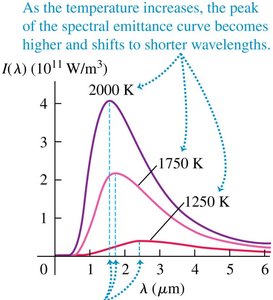
Wien's displacement law describes how the wavelength at which the emission of a blackbody spectrum is maximized shifts with temperature:
Formula:
Interpretation: As temperature increases, the peak of the spectral emittance curve shifts to shorter wavelengths.
Rayleigh-Jeans Law and the Ultraviolet Catastrophe
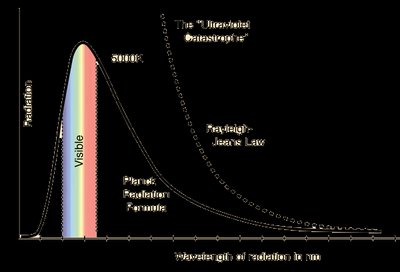
Classical physics, using the Rayleigh-Jeans law, predicted that the intensity of blackbody radiation would increase without bound at short wavelengths (the so-called "ultraviolet catastrophe"). The law is given by:
Formula:
Failure: This formula fits experimental data at long wavelengths but diverges at short wavelengths, predicting infinite energy emission, which is not observed.
Planck's Quantum Hypothesis
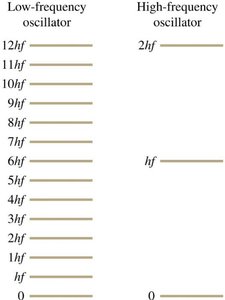
To resolve the ultraviolet catastrophe, Max Planck proposed that electromagnetic oscillators in the walls of a blackbody cavity could only have discrete energy values, quantized in multiples of (where is Planck's constant and is frequency):
Energy Quantization: , where
Implication: High-frequency oscillators are less likely to be excited, explaining the observed drop in intensity at short wavelengths.
Planck's Radiation Law
Planck derived a formula that accurately describes the observed blackbody spectrum at all wavelengths:
Formula:
Integration: Integrating this over all wavelengths gives the Stefan-Boltzmann law.
Wien's Law (from Planck's Law): The wavelength of maximum emission is .
The Uncertainty Principle and Quantum Mechanics
Wave-Particle Duality and the Double-Slit Experiment
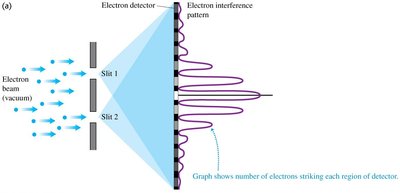
At small scales, matter exhibits both wave-like and particle-like properties. This is demonstrated by the double-slit experiment, where electrons (or photons) create an interference pattern, a hallmark of wave behavior, even when sent one at a time.
Complementarity Principle: We cannot simultaneously describe a quantum object as both a wave and a particle in a single experiment.
Measurement Effect: Attempting to observe which slit an electron passes through destroys the interference pattern.
Heisenberg Uncertainty Principle
The Heisenberg uncertainty principle sets fundamental limits on the precision with which certain pairs of physical properties can be known simultaneously:
Position-Momentum:
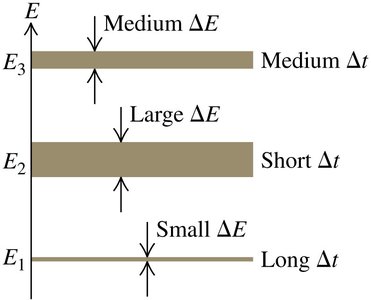
Energy-Time:
Interpretation: The more precisely one property is measured, the less precisely the other can be known.
Limitations of the Bohr Model
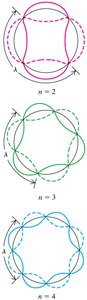
The Bohr model of the atom, while successful in predicting energy levels, is inconsistent with the uncertainty principle. It assumes electrons have well-defined orbits, which would imply zero uncertainty in both position and momentum along certain axes, violating quantum mechanics.
Need for Quantum Description: A complete description of matter must be based on wave properties, as in quantum mechanics.
Summary Table: Key Laws of Blackbody Radiation
Law | Formula | Description |
|---|---|---|
Stefan-Boltzmann Law | Total power radiated per unit area | |
Wien's Displacement Law | Peak wavelength shifts with temperature | |
Rayleigh-Jeans Law | Classical prediction; fails at short wavelengths | |
Planck's Law | Quantum prediction; matches experiment |
