 Back
Calculus-Based Motion: 1D and 2D Kinematics & Projectile Motion
Study Guide - Smart Notes
 Tailored notes based on your materials, expanded with key definitions, examples, and context.
Motion in One Dimension (1D)
Integral Calculus of Motion
Calculus provides a powerful framework for analyzing motion, allowing us to relate acceleration, velocity, and position through integration and differentiation. In one-dimensional motion, these relationships are foundational for solving kinematics problems.
Acceleration to Velocity: If acceleration as a function of time is known, velocity can be found by integrating acceleration with respect to time.
Velocity to Position: Similarly, integrating velocity with respect to time yields the position function.
Special Case (Constant Acceleration): For constant acceleration, the equations simplify to the classic kinematic equations.
Key Equations:
From acceleration to velocity:
From velocity to position:
Example: A rocket car starts at and accelerates according to . Find its velocity at time and at .
Integrate acceleration to get velocity:
At s:
Example: If the car starts at at , find its position at s.
Integrate velocity:
At s:
Motion in Two and Three Dimensions (2D/3D)
Vector Representation of Motion
In two or three dimensions, position, velocity, and acceleration are described by vectors. The motion can be analyzed by considering each component separately.
Position Vector:
Velocity Vector:
Acceleration Vector:
Example: A Mars rover's position is given by:
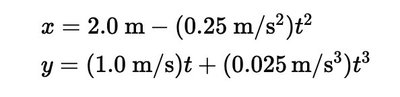
To analyze the rover's motion:
Sketch the path by plotting and for s.
Find velocity and acceleration by differentiating the position functions.
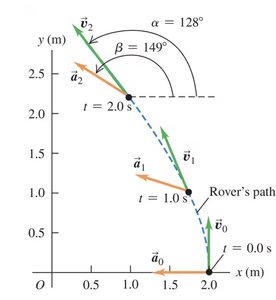
Key Points:
Velocity and acceleration vectors change direction and magnitude as the rover moves.
Graphical analysis helps visualize the motion and interpret the physical meaning of the equations.
Projectile Motion
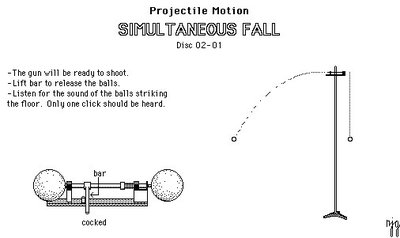
Projectile motion is a special case of two-dimensional motion where an object moves under the influence of gravity alone, after an initial launch. The horizontal and vertical motions are independent except for the time variable.
Horizontal Motion: Constant velocity, .
Vertical Motion: Constant acceleration due to gravity, .
Equations of Projectile Motion:
Horizontal position:
Vertical position:
Key Concepts:
Time of flight depends only on vertical motion.
Range depends on initial velocity and launch angle.
Maximum height is reached when vertical velocity is zero.
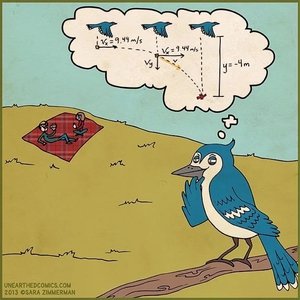
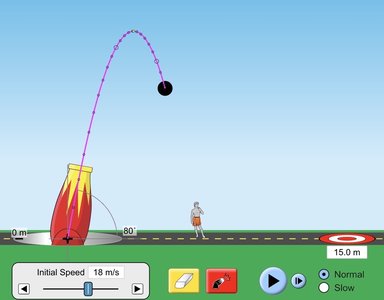
Sample Problem: Horizontal Launch from a Cliff
Problem: An object is thrown horizontally from a cliff with initial speed and takes s to hit the ground. How far from the base does it land? From what height was it thrown?
Horizontal distance:
Vertical distance (height):
Conclusion: The independence of horizontal and vertical motions allows us to solve for range and height separately using the appropriate kinematic equations.
Summary Table: Kinematic Equations for Constant Acceleration
Quantity | Equation | Notes |
|---|---|---|
Velocity (from acceleration) | For constant | |
Position (from velocity) | For constant | |
Projectile horizontal position | ||
Projectile vertical position |
Additional info:
These notes cover material from "Units, Physical Quantities & Vectors," "Motion Along a Straight Line," and "Motion in Two or Three Dimensions" as outlined in standard calculus-based physics syllabi.
Images included are directly relevant to the explanation of vector motion, projectile motion, and the graphical analysis of kinematics.
