 Back
BackCapacitance and Capacitors: Principles, Types, and Applications
Study Guide - Smart Notes
 Tailored notes based on your materials, expanded with key definitions, examples, and context.
Capacitance and Capacitors
Introduction to Capacitance
Capacitance is a fundamental property of electrical circuits, describing the ability of a system to store electric charge. Capacitors are devices specifically designed to exploit this property, and they are widely used in electronic circuits for energy storage, filtering, and timing applications.
Parallel-Plate Capacitor
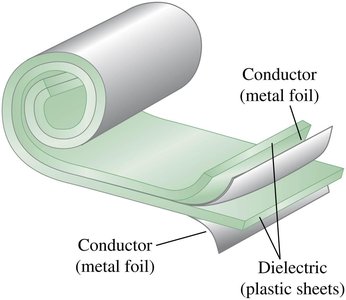
Physical Structure and Principle
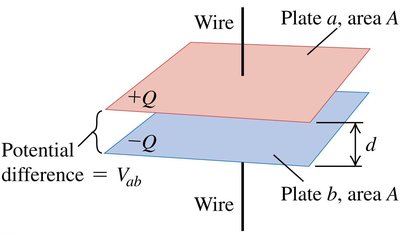
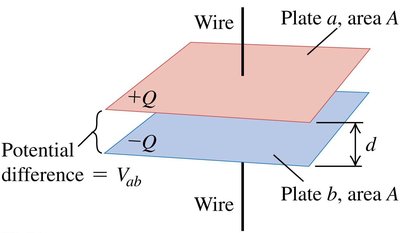
A parallel-plate capacitor consists of two parallel conducting plates, each of area A, separated by a distance d that is small compared to their dimensions. One plate carries a charge +Q, and the other carries -Q, creating a uniform electric field between them. The potential difference between the plates is Vab.
Capacitance (C) is defined as the ratio of the charge on one plate to the potential difference between the plates:
The capacitance of a parallel-plate capacitor in vacuum is: , where is the permittivity of free space.
Capacitance depends only on the geometry of the plates (area and separation).
Calculating Capacitance: General Steps
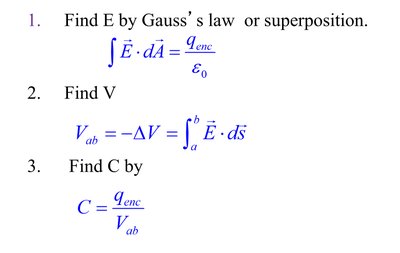
Find the electric field E using Gauss's law or superposition:
Find the potential difference:
Calculate capacitance:
Capacitance of Other Geometries
Spherical Capacitor
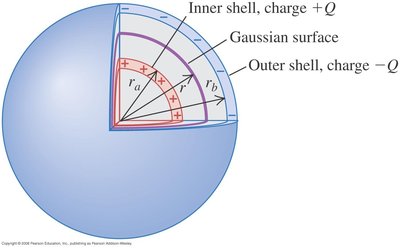
A spherical capacitor consists of two concentric spherical conducting shells. The inner shell has radius and charge +Q, and the outer shell has radius and charge -Q. The capacitance is given by:
For an isolated sphere ():
Cylindrical Capacitor
A cylindrical capacitor consists of two coaxial cylinders of length L, with radii a (inner) and b (outer). The capacitance is:
Capacitors in Circuits
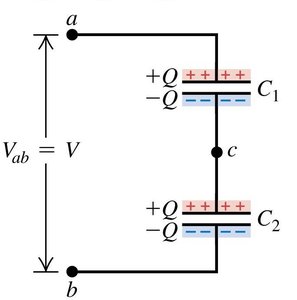
Capacitors in Series
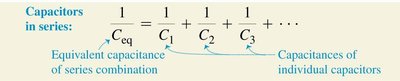
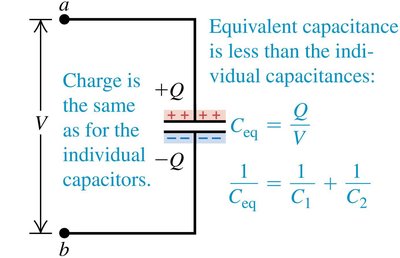
When capacitors are connected in series, the same charge passes through each, but the total voltage is the sum of the voltages across each capacitor. The equivalent capacitance is given by:
The equivalent capacitance is always less than the smallest individual capacitance in the series.
Capacitors in Parallel
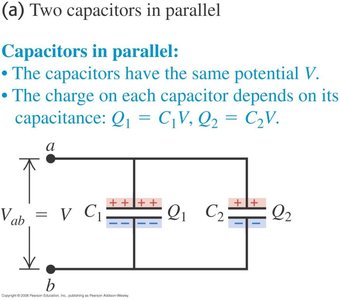
When capacitors are connected in parallel, the voltage across each is the same, but the total charge is the sum of the charges on each capacitor. The equivalent capacitance is:
The equivalent capacitance is always greater than any individual capacitance in the parallel combination.
Energy Storage in Capacitors
Potential Energy Stored
The energy stored in a capacitor is the work required to move charge from one plate to the other. The potential energy U is given by:

Energy Density
The energy per unit volume (energy density) stored in the electric field of a capacitor is:
In vacuum:

Dielectrics and Capacitance
Role of Dielectrics
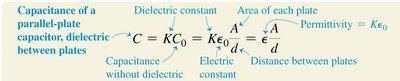
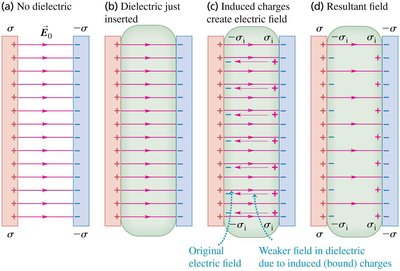
A dielectric is a nonconducting material placed between the plates of a capacitor to increase its capacitance. The dielectric constant K (or ) quantifies how much the capacitance increases compared to vacuum.
With dielectric:
Dielectrics increase the energy density:

Behavior with Battery Attached or Disconnected
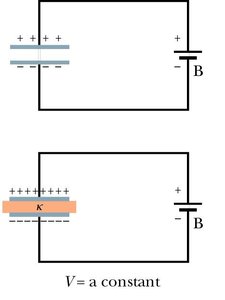
Battery attached (V constant): Inserting a dielectric increases capacitance and allows more charge to flow onto the plates.
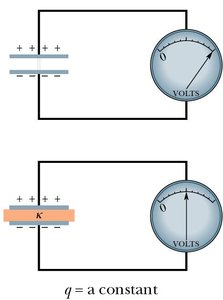
Battery disconnected (Q constant): Inserting a dielectric increases capacitance, so the voltage across the plates decreases.
Microscopic View: Polarization
When a dielectric is inserted, the electric field inside the capacitor decreases due to polarization of the dielectric material, which creates induced surface charges that partially cancel the field.
Key Terminology
Dielectric constant (K): Dimensionless factor indicating how much a material increases capacitance.
Dielectric strength: Maximum electric field a dielectric can withstand before breakdown (sparking).
Breakdown potential: Maximum voltage before dielectric failure.
Applications of Capacitors
Energy Storage and Discharge
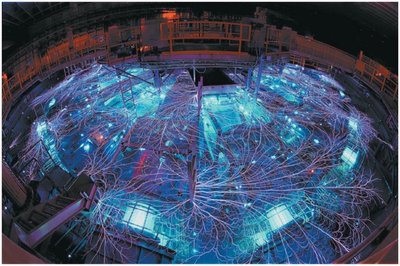
Capacitors are used to store and rapidly release energy in various applications, from camera flashes to large-scale experiments like the Z machine for nuclear fusion research.
Supercapacitors (Electric Double Layer Capacitors)
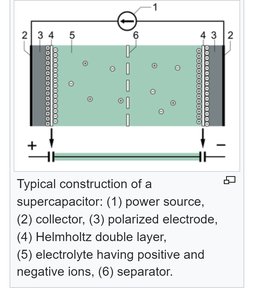
Supercapacitors, or ultracapacitors, are advanced capacitors with extremely high capacitance, used in high-power applications such as energy storage for renewable energy systems.
Summary Table: Capacitance Formulas for Common Geometries
Type | Capacitance Formula |
|---|---|
Parallel-Plate | |
Cylindrical | |
Spherical (nested) | |
Isolated Sphere |
Summary Table: Dielectric Constants of Common Materials
Material | Dielectric Constant (K) |
|---|---|
Vacuum | 1 |
Air (1 atm) | 1.00059 |
Teflon | 2.1 |
Mylar | 3.1 |
Glass | 5 – 10 |
Glycerin | 42.5 |
Water | 80.4 |
