 Back
BackCapacitance and Capacitors: Principles, Types, and Applications
Study Guide - Smart Notes
 Tailored notes based on your materials, expanded with key definitions, examples, and context.
Capacitance and Capacitors
Introduction to Capacitance
Capacitance is a fundamental property of capacitors, which are devices designed to store electrical potential energy. Capacitors are widely used in electronic circuits for energy storage, filtering, and signal processing.
Capacitor Construction: Consists of two conductors (plates) separated by an insulator (dielectric).
Charging a Capacitor: Charge is transferred from one plate to another, creating equal and opposite charges on each plate.
Energy Storage: The work done to move charges is stored as potential energy in the electric field between the plates.
Unit of Capacitance: Farad (F), where 1 F = 1 Coulomb/Volt.
Definition and Formula for Capacitance
The capacitance C of a capacitor is defined as the ratio of the charge Q stored on one plate to the potential difference V between the plates:
Formula:
Interpretation: A higher capacitance means more charge can be stored for a given potential difference.
Parallel Plate Capacitor
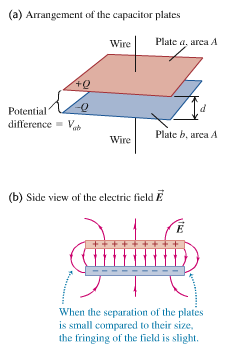
The parallel plate capacitor is the simplest and most commonly analyzed type. It consists of two large, flat plates of area A separated by a distance d, often with vacuum or air as the dielectric.
Capacitance Formula: , where is the vacuum permittivity ( F/m).
Electric Field: The electric field between the plates is uniform if the plate separation is much smaller than their size.
Spherical and Cylindrical Capacitors
Capacitors can also be constructed in spherical or cylindrical geometries, which are useful for specific applications.
Spherical Capacitor
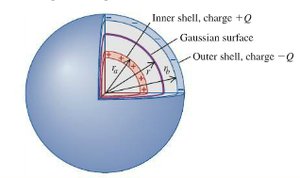
Consists of two concentric spherical shells separated by a dielectric (often vacuum).
Capacitance depends on the radii of the shells: , where and are the inner and outer radii.
Cylindrical Capacitor
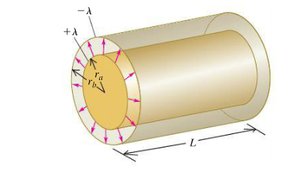
Formed by two coaxial cylinders of length L, inner radius , and outer radius .
Capacitance per unit length:
Capacitors in Series and Parallel
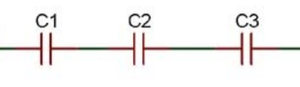
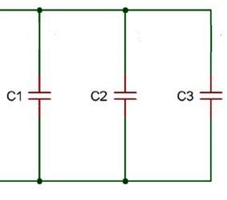
Capacitors can be combined in series or parallel to achieve desired capacitance values in circuits.
Series: The reciprocal of the equivalent capacitance is the sum of reciprocals:
Parallel: The equivalent capacitance is the sum:
Energy Storage in Capacitors
Capacitors store energy in the electric field between their plates. The energy U stored is given by:
When discharged, this energy is released as work.
Dielectrics and Capacitance
Inserting a dielectric material between the plates of a capacitor increases its capacitance by a factor called the dielectric constant K:
With Dielectric:
Dielectric Constant: is a property of the material; for all dielectrics.
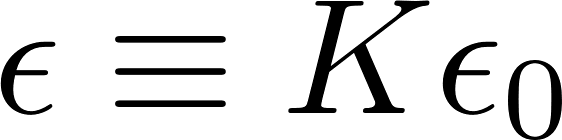
Permittivity:
Polarization and Bound Charges
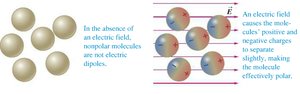
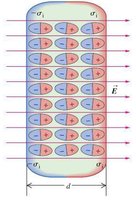
Dielectrics become polarized in an electric field, reducing the effective field inside the capacitor.
Free charges reside on the plates; bound charges are induced on the dielectric surfaces.
Capacitors with Dielectrics: Effects and Calculations
When a dielectric is inserted into a capacitor:
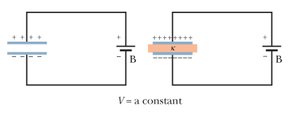
Isolated Capacitor: Capacitance increases, potential difference decreases, charge remains constant.
Capacitor Connected to Battery: Capacitance increases, charge increases, potential difference remains constant.
Applications and Historical Devices
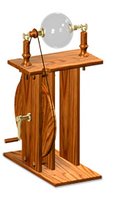
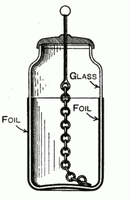
Capacitors are used in a wide range of applications, including energy storage, filtering, and timing circuits. Historical devices such as the Leyden jar and Hauksbee generator were early forms of capacitors.
Summary Table: Capacitance Formulas for Common Geometries
Type | Capacitance Formula | Key Parameters |
|---|---|---|
Parallel Plate | Area , separation | |
Spherical | Radii , | |
Cylindrical | Radii , (per unit length) | |
With Dielectric | Dielectric constant |
