 Back
BackCapacitance and Dielectrics: Fundamentals, Networks, and Applications
Study Guide - Smart Notes
 Tailored notes based on your materials, expanded with key definitions, examples, and context.
Capacitance and Dielectrics
Introduction to Capacitors
Capacitors are fundamental circuit elements used to store electric charge and energy in an electric field. They are widely used in electronic devices for energy storage, filtering, and timing applications.
Capacitor Definition: A capacitor consists of two separated conductors (plates) with equal and opposite charges.
Energy Storage: The energy is stored as electric potential energy in the electric field between the plates.
Applications: Capacitors are used in flash photography, stud finders, defibrillators, and more.
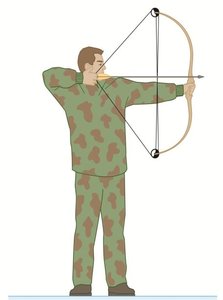
Analogy: Stretching an archer’s bow stores mechanical energy as elastic potential energy, similar to how a capacitor stores energy electrically.
Basic Capacitor Construction and Charging
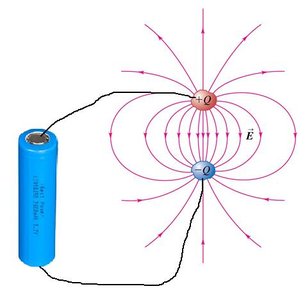
To make and charge a capacitor, connect two conductors to opposite ends of a battery. The battery creates a potential difference, causing one plate to become positively charged and the other negatively charged.
Capacitance (C): The ability of a capacitor to store charge per unit voltage. where is the charge and is the potential difference.
Unit: Farad (F), where .
Parallel-Plate Capacitor
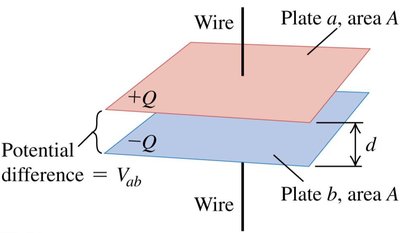
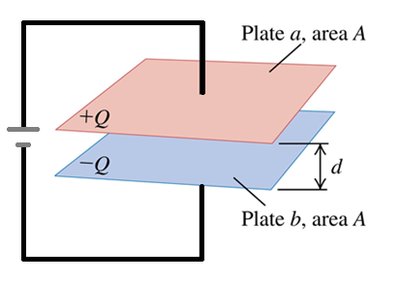
The parallel-plate capacitor is the most common geometry, consisting of two parallel conducting surfaces separated by a distance .
Capacitance Formula: where is the plate area, is the separation, and is the permittivity of free space ().
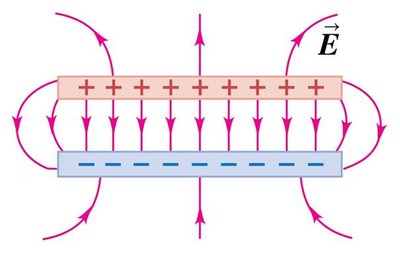
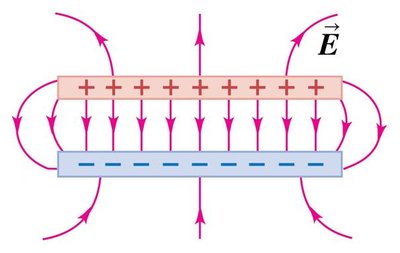
Electric Field: The field between plates is nearly uniform.
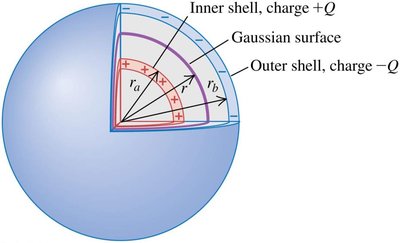
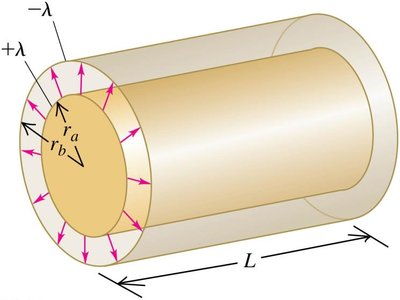
Capacitance for Different Geometries
Capacitance depends on the geometry of the conductors.
Parallel Plate:
Spherical:
Cylindrical:
Networks of Capacitors
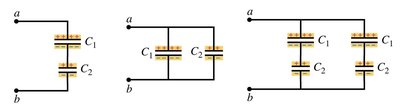
Capacitor Combinations: Series and Parallel
Capacitors can be combined in series or parallel to achieve desired capacitance values in circuits.
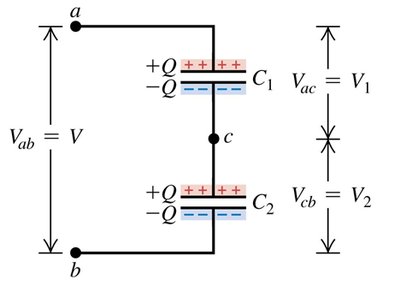
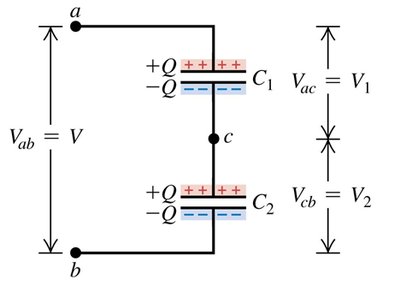
Series Combination: Capacitors are connected end-to-end. The same charge flows through each, but the voltage divides.
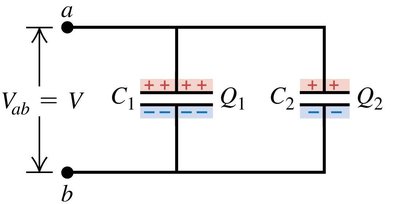
Parallel Combination: Capacitors are connected across the same two points. The voltage is the same, but the charge divides.
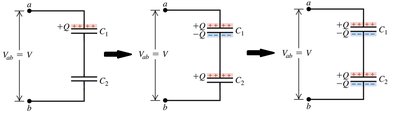
Capacitors in Series
When capacitors are in series, the total voltage is the sum of individual voltages, but the charge is the same for all.
Voltage Division:
Equivalent Capacitance:
Capacitors in Parallel
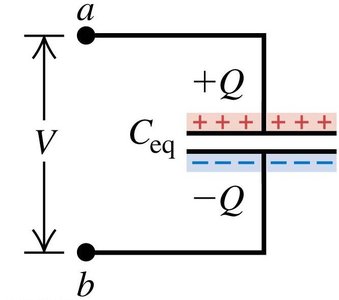
In parallel, the voltage across each capacitor is the same, but the total charge is the sum of individual charges.
Charge Addition:
Equivalent Capacitance:
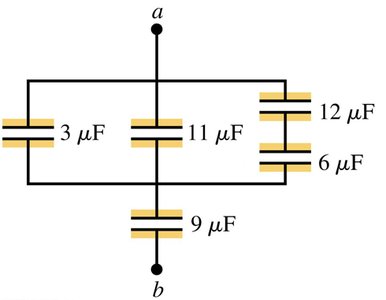
Example: Complex Capacitor Network
Complex networks can be analyzed by reducing series and parallel combinations stepwise.
Example: Five-capacitor network with values 3, 11, 12, 6, and 9 μF. The equivalent capacitance is calculated using series and parallel rules.
Energy Stored in a Capacitor
Work and Energy in Charging a Capacitor
The energy stored in a capacitor is equal to the work required to charge it.
Energy Formula:
Derivation: The formula is derived by integrating the work needed to move charge through a potential difference.
Energy Density in a Capacitor
Energy density is the energy stored per unit volume in the electric field.
Energy Density Formula:
Application: This formula applies to all capacitors, not just parallel-plate types.
Dielectrics in Capacitors
Role and Benefits of Dielectrics
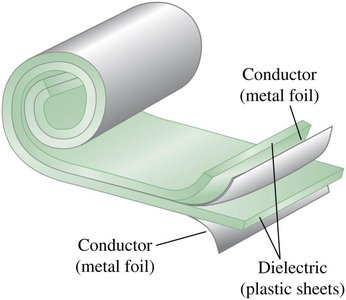
Most capacitors use a dielectric (insulating material) between their plates.
Mechanical Support: Dielectrics help keep plates separated.
Dielectric Breakdown: Dielectrics increase the maximum electric field before breakdown.
Capacitance Increase: Dielectrics increase the capacitance by reducing the voltage for a given charge.
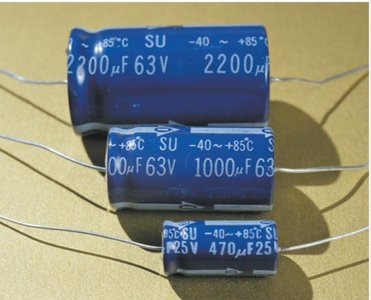
Dielectric Effect on Capacitance
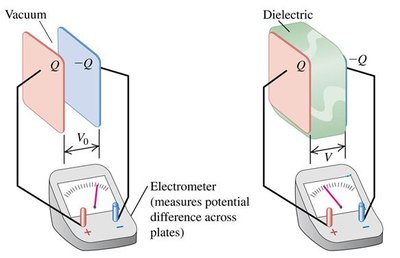
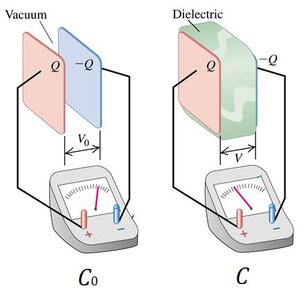
Inserting a dielectric reduces the measured voltage across the plates, increasing capacitance.
Dielectric Constant (K): , where is the capacitance without dielectric.
Typical Values: Vacuum , air , plastics –$6K=5.
Induced Charge and Polarization
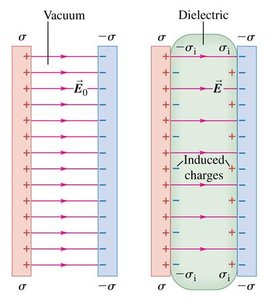
Dielectrics become polarized in an electric field, inducing surface charges that reduce the field.
Reduced Electric Field:
Permittivity:
Summary of Dielectric Effects
The presence of a dielectric changes several properties of the capacitor:
Increase in Capacitance:
Decrease in Voltage:
Decrease in Electric Field:
Increase in Permittivity:
Decrease in Electric Energy:
Decrease in Energy Density:
Dielectric Breakdown and Strength
If the electric field exceeds the dielectric strength, the material becomes conductive.
Dielectric Strength: Maximum field before breakdown, varies by material (e.g., Teflon: 60 × 106 V/m).
Dielectric Constant: Indicates how much the material increases capacitance.
Applications of Capacitors
Common Uses
Capacitors are essential in many devices:
Camera Flash: Stores energy for rapid discharge.
Electronic Stud Finder: Detects changes in capacitance due to metal fasteners.
Capacitive Touchscreens: Senses touch by measuring changes in capacitance.
Computer Keyboards: Uses capacitive sensing for key presses.
Defibrillators: Delivers stored energy to restart the heart.


Summary Table: Dielectric Properties
Material | Dielectric Constant (K) | Dielectric Strength (106 V/m) |
|---|---|---|
Air / Vacuum | 1.006 / 1 | 3 / --- |
Paper | 3.7 | 16 |
Pyrex glass | 5.6 | 14 |
Teflon | 2.1 | 60 |
Styrofoam | 2.56 | 24 |
Rubber | 6.7 | 12 |
Sr. Titanate | 233 | 8 |
Key Equations
Capacitance:
Parallel-Plate Capacitance:
Energy Stored:
Energy Density:
Dielectric Constant:
Permittivity:
