 Back
Capacitance and Dielectrics: Physics with Calculus Study Notes
Study Guide - Smart Notes
 Tailored notes based on your materials, expanded with key definitions, examples, and context.
Capacitance and Dielectrics
Introduction to Capacitance
Capacitance is a fundamental property of capacitors, devices that store electric charge and energy in an electric field. It is a scalar quantity, always positive, and is denoted by the symbol C. The unit of capacitance is the farad (F), defined as 1 coulomb per volt.
Definition: Capacitance (C) is the ratio of the charge stored (q) to the potential difference (V) across the plates:
Unit:
Symbol: The circuit symbol for a capacitor is two parallel lines separated by a gap.

Basic Capacitor Structure
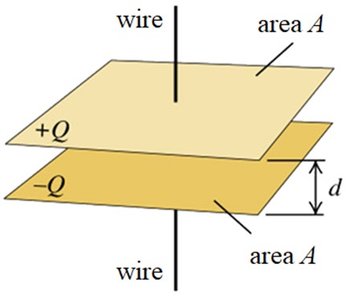
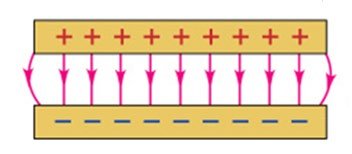
Capacitors typically consist of two conductive plates separated by an insulating material. When charges +q and -q are placed on the plates, an electric field is established between them.
Parallel-Plate Capacitor: The most common type, with plates of area A separated by distance d.
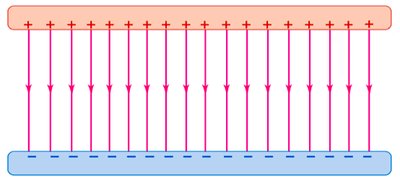
Charge Distribution: One plate holds positive charge, the other negative, creating a uniform electric field.
Calculating Capacitance
The capacitance of a parallel-plate capacitor depends on the geometry and the properties of the material between the plates.
Procedure:
Place charges +q and -q on the plates.
Find the resulting electric field E.
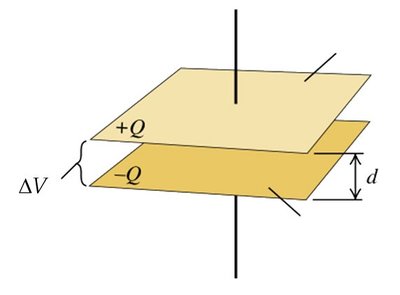
Integrate the field to get the potential difference V.
Divide charge by potential difference:
Formula for Parallel-Plate Capacitor: , where is the permittivity of free space.
Capacitance of Other Geometries
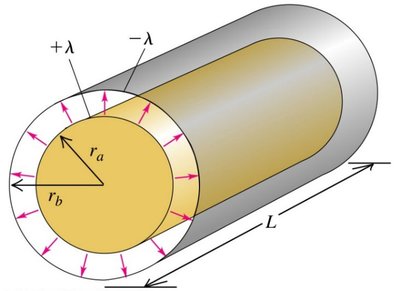
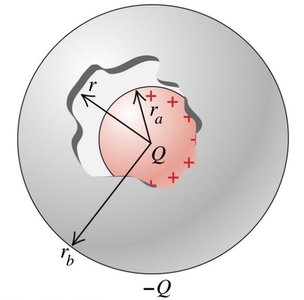
Capacitance can be calculated for different geometries, such as cylindrical and spherical capacitors.
Cylindrical Capacitor:
Spherical Capacitor:
Capacitors in Series and Parallel
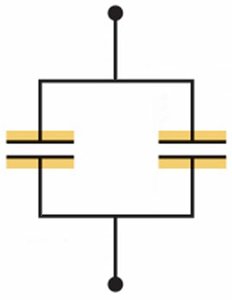
Capacitors can be combined in circuits to achieve desired capacitance values.
Series Combination: The reciprocal of the equivalent capacitance is the sum of reciprocals:
Parallel Combination: The equivalent capacitance is the sum:
Series: All capacitors have the same charge.
Parallel: All capacitors have the same potential difference.

Energy Stored in a Capacitor
The electric field between the plates stores potential energy. The energy stored in a capacitor is given by:
Energy Density: The energy per unit volume in the electric field is (unit: J/m3).
Dielectrics and Capacitance
Dielectrics are insulating materials placed between capacitor plates to increase capacitance. They reduce the effective electric field and allow more charge to be stored for the same voltage.
Dielectric Constant (K): A measure of how much the dielectric increases capacitance:
Effect on Field and Potential: ,
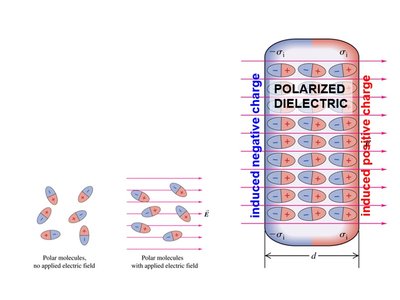
Free Charge Shielding: Induced surface charges on the dielectric reduce the effective field.
Molecular Model of Dielectrics
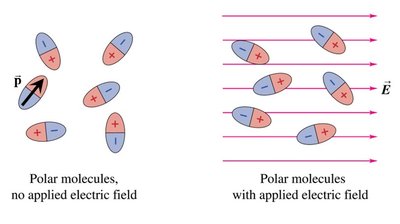
Polar Molecules: Have permanent dipole moments (e.g., H2O, NH3). In an electric field, they align with the field, creating induced surface charges.
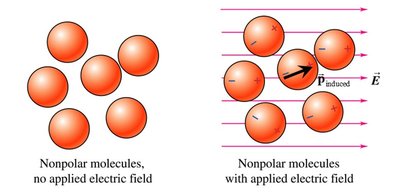
Nonpolar Molecules: No permanent dipole moment (e.g., N2, O2, CO2). In an electric field, a dipole is induced.
Summary Table: Capacitance Formulas for Common Geometries
Geometry | Capacitance Formula |
|---|---|
Parallel-Plate | |
Cylindrical | |
Spherical |
Key Points
Capacitance measures a capacitor's ability to store charge.
Dielectrics increase capacitance by reducing the electric field.
Capacitors store energy in the electric field between their plates.
Capacitors can be combined in series or parallel to achieve desired capacitance values.
Example: A parallel-plate capacitor with area 0.2 m2 and separation 1 cm, filled with a dielectric of K = 3, will have its capacitance tripled compared to the vacuum case. Additional info: Academic context was added to clarify the molecular model of dielectrics and the physical meaning of capacitance, as well as to provide a summary table for quick reference.
