 Back
BackCapacitance and Dielectrics: Principles, Calculations, and Applications
Study Guide - Smart Notes
 Tailored notes based on your materials, expanded with key definitions, examples, and context.
Chapter 24: Capacitance and Dielectrics
Introduction to Capacitors
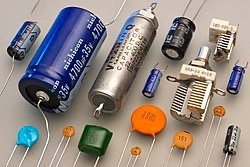
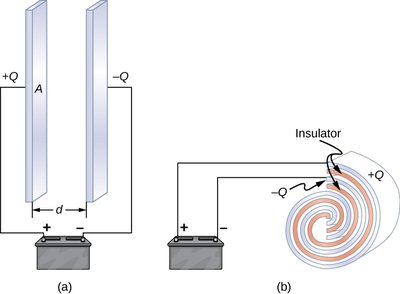
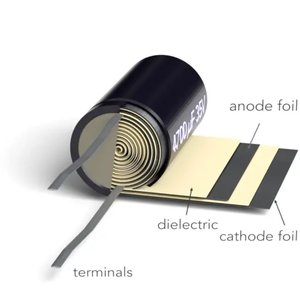
Capacitors are fundamental electrical components that store electric charge and energy. They are widely used in electronic circuits for energy storage, filtering, and signal processing. A typical capacitor consists of two conductive plates separated by an insulating material (dielectric).
Structure: Two metal plates (conductors) separated by a dielectric.
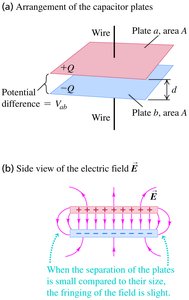
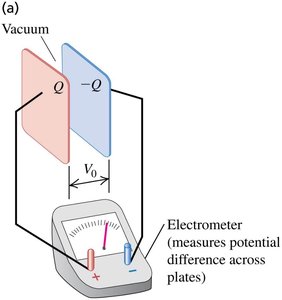
Function: Stores equal and opposite charges on each plate, creating an electric field and potential difference.
Energy Storage: The energy is stored in the electric field between the plates.

Capacitance: Definition and Calculation
The capacitance (C) of a capacitor quantifies its ability to store charge per unit potential difference. The SI unit of capacitance is the farad (F).
Definition:
Where: Q = charge on each plate, V = potential difference between plates
Unit:
For a parallel-plate capacitor in vacuum:
Where (permittivity of free space), A = plate area, d = separation
Capacitors in Circuits: Series and Parallel Combinations
Capacitors can be connected in series or parallel to achieve desired capacitance values in circuits.
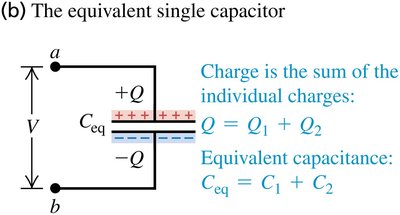
Parallel Connection
All capacitors share the same potential difference.
Equivalent capacitance:
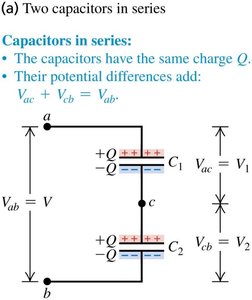
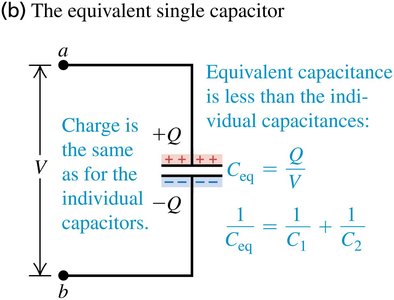
Series Connection
All capacitors have the same charge.
Equivalent capacitance:
Complex Networks
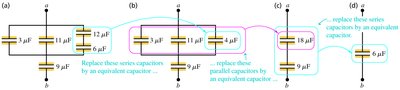
Capacitor networks can be simplified by reducing series and parallel groups step by step.
Special Capacitor Geometries
Spherical Capacitor
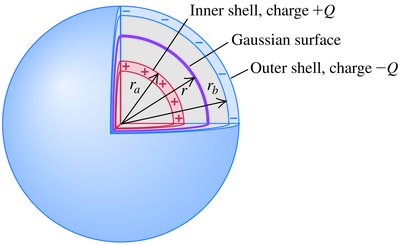
Consists of two concentric spherical conducting shells separated by a dielectric or vacuum.
Capacitance:
Where and are the radii of the inner and outer shells, respectively.
Cylindrical Capacitor
Formed by two coaxial cylinders separated by a dielectric or vacuum.
Capacitance per unit length:
Where and are the radii of the inner and outer cylinders.
Energy Stored in a Capacitor
The energy stored in a capacitor is equal to the work required to charge it.
Potential energy:
Energy density (vacuum):
Where is the electric field between the plates.
Dielectrics and Their Effects
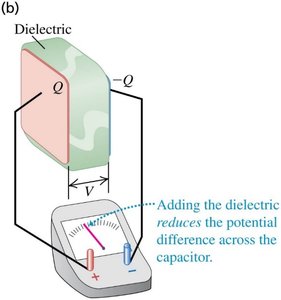
A dielectric is a non-conducting material placed between the plates of a capacitor. It increases the capacitance by reducing the effective electric field and potential difference for a given charge.
Dielectric constant (K): , where is the capacitance without dielectric.
Capacitance with dielectric:
Common dielectrics: Air, Teflon, Mylar, Glass, Water (see table below).
Material | Dielectric Constant (K) |
|---|---|
Vacuum | 1 |
Air (1 atm) | 1.00059 |
Teflon | 2.1 |
Mylar | 3.1 |
Glass | 5 – 10 |
Glycerin | 42.5 |
Water | 80.4 |
Polarization and Induced Charge
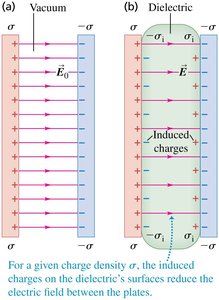
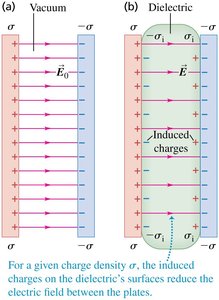
When a dielectric is inserted, its molecules become polarized, creating induced surface charges that reduce the electric field between the plates.
Reduced field:
Induced surface charge density:
Dielectric Breakdown
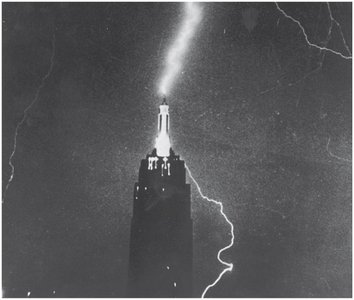
If the electric field exceeds a material's dielectric strength, the dielectric becomes conductive, leading to breakdown. Each material has a characteristic dielectric strength (e.g., Pyrex glass: V/m, dry air: V/m).
Gauss's Law in Dielectrics
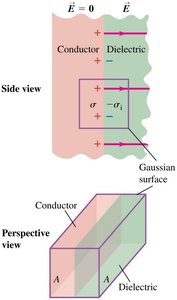
Gauss's law can be applied in the presence of dielectrics by considering only the free (not bound) charge enclosed by the Gaussian surface.
Applications of Capacitors
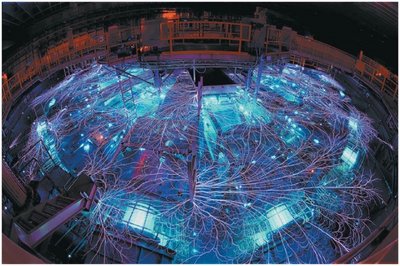
Capacitors are used for energy storage, filtering, and rapid energy discharge in applications such as the Z machine for controlled nuclear fusion.
Summary Table: Key Equations
Concept | Equation |
|---|---|
Capacitance (parallel-plate, vacuum) | |
Capacitance (with dielectric) | |
Energy stored | |
Energy density (vacuum) | |
Series combination | |
Parallel combination |
