 Back
BackCapacitance and Dielectrics – Study Notes
Study Guide - Smart Notes
 Tailored notes based on your materials, expanded with key definitions, examples, and context.
Capacitance and Dielectrics
Capacitors and Capacitance
A capacitor is a device that stores electric potential energy by separating positive and negative charges onto two nearby surfaces. Capacitors are fundamental components in electric circuits, especially for storing and releasing energy quickly.
Capacitor Structure: Consists of two conductive plates separated by an insulating material (dielectric).
Energy Storage: Capacitors store potential energy due to the separation of charges.
Connection to Battery: When connected to a battery, the voltage across the capacitor equals the battery voltage.
Charge on Capacitor: The charge stored is proportional to the voltage:
Capacitance (C): Measures the ability of a capacitor to store charge per unit voltage. Units: Farads (F).
Effect of Capacitance: Larger capacitance means more charge can be stored for the same voltage.
Formula:
Example: A 3 F capacitor connected to a 9 V battery stores of charge.
Parallel Plate Capacitors
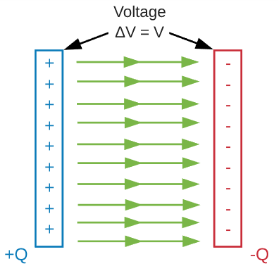
Parallel plate capacitors are the simplest and most common type, consisting of two flat plates of area separated by a distance .
Electric Field: The electric field between the plates is uniform and directed from the positive to the negative plate.
Field Outside: The electric field outside the plates is nearly zero (for large plates and small separation).
Equipotential Surfaces: Surfaces between the plates where the electric potential is constant and parallel to the plates.
Formulas:
Electric field between plates:
Capacitance: , where
Example: For plates of area (), separation (), and :
Energy Stored in a Capacitor
When a capacitor is charged, it stores energy in the electric field between its plates. The energy can be calculated in several equivalent ways:
Energy Density: The energy per unit volume in the electric field is .
Example: For a capacitor with and , .
Capacitors in Series and Parallel
Capacitors can be combined in circuits to achieve desired total capacitance values.
Series:
Parallel:
Key Points:
In series, all capacitors share the same charge but split the voltage.
In parallel, all capacitors share the same voltage but split the charge.
Example: Two capacitors, and , in series: , so .
Dielectrics
A dielectric is an insulating material placed between the plates of a capacitor. It increases the capacitance by reducing the effective electric field.
Dielectric Constant (\( \kappa \)): , where is the capacitance without the dielectric.
Dielectrics always increase capacitance ().
Electric field inside:
Constant Charge vs. Constant Voltage:
If the capacitor is disconnected from the battery (constant ), inserting a dielectric decreases .
If the capacitor remains connected (constant ), inserting a dielectric increases .
Example: A 3 F capacitor connected to a 9 V battery has . If a dielectric with is inserted, and (if still connected).
Dielectric Breakdown
Dielectric breakdown occurs when the electric field in the dielectric exceeds a critical value, causing it to become conductive.
Dielectric Strength: Maximum electric field a dielectric can withstand without breakdown (e.g., air: ).
Breakdown leads to current flow and possible damage to the capacitor.
Lightning is a natural example of dielectric breakdown in air.
Example: For air with dielectric strength and , the minimum plate separation is .
