Back
BackCapacitance and Dielectrics: Study Notes for College Physics
Study Guide - Smart Notes
 Tailored notes based on your materials, expanded with key definitions, examples, and context.
Chapter 24: Capacitance and Dielectrics
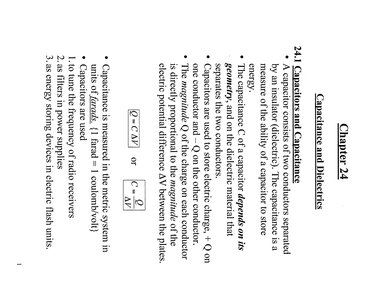
24.1 Capacitance and Capacitors
Capacitors are devices used to store electric charge and energy in an electric field. They consist of two conductors separated by an insulator (dielectric). The ability of a capacitor to store charge is quantified by its capacitance.
Capacitance (C): Defined as the ratio of the charge (Q) stored to the electric potential difference (ΔV) between the conductors.
Capacitance is measured in farads (F), where 1 F = 1 coulomb/volt.
Capacitors are used in electronic circuits, power supplies, and as energy storage devices.
24.1 Calculating Capacitance
Capacitance depends on the geometry and arrangement of the conductors. Several common capacitor types are discussed below:
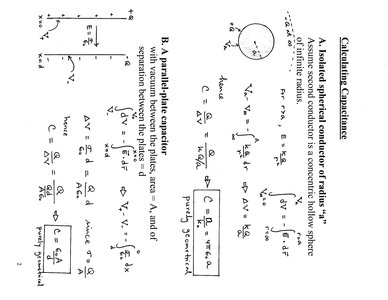
A. Isolated Spherical Conductor
For a sphere of radius r, the capacitance is:
Where is the permittivity of free space.
B. Parallel Plate Capacitor
Consists of two plates of area A separated by distance d.
Capacitance:
Increasing plate area or decreasing separation increases capacitance.
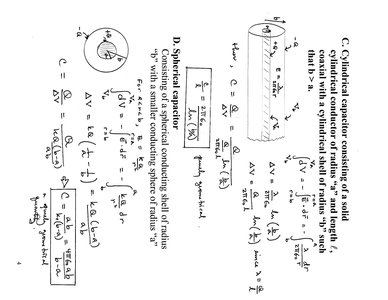
C. Cylindrical Capacitor
Consists of a solid cylindrical conductor of length L and radius a, surrounded by a cylindrical shell of radius b.
Capacitance:
D. Spherical Capacitor
Consists of two concentric spherical shells of radii a and b.
Capacitance:
24.2 Capacitors in Series and Parallel
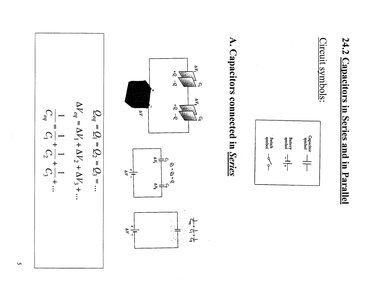
Capacitors can be combined in circuits either in series or in parallel, affecting the total capacitance.
A. Series Connection
The reciprocal of the total capacitance is the sum of the reciprocals of individual capacitances:
Charge on each capacitor is the same; potential differences add up.
B. Parallel Connection
Total capacitance is the sum of individual capacitances:
Potential difference across each capacitor is the same; charges add up.
24.3 Energy Stored in a Charged Capacitor
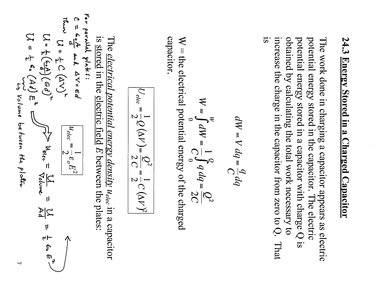
When a capacitor is charged, it stores energy in the electric field between its plates. The work done to charge the capacitor is stored as electrical potential energy.
Energy stored:
This energy can be released to do work in a circuit.
24.4 Capacitors with Dielectrics
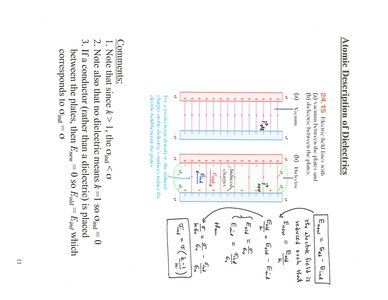
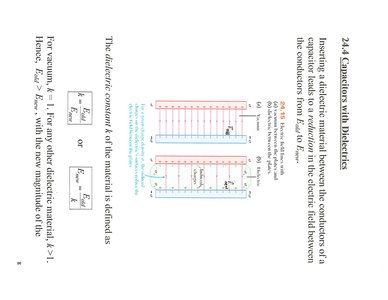
Inserting a dielectric material between the plates of a capacitor increases its capacitance and affects the electric field. The dielectric reduces the electric field by a factor of the dielectric constant k.
Dielectric constant k: or
For vacuum, ; for other materials, .
Capacitance with dielectric:
Permittivity of Dielectrics
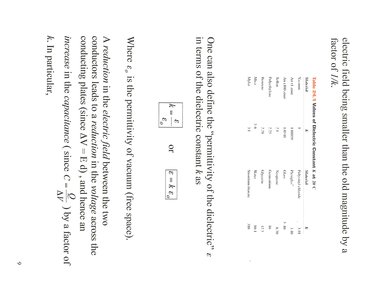
Permittivity of a dielectric:
Capacitance in terms of permittivity:
24.4 Dielectric Strength and Applications
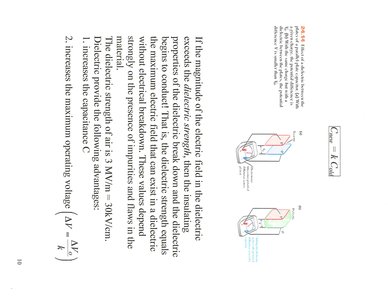
The dielectric strength is the maximum electric field a material can withstand without breakdown. Using dielectrics increases capacitance and allows higher operating voltages.
Dielectric strength of air: 3 MV/m = 3,000,000 V/m.
Advantages:
Increases capacitance
Increases maximum operating voltage
Voltage with dielectric:
Atomic Description of Dielectrics
Dielectrics are insulating materials whose molecules become polarized in an electric field, reducing the field inside the capacitor. The atomic description explains how the dielectric constant arises from molecular properties.
For vacuum, ; for other materials, .
Polarization reduces the electric field and increases capacitance.
Energy stored with dielectric: