 Back
BackCapacitance, Current, and Resistance: Study Notes for Physics 202
Study Guide - Smart Notes
 Tailored notes based on your materials, expanded with key definitions, examples, and context.
Capacitors and Capacitance
Introduction to Capacitors
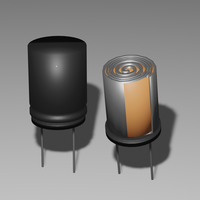
Capacitors are fundamental electrical components that store electric charge and energy. They consist of two conducting electrodes separated by an insulator (dielectric). The ability of a capacitor to store charge per unit potential difference is called capacitance.
Capacitance (C): Defined as , where is the charge stored and is the potential difference across the plates.
Units: The SI unit of capacitance is the farad (F), where .
Physical Structure: Capacitors can have various geometries, such as parallel-plate, cylindrical, or spherical.
Dielectric: The insulator between the plates increases the capacitance by reducing the electric field for a given charge.
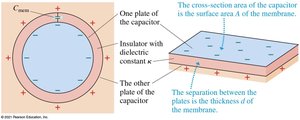
Parallel-Plate Capacitor
The parallel-plate capacitor is a common model for understanding capacitance. It consists of two flat plates of area separated by a distance .
Capacitance Formula: where is the vacuum permittivity ().
Potential Difference: The potential difference between the plates is related to the electric field and separation by .
Effect of Plate Separation: Increasing decreases ; decreasing increases .

Capacitors in Biological Systems
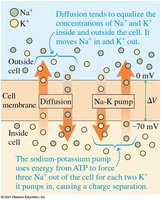
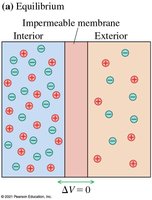
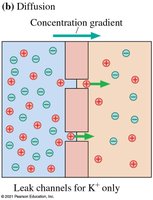
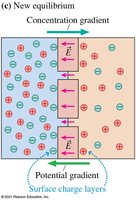
Cell membranes can be modeled as parallel-plate capacitors, where the membrane acts as the dielectric and the inner and outer surfaces act as plates. Ion pumps and channels create charge separation, leading to a potential difference across the membrane.
Application: The sodium-potassium pump maintains a potential difference by moving ions across the membrane.
Membrane Capacitance: The capacitance depends on the area of the membrane and its thickness.
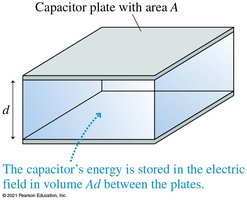
Energy Stored in a Capacitor
When a capacitor is charged, it stores energy in the electric field between its plates. The energy stored is given by:
Alternatively,
The energy is physically stored in the electric field in the volume between the plates.
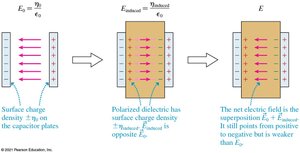
Dielectrics and Capacitance
A dielectric is an insulating material placed between the plates of a capacitor. It increases the capacitance by reducing the effective electric field.
Dielectric Constant (): , where is the capacitance without the dielectric.
Effect: Inserting a dielectric increases capacitance and allows the capacitor to store more charge for the same potential difference.
Electric Current and Resistance
Electric Current
Electric current is the flow of electric charge. In conductors, this is typically the movement of electrons. The direction of current is defined as the direction positive charges would move.
Current (I): , where is the charge passing through a cross-section in time .
Unit: The ampere (A), where .
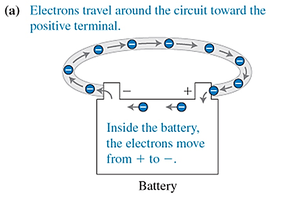
Electric Circuits
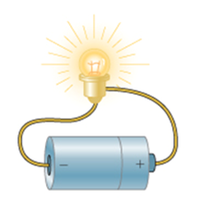
An electric circuit is a closed loop that allows current to flow. Essential components include a source of potential difference (battery), conductors (wires), and load (e.g., lightbulb).
Closed Circuit: Current flows only if the circuit is closed (no breaks).
Open Circuit: If there is a gap, current cannot flow and devices (like bulbs) will not operate.
Resistance
Resistance is a measure of how much a material opposes the flow of electric current. It is caused by collisions between moving electrons and the atoms in a conductor.
Ohm's Law: , where is the potential difference, is the current, and is the resistance.
Unit: The ohm (), where .
Microscopic Origin: Resistance arises from electron scattering in the atomic lattice of conductors.
Power in Electric Circuits
The power delivered to a device in a circuit is the rate at which energy is transferred.
Power Formula:
Application: Power determines the brightness of a lightbulb or the energy delivered to a resistor.
Building and Representing Circuits
Circuit diagrams are simplified visual representations of electrical circuits. Wires are often treated as ideal (zero resistance), and all points along an ideal wire are at the same potential.
Conservation of Charge: The same current flows through all elements in a single-loop circuit.
Switches: Opening a switch breaks the circuit and stops current flow.
Applications and Examples
Capacitors in Technology
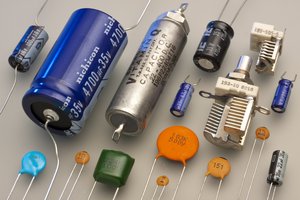
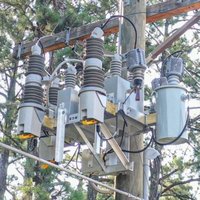
Commercial Capacitors: Used in electronics for energy storage, filtering, and timing applications.
Examples: Camera flashes, defibrillators, and power grids use capacitors for rapid energy release.

Biological Application: Cell Membrane as a Capacitor
The cell membrane acts as a capacitor, with ion pumps and channels creating a potential difference across the membrane. This is essential for nerve impulse transmission and cellular function.
Sodium-Potassium Pump: Maintains charge separation by moving Na+ and K+ ions across the membrane.
Membrane Potential: The resulting potential difference is crucial for biological processes.
Summary Table: Key Equations and Concepts
Concept | Equation | Units |
|---|---|---|
Capacitance (Parallel-Plate) | F (farads) | |
Energy Stored in Capacitor | J (joules) | |
Current | A (amperes) | |
Ohm's Law | V (volts) | |
Power | W (watts) |
Additional info: These notes cover core concepts from Chapters 23 and 24: Capacitance, Dielectrics, Energy Storage, Electric Current, Resistance, and Power in Circuits, with applications to both technology and biology. All equations are provided in LaTeX format for clarity and further study.
