 Back
BackCapacitor Charging Time & Electrostatic Equilibrium Problems – PHYS 202 Exam Prep
Study Guide - Smart Notes
 Tailored notes based on your materials, expanded with key definitions, examples, and context.
Q1. What is the correct ranking of the circuits based on the amount of time for the capacitor to charge completely, from the shortest to the longest amount of time?
Background
Topic: RC Circuits & Time Constant
This question tests your understanding of how the arrangement of resistors in a circuit affects the charging time of a capacitor. The time it takes for a capacitor to charge depends on the circuit's resistance and capacitance.
Key Terms and Formulas
Equivalent Resistance (): The total resistance seen by the capacitor in each circuit.
Time Constant ():
Capacitance (): The ability of a capacitor to store charge.
Step-by-Step Guidance
Analyze each circuit diagram to determine how the resistors are arranged (series or parallel).
Calculate the equivalent resistance for each circuit. For example, resistors in series add, while resistors in parallel combine as .
Use the formula to find the time constant for each circuit.
Rank the circuits based on their time constants: the smaller the time constant, the faster the capacitor charges.
Try solving on your own before revealing the answer!
Q2. The figure shows two tiny 5.0-g spheres suspended from very light 1.0-m-long threads. The spheres repel each other after each one is given the same positive charge and hang at rest when . What is the charge on each sphere?
Background
Topic: Electrostatics & Equilibrium
This question tests your ability to apply Newton's Laws and Coulomb's Law to a system in equilibrium, where two charged spheres are suspended and repel each other.
Key Terms and Formulas
Coulomb's Law:
Newton's Second Law: Forces in equilibrium (, )
Trigonometric relationships:
Mass (), gravitational acceleration (), thread length (), and angle ()
Step-by-Step Guidance
Draw a free-body diagram for one sphere, showing tension, gravity, and electrostatic force.
Write equations for equilibrium in the and directions: and .
Divide the equation by the equation to eliminate : .
Express using Coulomb's Law: , where is the distance between the spheres.
Set up the equation for in terms of known quantities: .
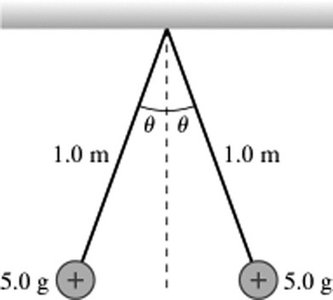
Try solving on your own before revealing the answer!
Final Answer: (Sample for Q2) 22 nC
Plugging in the values for mass, gravity, distance, angle, and Coulomb's constant gives the charge on each sphere.
