 Back
BackCapacitors and Capacitance: Concepts, Calculations, and Applications
Study Guide - Smart Notes
 Tailored notes based on your materials, expanded with key definitions, examples, and context.
Capacitors and Capacitance
Introduction to Capacitors
Capacitors are fundamental electrical components that store electric charge and energy in an electric field. They are widely used in electronic circuits for energy storage, filtering, and timing applications.
Definition: A capacitor consists of two conductors (plates) separated by an insulator (dielectric or air).
Symbol: The circuit symbol for a capacitor is two parallel lines; a battery is represented by long and short lines for positive and negative terminals, respectively.
Capacitance (C): The ability of a capacitor to store charge per unit voltage, measured in farads (F).
Equation: , where is the charge and is the potential difference.
Units: 1 farad (F) = 1 coulomb/volt (C/V). Practical capacitors are usually in microfarads (F, F) or picofarads (pF, F).
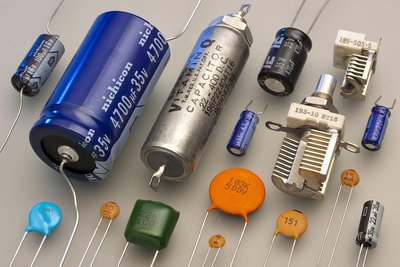
Physical Structure of a Capacitor
The simplest capacitor consists of two parallel conducting plates separated by a small distance, often filled with air or a dielectric material.
When the plates carry equal and opposite charges, a potential difference () exists between them.
The electric field () is established between the plates, directed from the positive to the negative plate.

Capacitance Calculation
The capacitance of a device depends on its geometry and the material between the plates.
Parallel-Plate Capacitor: , where is the area of each plate, is the separation, and is the vacuum permittivity ( F/m).
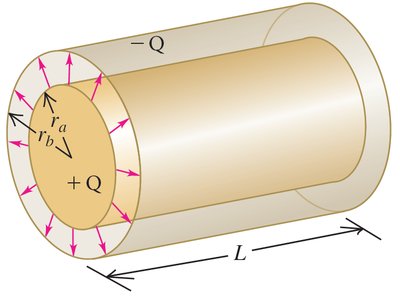
Cylindrical Capacitor: , where is the length, and are the radii of the inner and outer cylinders.
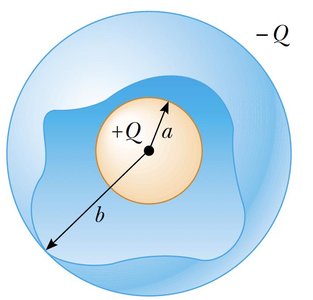
Spherical Capacitor: , where and are the radii of the inner and outer spheres.
Energy Stored in a Capacitor
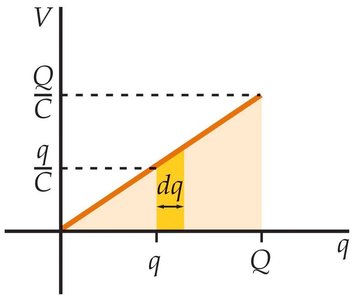
When a capacitor is charged, it stores energy in the electric field between its plates. The work done to charge the capacitor is stored as potential energy.
Potential Energy:
Energy Density: For a parallel-plate capacitor, the energy per unit volume is
Capacitors in Circuits: Series and Parallel
Capacitors can be combined in series or parallel to achieve desired capacitance values in circuits.
Parallel Combination: The equivalent capacitance is the sum of individual capacitances:
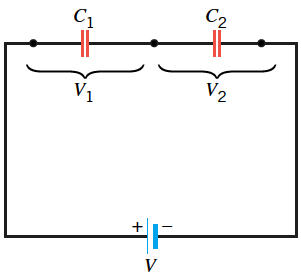
Series Combination: The reciprocal of the equivalent capacitance is the sum of reciprocals:
Key Properties:
In parallel: Same voltage across each capacitor; total charge is the sum of individual charges.
In series: Same charge on each capacitor; total voltage is the sum of individual voltages.
Dielectrics and Capacitance
A dielectric is an insulating material placed between the plates of a capacitor, increasing its capacitance by reducing the effective electric field.
Dielectric Constant (): Ratio of the electric field without dielectric to that with dielectric:
Capacitance with Dielectric:
Permittivity:
Inserting a dielectric increases capacitance and can affect stored energy depending on whether the capacitor is connected to a battery (constant voltage) or isolated (constant charge).
Summary Table: Series vs. Parallel Capacitor Properties
Configuration | Equivalent Capacitance | Voltage | Charge |
|---|---|---|---|
Series | Adds () | Same on each () | |
Parallel | Same across each () | Adds () |
Worked Example: Parallel-Plate Capacitor
Given: Plate area , separation m, air gap.
Capacitance:
Charge at V: C
Electric Field: V/m
Worked Example: Dielectric Effect
Given: F, V,
With dielectric inserted (battery connected): F, V, C
With dielectric inserted (battery disconnected): remains constant, increases, decreases:
Key Equations
(parallel-plate)
(with dielectric)
Applications and Conceptual Points
Capacitors are used for energy storage, filtering signals, and in timing circuits.
Dielectrics increase capacitance and allow capacitors to store more energy for a given voltage.
Capacitors can release energy much faster than batteries, making them useful in applications like camera flashes and defibrillators.
