 Back
BackCapacitors and Electric Current: Key Concepts and Applications
Study Guide - Smart Notes
 Tailored notes based on your materials, expanded with key definitions, examples, and context.
Capacitors
Planar, Cylindrical, and Spherical Capacitors
Capacitors are devices used to store electric charge and energy in the electric field between two conductors. The geometry of the conductors determines the capacitance and the electric field distribution. The three main types of capacitors discussed here are planar (parallel plate), cylindrical, and spherical capacitors.
Planar Capacitor: Consists of two parallel plates separated by a dielectric. The capacitance is given by: where is the area of the plates and is the separation distance.
Cylindrical Capacitor: Formed by two coaxial cylinders. The capacitance per unit length is: where and are the radii of the inner and outer cylinders, respectively.
Spherical Capacitor: Consists of two concentric spherical shells. The capacitance is: where and are the radii of the inner and outer spheres.
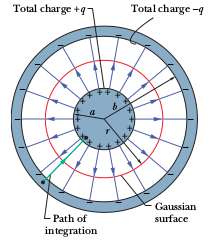
Example Application: Spherical and cylindrical capacitors are commonly used in high-voltage applications and in situations where a uniform electric field is required over a curved surface.
Potential Difference vs. Potential Drop
Definitions and Usage
The potential difference between two points is defined as the difference in electric potential energy per unit charge between those points. It is calculated as:
Potential Difference:
Potential Drop:
Potential drop is often used when describing the decrease in potential as charge moves through a resistor or other circuit element.
Current and Current Density
Electric Current
Electric current () is the rate of flow of electric charge through a conductor or circuit element. It is measured in amperes (A):
where is the charge passing through a cross-section in time .
Current Density
Current density () is the current per unit area flowing through a surface perpendicular to the direction of flow:
where is the cross-sectional area. The direction of is the direction of positive charge flow.
Concept Check: Current Density in Cylindrical Conductors
For a cylindrical conductor with varying radii, the current density at different radii can be related as follows:
This relationship arises from the conservation of current, assuming the total current is constant and the current density is uniform over each cross-section.
Resistance and Temperature Dependence
Resistance
Resistance () is a measure of how much a material opposes the flow of electric current. It is given by:
where is the resistivity, is the length, and is the cross-sectional area of the conductor.
Temperature Dependence
The resistance of most conductors increases with temperature. The relationship is:
where is the resistance at reference temperature , is the new temperature, and is the temperature coefficient of resistance.
Formula Sheet: Capacitors
Type | Capacitance Formula |
|---|---|
Parallel Plate | |
Cylindrical | |
Spherical |
Note: is the permittivity of free space.
Summary Table: Current Density Relationships
Radius | Current Density |
|---|---|
