Back
BackCapacitors and RC Circuits in Electric Circuits
Study Guide - Smart Notes
 Tailored notes based on your materials, expanded with key definitions, examples, and context.
Capacitors in Electric Circuits
Capacitors in Parallel
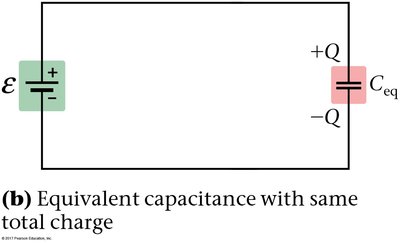
When capacitors are connected in parallel, each capacitor is directly connected across the same two points, so each experiences the same potential difference as the battery. The total charge stored is the sum of the charges on each capacitor.
Potential Difference:
Charge on Each Capacitor: , ,
Total Charge:
Equivalent Capacitance:
Key Point: The equivalent capacitance is greater than any individual capacitance in the parallel group.
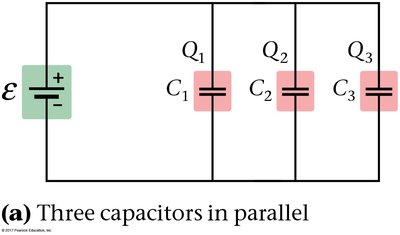
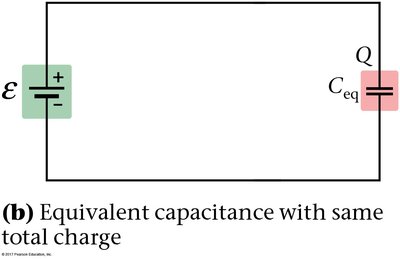
Example: If and is unknown, with a total energy and , the equivalent capacitance is found by , and .
Applications: Touch-sensitive devices use the principle of increased capacitance when a human body (acting as a capacitor plate) touches the device, similar to adding capacitors in parallel.
Capacitors in Series
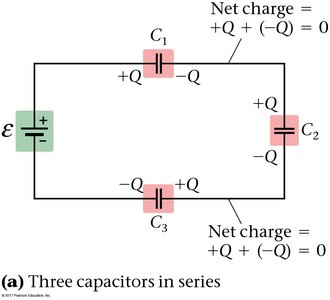
Capacitors in series have the same charge on each, but the total potential difference is the sum of the individual voltages across each capacitor. The reciprocal of the equivalent capacitance is the sum of the reciprocals of the individual capacitances.
Charge on Each Capacitor: (same for all in series)
Potential Difference: , ,
Total Voltage:
Equivalent Capacitance:
Key Point: The equivalent capacitance is less than the smallest individual capacitance in the series group.
Mixed Series and Parallel Circuits
More complex circuits can be simplified by reducing series and parallel groups step by step, just as with resistors.
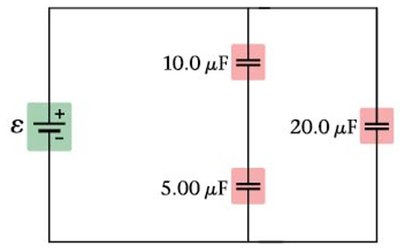
Example: For a circuit with a 12.0 V battery and capacitors of 10.0 µF, 5.00 µF (in series), and 20.0 µF (in parallel with the series combination):
Series: ,
Parallel:
Total energy stored:
RC Circuits
Charging and Discharging in RC Circuits
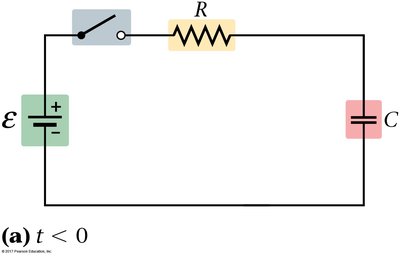
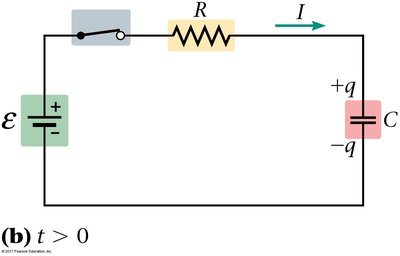
When a resistor and capacitor are connected in series with a battery (an RC circuit), the charging and discharging of the capacitor occur over a finite time, governed by the time constant .
Time Constant: (measured in seconds)
Physical Meaning: is the time for the charge (or current) to change significantly (about 63.2% of the way to its final value).
Charging a Capacitor
Charge as a Function of Time:
Current as a Function of Time:
At : ,
As : ,
At :
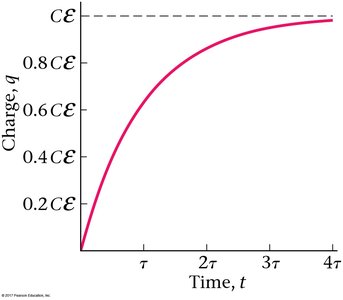
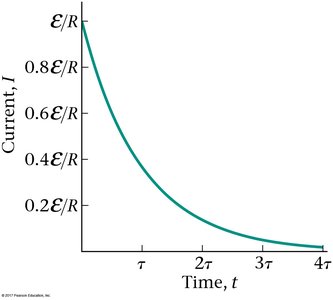
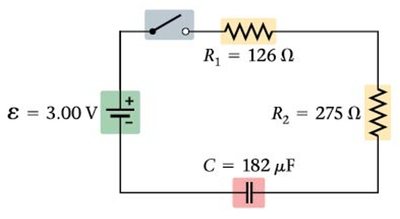
Example: Charging a Capacitor
Given , , , :
Final Charge:
Time to Reach 80% Charge: , where , so
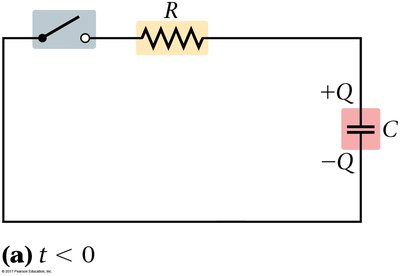
Discharging a Capacitor
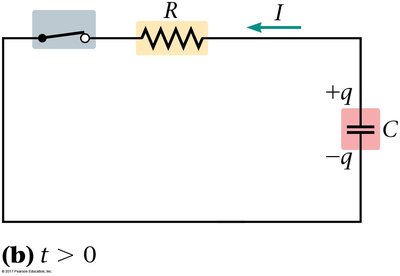
Charge as a Function of Time:
Current as a Function of Time:
At :
As :
Summary of RC-Circuit Characteristics
Charging and discharging are characterized by the time constant .
At , a charging capacitor acts like a short circuit; as , it acts like an open switch.
Conceptual Example: Current in an RC Circuit
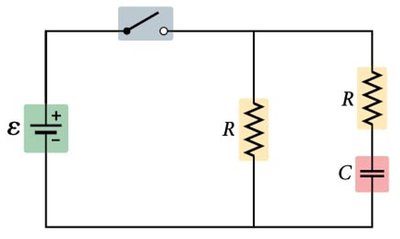
Consider a circuit with a battery, two resistors in parallel, and a capacitor:
Immediately after closing the switch: The capacitor acts as a short circuit. The battery is connected to two resistors in parallel, so and .
After a long time: The capacitor acts as an open switch. Current flows through only one resistor, so .