 Back
BackCapacitors, Circuits, and Magnetic Fields: Step-by-Step Physics Guidance
Study Guide - Smart Notes
 Tailored notes based on your materials, expanded with key definitions, examples, and context.
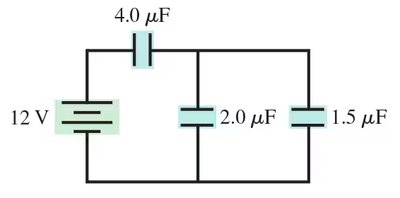
Q1. For the circuit shown in Figure P23.42:
a. What is the equivalent capacitance?
b. How much charge flows through the battery as the capacitors are being charged?
Background
Topic: Capacitors in Series and Parallel Circuits
This question tests your understanding of how to combine capacitors in series and parallel to find the equivalent capacitance, and how to use that to determine the total charge delivered by the battery.
Key Terms and Formulas
Capacitance (C): The ability of a system to store charge per unit voltage, measured in farads (F).
Series Combination:
Parallel Combination:
Charge on a Capacitor:
Step-by-Step Guidance
Identify which capacitors are in series and which are in parallel. In this circuit, the and capacitors are in parallel, and their combination is in series with the capacitor.
Calculate the equivalent capacitance of the parallel section: .
Combine the result with the capacitor in series: .
Once you have , use the battery voltage () to find the total charge delivered: .
Try solving on your own before revealing the answer!
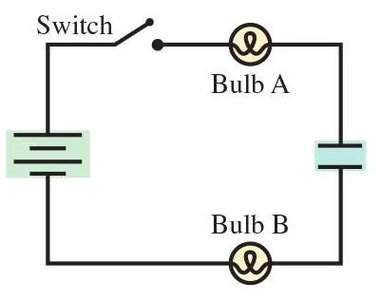
Q2. Figure Q23.27: Lightbulbs and Capacitor Circuit
a. Immediately after the switch is closed, are either or both bulbs glowing? Explain.
b. If both bulbs are glowing, which is brighter? Or are they equally bright? Explain.
c. For any bulb (A or B or both) that lights up immediately after the switch is closed, does its brightness increase with time, decrease with time, or remain unchanged? Explain.
Background
Topic: Charging a Capacitor in a Series Circuit
This question explores how current flows and how bulb brightness changes as a capacitor charges in a circuit with resistive elements (bulbs).
Key Terms and Concepts
Current (): The flow of electric charge through a circuit.
Capacitor Charging: When a capacitor is uncharged, it acts like a wire (short circuit) at the instant the switch is closed, allowing maximum current.
Brightness of Bulbs: Proportional to the current passing through them.
Step-by-Step Guidance
Immediately after the switch is closed, consider the capacitor as uncharged. What does this mean for the current in the circuit?
Analyze the path of the current: Does it flow through both bulbs? Are the bulbs in series or parallel?
Compare the current through each bulb to determine their relative brightness.
As time passes and the capacitor charges, what happens to the current in the circuit and, consequently, the brightness of the bulbs?
Try solving on your own before revealing the answer!
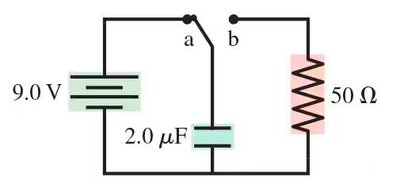
Q3. Figure P23.49: Capacitor Discharge Through a Resistor
The switch has been in position a for a long time. It is changed to position b at s. What are the charge on the capacitor and the current through the resistor (a) immediately after the switch is changed? (b) At ? (c) At ?
Background
Topic: RC Circuits – Discharging a Capacitor
This question tests your understanding of exponential decay of charge and current in an RC circuit after the switch is moved to discharge the capacitor through a resistor.
Key Terms and Formulas
Initial Charge on Capacitor:
Exponential Decay of Charge:
Exponential Decay of Current: , where
Time Constant:
Step-by-Step Guidance
Calculate the initial charge on the capacitor using with the given values.
Find the time constant using the resistor and capacitor values.
For , use and .
For later times, use the exponential decay formulas for and , plugging in the appropriate time values.
Try solving on your own before revealing the answer!
