 Back
BackCenter of Mass and Forces: Newton’s Laws and Applications
Study Guide - Smart Notes
 Tailored notes based on your materials, expanded with key definitions, examples, and context.
Center of Mass and Stability
Definition and Properties of Center of Mass
The center of mass (CM) of an object is a point representing the average position of all the mass in the system. It is often depicted as a dot in diagrams and is crucial for analyzing stability and motion.
Definition: The CM is the weighted average location of all mass in an object or system.
Stability: The position of the CM relative to the area of support determines whether an object is stable, unstable, or in neutral equilibrium.
Equilibrium Types:
Stable equilibrium: The CM returns to its original position after a small displacement.
Unstable equilibrium: The CM moves further away after a small displacement.
Neutral equilibrium: The CM remains in its new position after displacement.
Human Application: Humans must keep their CM over their support base to avoid toppling.
Force: Concepts and Types
Definition and Measurement
A force is a push or pull acting on an object, measured in Newtons (N). Forces can be due to gravity, support, tension, applied actions, or friction.
Force due to gravity:
Force of support: Equal to the apparent weight, often perpendicular to the supporting surface.
Force diagrams: Visual representations (Free Body Diagrams) showing all forces acting on an object.
Force Symbols and Directions
Different forces are represented by specific symbols and have characteristic directions and formulas:
Force | Symbol | Direction | Formula | Notes |
|---|---|---|---|---|
Gravity | Fg | Down toward Earth | Sometimes W is used if equal to support force | |
Support/Normal | Fs, N, FN | Perpendicular to surface | Newton's 2nd Law | Equals apparent weight; not always equal to gravity |
Tension | T, Fs, FT | Along rope/wire, away from object | Newton's 2nd Law | For ropes, wires, cables; not always equal to gravity |
Applied | FA, FPerson | Direction of push | Newton's 2nd Law | Often applied by a person |
Friction | ff, FF, Fair | Parallel, opposite motion | Newton's 2nd Law | Opposes motion |
Force Diagrams and Free Body Diagrams (FBD)
Steps for Drawing Force Diagrams
Force diagrams are essential for visualizing the forces acting on an object. Follow these steps:
Depict the object's CM as a dot.
Draw all forces due to fields (e.g., gravitational, electric, magnetic).
Draw all forces due to contact (e.g., support, tension, friction, applied).
Draw a clear x-y axes for reference.
Newton’s Laws of Motion
First Law: Inertia
Newton's First Law states that an object at rest remains at rest, and an object in motion remains in motion unless acted upon by an unbalanced external force. This property is called inertia.
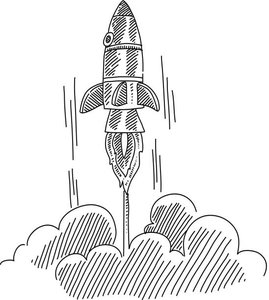
Example: A rocket accelerating in space continues moving unless acted upon by another force.
Second Law: Force and Acceleration
Newton's Second Law relates the net force acting on an object to its mass and acceleration:
Formula:
Directly proportional: Acceleration increases with force.
Inversely proportional: Acceleration decreases with mass.
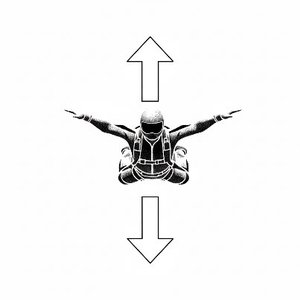
Example: A skydiver experiences forces of gravity and air resistance, reaching terminal velocity when these forces balance.
Third Law: Action and Reaction
Newton's Third Law states that for every action, there is an equal and opposite reaction:
Formula:
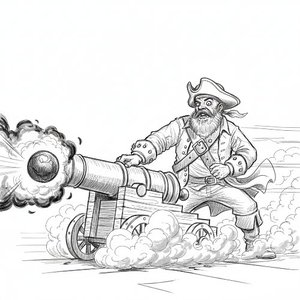
Example: When a cannonball is launched, the cannon recoils in the opposite direction.
Force Problems and Applications
Solving Force Problems
Force diagrams and Newton’s Laws are applied to solve problems involving constant velocity, acceleration, systems of objects, and forces at angles.
Elevator problems: Calculate apparent weight during vertical acceleration.
Systems of objects: Analyze forces acting on multiple connected objects.
Forces at angles: Use trigonometry to resolve forces into components.
Trigonometry in Force Analysis
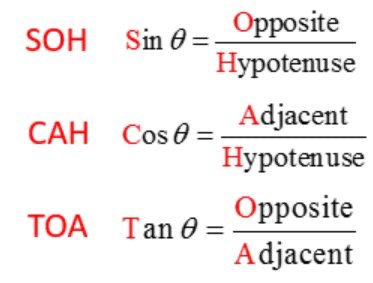
Trigonometric relationships help resolve forces into perpendicular components:
SOH:
CAH:
TOA:
Additional Academic Context
Mass vs. Weight: Mass is a measure of matter (kg), weight is the force due to gravity (N).
Vector vs. Scalar: Forces are vector quantities (magnitude and direction); mass is scalar (magnitude only).
Equilibrium: An object is in equilibrium when the net force is zero.
Apparent Weight: The force of support felt in an accelerating system (e.g., elevator).
Additional info: Academic context was added to clarify definitions, examples, and applications for completeness.
