 Back
BackCh 09: Work and Kinetic Energy – Study Notes
Study Guide - Smart Notes
 Tailored notes based on your materials, expanded with key definitions, examples, and context.
Work and Kinetic Energy
Introduction to Energy and Kinetic Energy
Energy is a fundamental physical quantity that objects possess, though its exact nature is not fully understood. What is well established is how energy behaves: it can be transferred between objects and transformed between different forms, but it cannot be created or destroyed. The SI unit of energy is the joule (J).
Forms of Energy: Includes kinetic, potential, thermal, light, sound, electrical, and more.
Law of Conservation of Energy: Energy can only be transformed from one form to another.
Kinetic Energy (KE) is the energy associated with an object's motion. It is a scalar quantity (no direction) and is always positive.
Formula:
Example: Calculate the kinetic energy of a 5 kg box moving at 3 m/s:
Work Done by a Constant Force
When a constant force acts on an object and causes displacement, it does work on the object, transferring energy to or from it. The unit of work is the joule (J).
Definition: Work is the process of energy transfer via force and displacement.
Formula: where is the angle between the force and displacement vectors.
Sign of Work: Positive if force aids motion, negative if it opposes motion.
Example: Pulling a 2 kg box with 3 N over 5 m:
Work Done by Gravity
Gravity, as a force, can do work on objects moving vertically. The work done by gravity depends only on the vertical displacement, not the path taken (path independence).
Formula: (positive if object moves down, negative if up)
Example: A 5.1 kg book falls 2 m:
Dot Product (Scalar Product) and Work
The dot product is a mathematical operation used to calculate work when force and displacement are vectors.
Definition:
Component Form:
Interpretation: The dot product is maximal when vectors are parallel, zero when perpendicular, and negative when anti-parallel.
Work on Inclined Planes
When calculating work on an incline, always use the angle between the force and the direction of displacement, not the incline angle itself.
Work by Gravity: (negative if moving up, positive if down)
Example: Pulling a crate up a ramp: calculate work by gravity, friction, and applied force separately.
Net Work and the Work-Energy Theorem
The net work done on an object is the sum of the work done by all forces. The Work-Energy Theorem states that the net work done equals the change in kinetic energy.
Formula:
Example: If a 4 kg box speeds up from 6 m/s to 10 m/s:
Work from Force vs. Displacement Graphs
For variable forces, the work done is the area under the force vs. displacement graph.
Positive Work: Area above the x-axis
Negative Work: Area below the x-axis
Calculation: Use geometric area formulas (rectangle, triangle) to find total work.
Springs and Hooke’s Law
Springs exert a restoring force proportional to their displacement from equilibrium, described by Hooke’s Law.
Formula:
k: Spring constant (N/m), measures stiffness
x: Displacement from relaxed length
Restoring Force: Always acts opposite to displacement
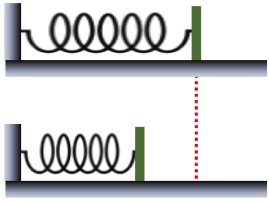
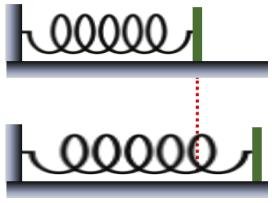
Work Done by Springs
Work done by or on a spring is calculated differently because the force varies with displacement.
Formula for Work by Spring:
Formula for Work Done ON Spring:
Example: Compressing a spring with k = 500 N/m by 2 m:
Power
Power is the rate at which work is done or energy is transferred. The SI unit is the watt (W), where 1 W = 1 J/s.
Average Power:
Example: A 100-watt light bulb uses 100 J of energy per second.
Application: Calculating the power required to lift an elevator or accelerate a car.
Summary Table: Key Formulas in Work and Kinetic Energy
Concept | Formula |
|---|---|
Kinetic Energy | |
Work (Constant Force) | |
Work by Gravity | |
Work by Spring | |
Work-Energy Theorem | |
Power |
