 Back
BackCh 10: Energy & Work – Study Notes
Study Guide - Smart Notes
 Tailored notes based on your materials, expanded with key definitions, examples, and context.
Energy and Work
Introduction to Energy
Energy is a fundamental physical quantity that describes the ability of objects to perform work or produce change. It exists in various forms and is measured in Joules (J). Energy cannot be created or destroyed, only transformed from one form to another (the Law of Conservation of Energy).
Kinetic Energy (KE): Energy due to motion.
Potential Energy: Stored energy due to position or configuration.
Thermal, Light, Sound, Electrical Energy: Other common forms.
Kinetic Energy (KE) is given by the formula:
KE is always positive and scalar (no direction).
Example: Calculate the kinetic energy of a 5 kg box moving at 3 m/s to the right and 2 m/s to the left. KE is positive in both cases.
Work Done by a Constant Force
When a constant force acts on an object and causes displacement, it does work on the object, transferring energy to or from it. The unit of work is the Joule (J).
Work (W): The amount of energy transferred by a force.
Work is positive if the force acts in the direction of motion, negative if opposite.
The formula for work done by a constant force is:
Where F is the force, d is the displacement, and θ is the angle between the force and displacement vectors.
Example: Pulling a 2 kg box with 3 N over 5 m, or stopping a 5 kg cart with a 100 N force over 2.5 m.
Work Done by Gravity
Gravity, as a force, can do work on objects moving vertically. The work done by gravity depends only on the change in vertical position (path independence):
Positive when the object moves downward, negative when upward.
Example: Calculating work done by gravity on a falling book or a rock thrown upward.
Work Done by Friction
Friction always opposes motion and does negative work, removing mechanical energy from the system.
Work by kinetic friction:
Example: Pulling a box with friction, calculating work done by friction, weight, and normal force.
Work Done by Springs (Hooke's Law)
Springs exert a restoring force proportional to their displacement from equilibrium, described by Hooke's Law:
k is the spring constant (N/m), x is the displacement from equilibrium.
Work done by a spring (variable force):
Example: Compressing or stretching a spring and calculating the work done.
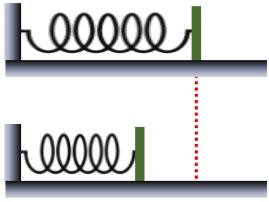
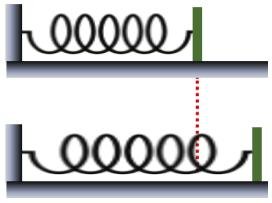
Net Work and the Work-Energy Theorem
The net work done on an object is the sum of the work done by all forces. The Work-Energy Theorem relates net work to the change in kinetic energy:
Example: Calculating net work on a box with applied force and friction.
Calculating Work from Force vs. Displacement Graphs
The work done by a force (constant or variable) is the area under the force vs. displacement graph:
Area above the x-axis: Positive work
Area below the x-axis: Negative work
Example: Calculating work from a graph with rectangular and triangular sections.
Power
Power is the rate at which work is done or energy is transferred. The unit is the Watt (W = J/s):
Example: Calculating the energy used by a light bulb or the power delivered by a car engine.
Conservation of Energy
Conservation of Mechanical Energy
Mechanical energy (ME) is the sum of kinetic and potential energies:
In the absence of non-conservative forces (like friction), mechanical energy is conserved:
Example: Dropping a ball from a height and calculating its speed before impact using energy conservation.
Conservative vs. Non-Conservative Forces
Conservative forces (gravity, springs) conserve mechanical energy; non-conservative forces (friction, applied forces) do not.
Conservative Forces | Non-Conservative Forces |
|---|---|
Gravity (weight) | Applied Forces |
Spring (Hooke's Law) | Friction |
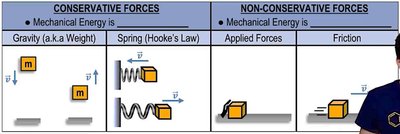
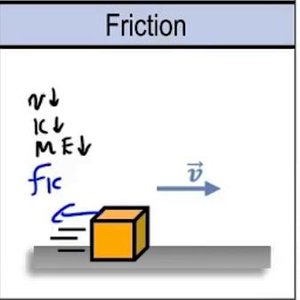
Conservative forces are reversible; non-conservative forces dissipate energy (e.g., as heat).
Conservation of Energy with Non-Conservative Forces
When non-conservative forces do work, mechanical energy is not conserved, but total energy is:
is the work done by non-conservative forces (applied, friction, etc.).
Example: Calculating the final speed of a hockey puck pushed across ice with friction.
Elastic (Spring) Potential Energy
Springs store energy when compressed or stretched:
Combine with gravitational potential energy in energy conservation problems.
Example: Block compressing a spring and calculating launch speed.
Solving Problems with Energy Conservation
Energy conservation is a powerful tool for solving problems involving curved paths, connected objects, and projectiles:
Draw a diagram.
Write the conservation of energy equation.
Expand and solve for the unknown.
Projectile Motion and Energy Conservation
Projectile motion problems involving speed or height can often be solved using energy conservation, especially when forces are not constant.
Example: Calculating the speed of a ball before hitting the ground or its maximum height using energy methods.
Summary Table: Key Equations
Concept | Equation |
|---|---|
Kinetic Energy | |
Work (Constant Force) | |
Work by Gravity | |
Work by Spring | |
Elastic Potential Energy | |
Power | |
Work-Energy Theorem | |
Conservation of Mechanical Energy | |
Conservation with Non-Conservative Work |
Additional info:
When solving energy problems, always identify the system, note all forces, and determine if they are conservative or non-conservative.
For variable forces, use the area under the force vs. displacement graph to find work.
Energy conservation is especially useful for systems with changing potential and kinetic energy, such as projectiles, blocks on inclines, and spring-mass systems.
